

UK Corporate Security Risk Management: Strategic Guide
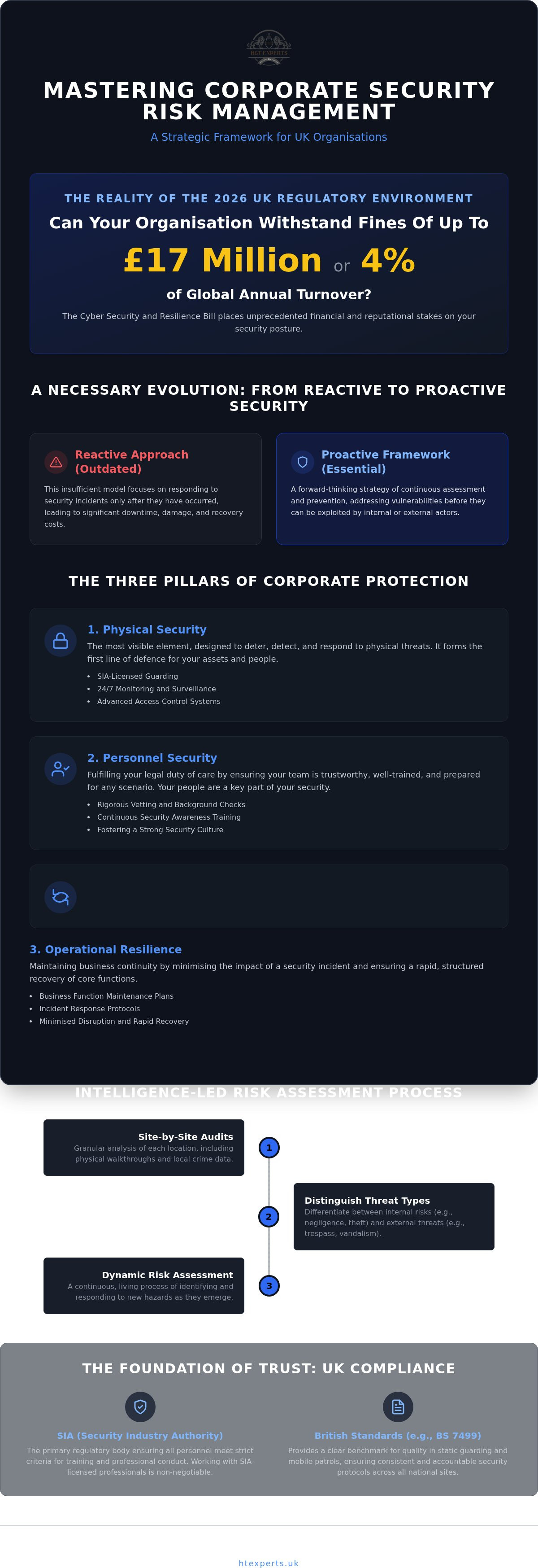
Could your organisation withstand a fine of up to £17 million or 4% of its global annual turnover? This is the reality of the UK’s 2026 regulatory environment under the Cyber Security and Resilience Bill. You likely feel the weight of managing inconsistent security standards across multiple national sites, whilst fearing the operational downtime that follows a breach. It’s often difficult to quantify the ROI of physical security, yet the stakes have never been higher for your people and reputation. We recognise that a fragmented approach to safety is no longer viable in a demanding corporate landscape. This guide empowers you to master the complexities of corporate security risk management through professional, UK-wide operational strategies.
By reading on, you’ll gain a clear framework for identifying vulnerabilities and ensuring compliance with the latest UK health and safety standards. We’ll examine how to build a resilient defence through 24/7 monitoring and SIA-licensed guarding, providing the oversight your business deserves. From understanding the ISO/IEC 27001:2022 requirements to establishing a reliable national security partnership, this strategic guide offers the clarity needed to protect your assets with absolute confidence.
Key Takeaways
• Learn how to transition from reactive security to a proactive corporate security risk management framework that identifies threats before they escalate.
• Discover the methodology for conducting comprehensive site-by-site audits to distinguish between internal negligence and external criminal threats.
• Understand why high-level strategy requires a reliable national partner to ensure consistent operational execution across all your UK locations.
• Master the steps to building an integrated security programme that aligns protection objectives with your organisation's broader financial and operational goals.
• Explore how combining SIA-licensed guarding with specialist cleaning services creates a more resilient and professional environment for your people and assets.
What is Corporate Security Risk Management in the Modern Business Environment?
Corporate security risk management is the systematic process of identifying and mitigating threats to an organisation’s physical and human assets. It’s no longer a peripheral concern managed in isolation. In the modern UK business environment, it serves as a core strategic function that ensures operational longevity. This discipline provides a structured framework for protecting everything from high-value equipment to the reputation of your brand. It's about creating a safe environment where your people can perform their duties without fear of disruption.
The shift from reactive security to proactive risk management is a response to an increasingly complex threat landscape. Historically, many businesses focused on responding to incidents after they occurred. In a post-2025 landscape, this approach is insufficient. Proactive strategies involve continuous assessment and the implementation of preventative measures. This ensures that vulnerabilities are addressed before they can be exploited by external or internal actors. Protecting personnel and physical assets requires a forward-thinking methodology that prioritises prevention over recovery.
A resilient organisation also fosters a strong security culture amongst its staff and stakeholders. Security should never be viewed as an external imposition. Instead, it must be integrated into the daily behaviour of every employee. When personnel are trained to recognise and report anomalies, they become an active component of the corporate security risk management strategy. This collective vigilance creates a formidable barrier against breaches and operational downtime.
The Three Pillars of Corporate Protection
Effective protection relies on three interconnected pillars that work in synergy to provide total site resilience. Physical security is the most visible element, involving SIA-licensed guarding, 24/7 monitoring, and advanced access control systems. These measures deter unauthorised entry and provide an immediate response to physical threats. Personnel security involves rigorous vetting and continuous training, fulfilling your legal duty of care whilst ensuring your team is prepared for any scenario. Operational resilience focuses on maintaining business functions. It ensures that even if a security incident occurs, the impact on your core operations is minimised and recovery is rapid.
Regulatory Compliance and UK Standards
Adhering to established UK standards is essential for managing corporate liability and ensuring professional service delivery. The Security Industry Authority (SIA) remains the primary regulatory body, ensuring that all security personnel meet strict criteria for training and conduct. Working with SIA-licensed professionals is a non-negotiable requirement for any serious corporate entity. Compliance with British Standards like BS 7499, which covers static guarding and mobile patrols, provides a benchmark for quality. These standards ensure that security protocols are consistent across all sites, providing the oversight and accountability necessary for complex national operations.
Identifying and Assessing Corporate Security Risks Across UK Operations
Effective corporate security risk management begins with a granular understanding of the specific threats facing each location. You can't manage what you haven't identified. A robust methodology involves a site-by-site audit that moves beyond generic checklists to address local variables. This process includes physical walkthroughs, interviews with site managers, and an analysis of local crime data. It ensures that resources are allocated where they're needed most, rather than being spread thin across a national portfolio.
It's vital to distinguish between internal and external threats to build a comprehensive defence. Internal risks often involve employee negligence or theft, whilst external threats typically manifest as trespass or vandalism. Both require distinct mitigation strategies. Intelligence-led security plays a pivotal role here. By utilising real-time data and historical patterns, your organisation can anticipate potential breaches before they occur. This proactive stance is the hallmark of a mature security operation.
Dynamic risk assessment is a continuous, living process of identifying and responding to hazards as they emerge, rather than a static, one-off document.
Physical Vulnerability Assessments
Perimeter controls are your first line of defence. During an assessment, we evaluate whether gates, fences, and entry points for corporate offices or industrial sites are sufficient for the current threat level. We often find that blind spots in CCTV coverage or inadequate lighting provide easy opportunities for unauthorised access. It's also essential to assess the effectiveness of existing security guarding protocols. If your guards aren't positioned correctly or lack clear instructions, even the best technology will fail to protect your assets.
The Human Element: Staff and Visitor Risks
High-traffic corporate environments present unique challenges for access control. The risk of social engineering, where an intruder gains entry by manipulating staff, remains a significant concern. Your strategy must include clear protocols for visitor management and unauthorised entry. This extends to developing robust emergency evacuation and lockdown procedures. Training your team to recognise suspicious behaviour is just as important as the physical locks on the doors. Partnering with an experienced provider like H&T Experts Ltd ensures these human risks are managed with professional discipline and oversight.
Strategic vs. Operational Mitigation: Comparing Security Frameworks
A sophisticated corporate security risk management strategy is only as effective as its operational execution. In the boardroom, risk management is often viewed as a high-level planning exercise involving insurance, legal compliance, and financial forecasting. This is the "why" and "what" of your security posture. However, the "how" takes place on the ground. Operational mitigation is the daily application of protocols that turn a theoretical framework into a tangible defence. Without a clear link between these two layers, your organisation remains vulnerable to the very threats your strategy aims to prevent.
Execution requires precision. Even a perfect strategy fails without a reliable security company to implement it. Professional providers bridge the gap between abstract risk assessments and the physical reality of site protection. They ensure that the standards set at the corporate level are maintained consistently across every national site. This reliability is what prevents operational downtime and protects your reputation during a crisis. It transforms security from a cost centre into a value-adding function that provides peace of mind for stakeholders.
Technology-Integrated Surveillance
Modern surveillance relies on a rapid-action loop. 24/7 monitoring centres serve as the first line of corporate defence, providing constant oversight without the need for a massive on-site footprint. Remote monitoring allows for the immediate detection of anomalies, significantly reducing overheads whilst maintaining high levels of vigilance. When an alarm is triggered, the system initiates a predefined response sequence. This integration ensures that your security posture is always active, providing a level of coverage that manual checks alone cannot match. It creates a seamless flow from detection to intervention.
Professional Guarding and Physical Presence
Physical presence remains the most effective deterrent for corporate crime. Whilst technology provides data, human intervention provides judgment and authority. SIA-licensed guards are essential for managing complex, public-facing corporate environments where human interaction is constant. They possess the training to de-escalate situations and manage access control with professional discipline. For multi-site UK portfolios, mobile patrols offer a cost-effective alternative. These patrols provide irregular, high-visibility checks that disrupt the planning phase of potential intruders, ensuring that your assets are protected even when a permanent guard isn't present.
The true strength of your framework lies in the synergy between these elements. Proactive monitoring identifies the threat, but it's your emergency security response capability that neutralises it. This combination ensures that your organisation is not just observing risks, but actively managing them. By aligning high-level strategy with disciplined operational delivery, you create a resilient environment that can withstand the demands of the modern UK business landscape.
Developing an Integrated Security Risk Management Programme
Building a resilient programme requires a methodical approach that embeds security into the core of your operations. It starts with a comprehensive policy that outlines responsibilities and expectations for every level of the organisation. This document serves as the foundation for your corporate security risk management efforts, ensuring that every stakeholder understands their role in maintaining safety. A robust programme must be flexible enough to adapt to emerging threats in 2026, such as sophisticated social engineering or the exploitation of automated facility systems.
Alignment with broader business goals is critical for securing the necessary budget and resources. Security should be viewed as an enabler of business continuity rather than a restrictive cost. By demonstrating how effective risk management protects revenue streams and reduces insurance premiums, you can justify the investment in high-quality guarding and monitoring. Regular reviews and "red teaming" exercises are essential to test your defences. These simulated attacks identify weaknesses in your perimeter and protocols before a real-world adversary can exploit them.
Crisis Management and Emergency Protocols
When a breach occurs, the speed of your response determines the extent of the damage. Clear escalation paths must be established so that information reaches decision-makers without delay. Rapid response teams play a vital role in minimising asset damage and securing the site immediately after an incident. Staff training is equally important. Employees need to know how to react calmly and professionally during a security alert, ensuring that evacuation or lockdown procedures are followed precisely. To ensure your programme is built on 25 years of operational experience, partner with H&T Experts Ltd for a professional security audit.
Data-Driven Security Improvements
Modern programmes rely on evidence rather than intuition. Using incident reports and monitoring data allows you to refine your risk assessments over time. You should track key performance indicators (KPIs) to maintain high standards across all sites. These metrics include:
• Average response times for emergency security alerts.
• Frequency and nature of detected breach attempts.
• Consistency and coverage of mobile patrol routes.
Leveraging integrated security and cleaning data provides even deeper facility oversight. For instance, cleaning teams often notice physical vulnerabilities like broken locks or malfunctioning gates during their shifts. Combining these insights creates a comprehensive view of your site’s health, allowing for faster repairs and more effective deterrence. This synergy ensures that your facility is not only clean but fundamentally secure.
Enhancing Corporate Resilience with Professional Security and Facility Services
Professional operational services form the backbone of any successful corporate security risk management programme. Whilst high-level strategy provides the roadmap, it's the consistent delivery of physical security and facility maintenance that ensures a site remains resilient against threats. This operational layer turns theoretical safety into a tangible reality. By integrating these services, an organisation moves beyond simple compliance to a state of assured resilience where every asset and individual is managed by a capable, vigilant entity.
The benefit of a single-provider approach for both security and specialist facility maintenance cannot be overstated. When one partner handles both guarding and specialist cleaning, you eliminate the communication gaps that often lead to vulnerabilities. This synergy creates a higher level of accountability and oversight. It ensures that your facility is managed with a unified standard of excellence, where every team member is trained to uphold the integrity of the site. This streamlined model reduces administrative burden whilst providing a more cohesive defence against operational downtime.
The Role of Specialist Cleaning in Site Security
Maintaining high standards of cleanliness directly impacts the effectiveness of your security posture. For example, clean windows and clear perimeters are vital for effective surveillance and the elimination of blind spots. Overgrown vegetation or accumulated debris can obscure CCTV angles or provide cover for unauthorised access. Specialist cleaning also plays a critical role in crisis response. Emergency sanitation and biohazard cleaning are essential components of an effective recovery plan following a security breach or environmental incident. By ensuring corporate sites remain professional and safe, you demonstrate a steadfast commitment to the duty of care you owe to all stakeholders.
Why H&T Experts is the Preferred UK Partner
Managing corporate risks requires a partner with deep operational experience and a proven track record. H&T Experts Ltd leverages over 25 years of industry excellence to provide a stable force in a demanding market. We offer national coverage whilst maintaining a local-level attention to detail that ensures total accountability. Our approach provides immediate confidence through integrated solutions that are both traditional in their values and modern in their execution. The peace of mind provided by our 24/7 monitoring and professional guarding allows your leadership team to focus on core objectives. Protect your corporate assets with H&T Experts today.
True corporate resilience is achieved when security is treated as a core business function rather than a grudge purchase. It's an investment in your organisation's stability and reputation. When you prioritise professional oversight and rigorous standards, you create an environment where risks are not just identified but actively neutralised. This composed, business-like delivery of protection ensures that your organisation is prepared for any situation, providing the stable foundation required for long-term success in the UK market.
Securing Your Corporate Future through Operational Excellence
Effective corporate security risk management is not a static achievement but a continuous commitment to vigilance and adaptation. By moving beyond reactive measures and embracing an integrated approach that combines SIA-licensed guarding with 24/7 monitoring, your organisation builds a formidable defence against disruption. This guide has detailed how site-specific audits and the synergy between security and specialist facility maintenance create the resilient environment necessary for modern UK operations. You now have the framework to protect your people and assets with professional discipline.
Success in this demanding landscape requires a partner with the weight of experience. H&T Experts Ltd brings over 25 years of operational excellence to every site we manage. Our 24/7 rapid response centre and highly trained, SIA-licensed professionals ensure your business remains protected around the clock. Don't leave your reputation to chance. Contact H&T Experts for a Professional Security Risk Consultation to ensure your operations are managed by a stable and capable entity. We're ready to help you establish a secure foundation for long-term growth.
Frequently Asked Questions
What are the main components of a corporate security risk management plan?
The core components include a site-specific risk assessment, physical security measures, and a robust incident response framework. A successful plan also integrates personnel training and regular audits to ensure protocols remain effective. This structure allows your organisation to manage corporate security risk management with precision. By aligning these elements with your business continuity goals, you protect your people and assets whilst maintaining operational efficiency across all national locations.
How does SIA licensing affect corporate security in the UK?
SIA licensing is the mandatory standard for security professionals in the UK. It ensures that personnel have undergone rigorous training and background checks to meet legal and professional requirements. For your organisation, hiring SIA-licensed guards provides immediate confidence in their competence and accountability. This licensing framework is vital for managing corporate liability and ensuring that your security posture adheres to the highest industry standards for asset protection and public safety.
Is 24/7 monitoring better than on-site guarding for corporate offices?
Neither is inherently better; they serve complementary functions within a resilient security strategy. 24/7 monitoring provides constant, cost-effective oversight and early detection of anomalies across multiple sites. On-site guarding offers a physical deterrent and the ability for immediate human intervention in complex situations. Most robust corporate security risk management programmes utilise both to ensure that detection is always followed by a swift, professional response to any detected breach or emergency.
How often should a corporate security risk assessment be updated?
You should update your risk assessment at least once every twelve months to account for evolving threats and regulatory changes. However, a review is also necessary after any significant operational change, such as a site refurbishment, a change in occupancy, or following a security incident. In the 2026 landscape, staying current with British Standards and emerging risks ensures that your protection strategies remain effective and your organisation stays fully compliant.
Can specialist cleaning really improve our corporate security profile?
Specialist cleaning directly supports security by maintaining clear lines of sight and ensuring that surveillance equipment isn't obscured by dirt or debris. Clear windows and well-maintained perimeters allow for better visual monitoring and deter potential intruders who look for signs of neglect. Additionally, specialist teams handle emergency sanitation following incidents, ensuring your site remains professional and safe for all stakeholders whilst supporting your broader resilience and crisis management goals.
What happens during a rapid security response alert?
A rapid response alert initiates a predefined sequence of actions designed to neutralise threats immediately. Once an anomaly is detected by 24/7 monitoring, the alert is verified and SIA-licensed professionals are dispatched to the site. These teams are trained to secure the perimeter, assess damage, and coordinate with emergency services if necessary. This process ensures that asset damage is minimised and your business operations can resume as quickly as possible following a breach.
How do we balance corporate security with a welcoming environment for visitors?
Achieving this balance requires professional guarding that prioritises both authority and hospitality. SIA-licensed personnel can be trained to manage front-of-house duties, providing a reassuring presence whilst maintaining strict access control protocols. By integrating technology like discreet visitor management systems, you can ensure a seamless entry process for guests without compromising the integrity of your site. This approach demonstrates a commitment to both security and a professional corporate image.
What are the costs associated with professional corporate security risk management?
The costs are determined by the specific requirements of your national operations, including the number of sites, the level of guarding required, and the complexity of your monitoring needs. Factors such as the frequency of mobile patrols and the integration of specialist cleaning services also influence the final contract fees. Investing in professional corporate security risk management should be viewed as a strategic protection of your assets and reputation, rather than just an operational expense.




Ready to Experience Unparalleled Security Solutions?
H&T Experts Ltd is here to ensure your peace of mind. Connect with us today and take the first step towards a safer tomorrow.