

Key Holding & Alarm Response: 2026 UK Buying Guide
Could the cheapest quotation leave your premises least prepared when an alarm sounds? Key holding and alarm response costs can be difficult to compare when headline fees do not explain what is covered, how call-outs are handled or which charges may apply separately. The useful question is not only what a service costs, but whether its coverage matches your premises and requirements.
It is reasonable to want a clear figure before committing. But if proposals describe alarm arrangements, response procedures and contract inclusions differently, similar-looking fees may buy different services. Compare the scope and responsibilities as carefully as the price.
This guide explains what can shape a quotation and what to ask providers, so you can identify the coverage your premises require. H&T Experts Ltd has more than 25 years’ operational experience in security, including 24/7 monitoring and emergency response. Confirm whether key holding is included in the specific service scope you are considering, and ask for the response arrangements and any additional charges in writing.
Key Takeaways
• Assess how your premises, required coverage and response arrangements affect key holding and alarm response costs, rather than judging a proposal by its headline fee.
• Check whether key holding and alarm response are priced together or separately, and confirm exactly what the agreed scope includes.
• Compare quotations using the same criteria, including availability, call-out terms, exclusions, reporting and contract flexibility.
• Prepare details of site use, operating patterns, alarm arrangements and access requirements so providers can prepare comparable proposals.
• Match your documented requirements to confirmed coverage, and ask the provider directly about key holding before proceeding.
Key holding and alarm response costs: what does a business actually pay for?
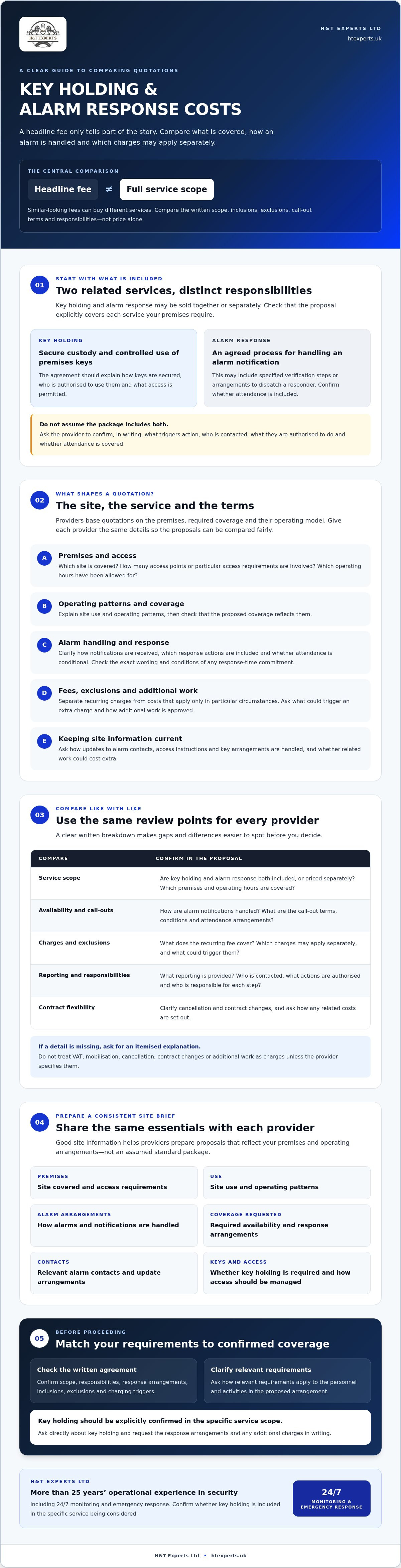
A quotation is useful only when you know what the provider agrees to do. Key holding is the contracted custody and controlled use of authorised premises keys; alarm response is the agreed process for handling an alarm notification and, where specified, arranging a response. These services may be sold together or separately, so check that the proposal explicitly covers each service you need.
The term Keyholder describes a person entrusted with keys and access. In a commercial service, the label alone does not explain how keys are secured, who is authorised to use them or what happens when an alarm activates. The written agreement should set out these responsibilities and procedures.
What is usually meant by key holding and alarm response?
If key holding is included in the contract, it concerns the secure custody of premises keys and their controlled use by authorised people. Alarm response may start with receiving a notification and include specified verification steps or arrangements to dispatch a responder. The process depends on the provider and contract. Confirm what triggers action, who is contacted, what the provider is authorised to do and whether attendance is included.
Why do providers structure fees differently?
Providers base quotations on the premises, required coverage and their operating model. For example, a site with several access points or particular access requirements may need a different arrangement from a straightforward single-site request. Operating patterns also affect the coverage a business asks for. Give every provider the same details before comparing proposals.
Some quotations set a recurring charge for an agreed service, while call-outs or other work may be priced separately. Ask what the recurring fee covers, what could trigger an additional charge and how extra work is approved. Do not assume that alarm response includes every attendance, or that key holding is automatically part of a package.
This distinction matters when assessing key holding and alarm response costs. A low headline fee may exclude a response arrangement you need, or leave call-out terms unclear. Compare the written scope, inclusions, exclusions, charging triggers and responsibilities. If any detail is missing, request an itemised explanation before deciding. The proposal should reflect your premises and operating arrangements, not an assumed standard package.
Which service factors shape key holding and alarm response quotations?
A useful quotation shows how your site’s practical requirements translate into coverage and charges. Focus on the premises, service scope, response arrangements and the administration needed to keep information current. Confirm these details with each provider before comparing key holding and alarm response costs. Otherwise, similar-looking fees may relate to different services.
How premises and coverage affect a quotation
Ask providers to identify the premises covered and confirm the operating hours and access requirements allowed for in the quotation. Clarify how alarm notifications are received, which response actions are included and whether attendance is conditional. If a provider offers a response-time commitment, check its exact wording and conditions in the written terms rather than relying on a verbal assurance.
Coverage may also depend on the provider’s operating model and the service requested. If key holding forms part of the proposal, ask how authorised access is managed. The Security Industry Authority (SIA) provides information on the UK’s private security industry, including licensing. Ask providers to explain how relevant requirements apply to the personnel and activities in your proposed arrangement.
Which charges and exclusions should buyers clarify?
Request a written breakdown that separates ongoing charges from costs that apply only in particular circumstances. Ask about VAT, mobilisation, cancellation, contract changes and additional work, but do not assume these are charges unless the provider specifies them. Also establish how updates to alarm contacts, access instructions or key arrangements are handled, and whether related work could cost extra.
Use a simple schedule to compare each provider’s answers:
| Quotation category | What to confirm |
|---|---|
| Recurring fees | Which contracted services, sites and operating periods are covered? |
| Conditional fees | When might call-outs, mobilisation or additional work be charged, and how are VAT and approval handled? |
| Excluded services | What is outside the scope, including any response, attendance or work not expressly listed? |
This format can reveal gaps before they become misunderstandings. A proposal, for example, may cover alarm notification but not specify attendance, or may include one site while leaving another outside the agreement. Ask the provider to clarify or revise unclear wording so each quotation reflects the same requirements.
For a fair comparison, document your operating arrangements and ask each provider to confirm its scope, exclusions and charging conditions in writing. You can also review security monitoring and emergency response services from H&T Experts Ltd, then confirm directly whether the specific coverage you require is available.
How to compare key holding and alarm response costs fairly
Compare proposals against the same written requirements, not just the headline fee. A lower figure may reflect a narrower scope, different availability or more exclusions, so it is not automatically better value. First, make a checklist of what your premises need. Then mark each item in every quotation as included, optional, excluded or unclear.
What should a like-for-like quote comparison include?
Ask each provider the same questions. Confirm which services and premises are covered, how alarm notifications are handled, and what key custody arrangements and escalation responsibilities apply if they are part of the proposal. Check whether attendance is included or charged separately. Look for clear reporting arrangements, named points of contact and a process for updating site or alarm information.
Check the contract terms as well. Record the duration, how changes to the scope are managed and what flexibility applies if your requirements change. If a proposal uses a broad phrase such as “response included”, ask what it means in practice and request written clarification.
| Comparison point | What to verify |
|---|---|
| Coverage | Which premises, services and alarm arrangements are included? |
| Availability | What operating periods are covered, and are any limits stated? |
| Call-out terms | What triggers a call-out, what is included and when might separate charges apply? |
| Exclusions | Which tasks, locations or circumstances fall outside the agreement? |
| Reporting | What information is provided after an event, and to whom? |
| Contract flexibility | How are changes, renewals and cancellation handled? |
How can you assess value beyond the headline fee?
Value depends on whether the documented scope addresses your premises’ risks and gives you clear accountability. Consider the provider’s relevant experience, staff training and the clarity of its operational arrangements. If the proposal cites qualifications, approvals or accreditations, ask for evidence and verify it directly rather than treating a logo or claim as proof. Note any specific standards you need to check before deciding.
Review the completed comparison side by side. If one quotation costs less but leaves availability, reporting or exclusions unresolved, ask for clarification or a revised proposal before ranking it. A sound decision is based on requirements and written commitments, not assumptions.
For further guidance on assessing providers, read this guide to choosing a reliable security company. The same checks can help you compare key holding and alarm response costs on a consistent basis.
What should you prepare before requesting an alarm response quotation?
A clear enquiry gives providers the information they need to propose relevant coverage and gives you a consistent basis for comparing replies. Before requesting proposals, gather details about how the premises are used, when coverage is needed and how existing alarm arrangements work. Include known risks and access constraints so providers do not have to make assumptions that could become gaps in the agreed service.
What information should you give potential providers?
Prepare a short site brief for each premises. Include its use, operating patterns, relevant access arrangements and the periods when coverage is required. Describe how alarm notifications are currently received, list authorised contacts and note practical constraints that could affect access or response. If you want key holding, state this explicitly and ask the provider to confirm whether it is available within the proposed scope.
Premises and use
outline site activities, access points relevant to the service and any known operational risks.
Operating arrangements
specify when coverage is required and any periods when the site is unoccupied.
Alarm details
explain the existing notification pathway and provide relevant contact and escalation information.
Expected coverage
state the response actions you require and identify any services you want priced separately.
Give every provider the same brief. Ask for a written scope that lists what is included, what is excluded and what may be charged separately. An itemised response makes proposals easier to review later and helps you check whether a difference reflects a different service or simply unclear wording.
Which questions help reveal service gaps?
Ask who receives an alarm alert, what circumstances trigger dispatch and how actions are recorded. Clarify who is responsible at each stage, how escalation contacts are used and what happens if a contact cannot be reached. Ask how changes to site access, alarm details or authorised contacts are handled, and how exclusions, incident reporting and performance reviews are addressed. Confirm each answer in the written proposal.
If monitoring and response are being considered separately, make that distinction clear in your enquiry. Review the stated scope of professional 24/7 security monitoring alongside the response arrangements, and ask providers to explain how the services relate. Clear requirements also make it easier to assess whether proposed key holding and alarm response costs reflect the coverage you need. Do not assume that every provider offers the same package.
H&T Experts Ltd provides 24/7 security monitoring and emergency security response, supported by trained professionals and more than 25 years of operational experience. Discuss your security monitoring requirements and confirm directly whether key holding is available within the service scope you require.
Choose a dependable provider and request a clear, tailored quotation
Choose a provider whose written offer matches your documented requirements, rather than assuming a standard package will fit. Before appointing anyone, confirm which premises and services are covered, who is responsible at each stage and what happens when circumstances fall outside the agreed scope. Clear commitments help you judge whether the proposed key holding and alarm response costs reflect suitable coverage for your business.
What evidence should you request before appointing a provider?
Ask for the service scope and responsibilities in writing, including exclusions, escalation arrangements and how actions will be recorded. If a provider states response targets or particular operating arrangements, check the precise terms and any conditions attached. Do not rely on an informal assurance to fill a gap in the contract.
Check claims as part of your due diligence. Ask for evidence of relevant qualifications, accreditations and insurance, then verify the details directly with the provider or appropriate issuing body. These checks help you understand the provider’s stated credentials. Do not assume a specific qualification or accreditation applies without confirming it. You can also request references or documented evidence to support claims about experience and service delivery.
How can H&T Experts Ltd help clarify your requirements?
H&T Experts Ltd provides 24/7 security monitoring and emergency security response, delivered by trained professionals. The company has more than 25 years of operational experience. These capabilities can inform a discussion about your security requirements, but verify the precise alarm response coverage, process and inclusions for the service you are considering.
When making an enquiry, explain how your premises are used, describe the existing alarm arrangements and set out the coverage you require. If you need key holding, ask directly whether it is available as part of the proposed contracted service. H&T Experts Ltd’s published information does not confirm a standalone key holding service, so do not assume it is included. Request a written proposal that distinguishes confirmed services from anything unavailable or still to be agreed.
For further context, read the emergency security response guide. To discuss your requirements with H&T Experts Ltd, request a tailored security services discussion, including confirmation of whether key holding is available within the scope you need.
Make your next security decision with clarity
Choose a provider by matching your documented requirements to written, verified coverage, not an assumed standard package. Check what the quotation includes, how response arrangements work and which conditions or exclusions could affect the service. This is the fairest way to assess key holding and alarm response costs and avoid comparing proposals that meet different needs.
H&T Experts Ltd brings more than 25 years of operational experience, with trained professionals, technology-integrated security solutions, 24/7 security monitoring and emergency security response. If key holding is part of your requirement, confirm directly whether it is available within the service scope. Clarify the response process and inclusions before making a decision.
Ready to discuss the coverage your premises require? Discuss your security response requirements with H&T Experts Ltd and request a clear proposal for your needs.
Frequently Asked Questions
How much do key holding and alarm response services cost in the UK?
There is no single fee that applies to every UK premises or service arrangement. Key holding and alarm response costs depend on the requested scope, site requirements, operating arrangements and how call-outs or additional work are charged. Ask providers for a written, itemised quotation that separates recurring fees from conditional charges. This makes it easier to compare proposals without relying on a headline figure that may cover a different level of service.
What is usually included in a key holding and alarm response contract?
Inclusions vary, so check the written agreement rather than assuming there is a standard package. It should state whether key holding, alarm notification handling, response arrangements and any attendance are included, as well as which premises are covered. Check responsibilities, contact and escalation procedures, exclusions, reporting arrangements and any separately chargeable work. If a service or action is not clearly described, ask the provider to confirm it in writing before agreeing.
Can alarm response be provided without key holding?
It may be possible, depending on the provider’s services and the response arrangements agreed for the premises. Ask how an alert would be handled if the provider does not hold authorised keys, and whether the proposed service includes attendance or relies on another authorised contact. Confirm the practical limits and responsibilities in writing. H&T Experts Ltd lists emergency security response, but its information does not confirm a standalone key holding service.
Why do key holding and alarm response quotations differ between providers?
Quotations can differ because providers may be pricing different premises, operating periods, coverage and response procedures. Proposals may also treat call-outs, administration, additional work and exclusions differently. Compare the scope line by line: check which sites and services are covered, how alarm notifications are handled and what happens if requirements change. A difference in fees is meaningful only once you know whether the offers provide comparable coverage.
Are alarm call-outs always included in the service fee?
No. Do not assume a recurring service fee covers every alarm call-out or attendance. The contract may specify separate charges, limits, conditions or exclusions, and providers’ arrangements differ. Ask what triggers a charge, what the fee covers, whether additional time or work is treated separately and how approval is handled. Have the provider set out these terms in writing so you can assess possible costs before accepting the proposal.
What should I check before accepting an alarm response quotation?
Check that the proposal names the premises, defines the service scope and explains who is responsible at each response stage. Review availability, escalation contacts, call-out terms, exclusions, reporting, contract changes and cancellation provisions. Verify stated qualifications, accreditations or insurance claims directly with the provider or relevant organisation. If response targets are offered, confirm their exact wording and conditions in the written terms rather than relying on a verbal explanation.
How can I request a comparable key holding and alarm response quote?
Send each provider the same written brief. Include the premises’ use, operating patterns, existing alarm arrangements, authorised contacts, access requirements, known risks and the coverage you expect. State whether you require key holding and ask the provider to confirm whether it is available. Request an itemised proposal that identifies recurring fees, conditional charges, inclusions and exclusions. Use the same checklist to compare replies and clarify gaps before deciding.
Other Services




Ready to Experience Unparalleled Security Solutions?
H&T Experts Ltd is here to ensure your peace of mind. Connect with us today and take the first step towards a safer tomorrow.