

Industrial Site Security Plan: A Practical UK Guide for 2026
What if the security measures intended to protect your industrial site are the ones staff routinely work around? A practical industrial site security plan must reflect how the site operates, from shift changes and deliveries to contractor visits and emergency access.
It’s understandable to want clear answers: which threats matter most, where are the weak points, and who is responsible when something happens? A generic checklist can miss risks created by your site’s layout and working routines. Controls need to be proportionate, workable and supported by clear instructions.
This guide explains how to assess and prioritise site-specific risks, then match them with physical, procedural, people-based and technology-supported controls. You’ll also learn how to assign responsibilities, set reporting and escalation procedures, and review the plan as operations or risks change. Where appropriate, trained security guarding, monitoring or emergency response may support implementation. Start by understanding your site and its needs.
Key Takeaways
• Build an industrial site security plan around the assets, threats and weak points specific to your operations.
• Use a consistent method to assess likelihood and impact, then prioritise risks that need action.
• Match each priority risk with proportionate physical, procedural, people-based or technology-supported controls, and assign an owner.
• Turn controls into clear procedures so staff, contractors and security personnel know what to do and when to escalate an incident.
• Review the plan after incidents, site or process changes, and exercises. Track outstanding actions and recurring patterns.
What an industrial site security plan must protect and why
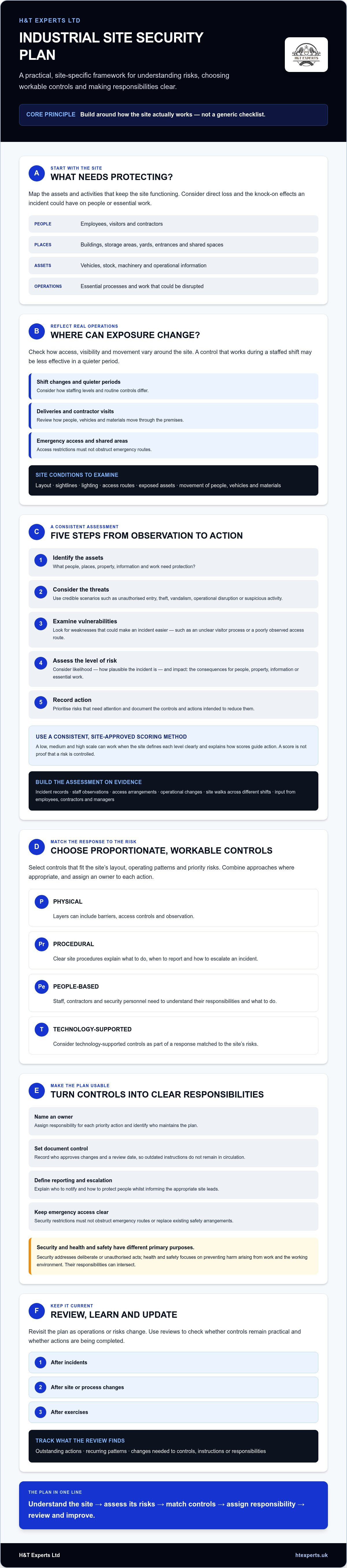
An industrial site security plan is a controlled, site-specific framework that records what needs protecting, the security risks that could affect it, and the controls and actions intended to reduce those risks. It should help people make consistent decisions, not sit unused as a generic checklist.
Start with the assets and activities that keep the site functioning. These may include employees and visitors, buildings and yards, vehicles, stock, machinery, operational information and essential processes. Consider direct loss, such as theft or damage, as well as knock-on effects. Unauthorised access to a production area, for example, could disrupt work or expose people to danger.
Security and health and safety have different primary purposes. Security addresses deliberate or unauthorised acts, whilst health and safety focuses on preventing harm arising from work and the working environment. Their responsibilities can intersect. Access restrictions must not obstruct emergency routes, and incident procedures should explain how to protect people whilst notifying the appropriate site leads. The plan should complement, not replace, existing safety arrangements.
What should an industrial site security plan cover?
Define the site boundary and the areas covered, including buildings, storage areas, yards, entrances and relevant shared spaces. Then consider how access and exposure change during normal operations, shift changes, contractor visits, deliveries and periods when fewer people are present. A control that works during a staffed shift may be less effective during a quiet period.
Keep the plan under document control. Name the person responsible for maintaining it, identify who approves changes, and record a review date. This gives staff a clear reference point and helps prevent outdated instructions from remaining in circulation.
Which site conditions shape the security plan?
Assess the site as it operates in practice. Layout, sightlines, lighting, access routes and the location or value of exposed assets can affect where unauthorised entry or activity may be harder to detect. Consider how people, vehicles and materials move through the premises, including where legitimate access could create vulnerabilities. Physical security can combine layers such as barriers, access controls and observation. See this overview of physical security measures.
Map dependencies as well as locations. Identify processes or areas where disruption could interrupt essential work, then consider how an incident in one place might affect another. The plan’s controls should reflect those risks and the site’s operating patterns. Check applicable UK requirements against current authoritative guidance.
In short: define the site and its critical assets, identify risks arising from its layout and operations, then document controls and responsibilities that address those risks. This is the foundation for a plan staff can use and management can review.
How to assess industrial site security risks systematically
A consistent assessment turns observations into decisions. For each part of the site, work through five steps: identify the assets, consider the threats, examine vulnerabilities, assess the level of risk, then record action. This gives managers a clear basis for deciding what needs attention first.
Consider credible scenarios such as unauthorised entry, theft, vandalism, operational disruption or suspicious activity. A threat is the event that could cause harm. A vulnerability is a weakness that could make it easier, such as an unclear visitor process or a poorly observed access route.
How do you identify threats and vulnerabilities?
Use evidence from incident records, staff observations, access arrangements and operational changes. Walk the site during different shifts, including quieter periods, and check how visibility, movement and routine controls differ. Speak with employees, contractors and managers who understand how work is actually carried out. For sites involving construction activity, the HSE’s guidance on HSE site security procedures offers relevant considerations around site boundaries, access and public protection.
How should risks be prioritised and recorded?
Likelihood means how plausible an incident is in the site’s circumstances. Impact means the consequences if it occurs, including effects on people, property, information or essential work. Agree a site-approved scoring method with clear definitions so managers assess risks consistently. A simple low, medium and high scale can work if the site defines what each level means and how scores guide action. Don’t treat a score as proof that a risk is controlled.
Record each significant risk with enough detail to support a decision:
• The threat and affected asset, area or process
• Likelihood, impact and the reasoning behind the assessment
• Existing controls and any gaps they leave
• Proposed action, accountable owner, target date and review trigger
Risk priority depends on the site’s context and the evidence available, not on a score viewed in isolation. Review the assessment when incidents, operating patterns or access arrangements change. A checklist can help structure the work, but it can’t replace competent assessment or current, site-specific advice.
A security professional may help assess whether proposed guarding, monitoring or response arrangements fit the identified risks. H&T Experts Ltd provides security guarding and monitoring as potential elements of a wider plan, not substitutes for the assessment itself.
Which security controls belong in an industrial site security plan?
Choose controls that address the risks identified, then assign someone to own each one. A layered approach is more dependable than relying on a single measure: a boundary can deter or delay unauthorised access, whilst controlled entry, staff procedures and monitoring can help identify or respond to a breach. Each layer still needs to work in practice.
| Control type | Examples and risks addressed | Limitations and responsible owner |
|---|---|---|
| Physical | Perimeter barriers, secure doors and controlled access points can restrict entry to yards, buildings or storage areas. | Barriers may be bypassed, damaged or unsuitable for vehicle flows. The site’s designated facilities or security lead should arrange checks and maintenance. |
| Procedural | Visitor management, contractor induction, delivery checks, key control and incident reporting help manage access and clarify what to do. | Procedures fail if they’re unclear or routinely skipped. Relevant operational managers should maintain them and ensure staff understand them. |
| People-based | Staff awareness and trained security guarding can support observation, challenge and reporting of suspicious activity. | People need clear instructions, suitable training and defined escalation routes. Site leadership should set expectations and oversee delivery. |
| Technology-supported | CCTV and monitoring may help identify activity or support incident review. | Coverage, reliability and appropriate handling of footage need consideration. The appointed site owner should oversee checks and consult relevant guidance. |
How do layered controls work together?
For example, a controlled entrance may channel vehicles to a defined point, whilst delivery procedures verify who is expected and staff report anything unusual. Monitoring may add another layer, but cameras don’t secure a site on their own or guarantee deterrence. Blind spots, equipment faults or missed alerts can weaken coverage, and procedures still depend on people following them.
Equipment decisions are separate from security services. H&T Experts Ltd provides security guarding, 24/7 security monitoring and emergency security response. These services may support a plan where appropriate, but they don’t replace site risk assessment or decisions about equipment.
How should controls fit industrial operations?
Build controls around vehicle movements, delivery schedules, contractor induction and authorised access outside normal operating periods. A process that creates queues at a busy entrance or prevents legitimate access can undermine compliance and disrupt work. Test proposed arrangements against real routines, and define who can approve exceptions.
Before implementation, check current relevant guidance from the Security Industry Authority, the Health and Safety Executive and the Information Commissioner’s Office. Their guidance can inform decisions on security personnel, site safety, CCTV and personal data. An industrial site security plan should record the chosen controls, their limitations and the person accountable for keeping each one effective.
How to turn the security plan into clear site procedures
A control only works if people know what to do. Translate priority measures into short, role-based procedures that state the action, who makes the decision and how to escalate a concern. The industrial site security plan should be usable during routine operations and under pressure, with current instructions accessible to the people who need them.
What should staff and contractor procedures explain?
Set out how authorised access is checked, where visitors sign in, who can approve an exception and how concerns are reported. Give employees and contractors clear induction instructions, including whom to contact if they see an unfamiliar person, a damaged entry point or behaviour that needs attention. Don’t rely on informal knowledge passed between colleagues.
Make shift handovers explicit. Record relevant changes to access arrangements, unresolved incidents and temporary operating conditions, then confirm who accepts responsibility. Site leadership should own the overall procedures. Employees and contractors should follow reporting instructions, whilst appointed security personnel should work to agreed site instructions and escalation routes.
How should the site prepare for a security incident?
Define a simple response sequence: receive and assess the alert, notify the designated decision-maker, take the authorised next step, document what happened and pass on outstanding actions. Procedures should clarify when staff should avoid intervening and how urgent threats to people are escalated. State who communicates internally and who is authorised to contact relevant external responders.
Preserve relevant records, such as incident notes or CCTV footage, without altering or circulating them unnecessarily. Set out who secures and accesses those records, and verify applicable privacy, retention and evidence-handling requirements against appropriate guidance. Keep reports factual: record times, observations, decisions and actions, and distinguish what someone saw from what they inferred.
Plan reviews and exercises around the site’s risks. A short scenario exercise can test whether staff know whom to contact and whether decision-makers receive the information they need. Capture lessons, assign follow-up actions and update procedures when access, operations or responsibilities change.
Decisions about guarding and monitoring should follow the assessment. Define the coverage needed, the risks the service is intended to address and how alerts or observations connect to the site’s response arrangements. Explore professional security guarding and emergency security response as possible parts of that approach. For support aligning site procedures with professional guarding, discuss security guarding support.
How to review the industrial site security plan and arrange support
A security plan should change when the site or its risks change. Set a planned review interval, then bring the review forward after an incident, a change to the layout or access arrangements, a new process, or lessons from an exercise. Staff feedback can also reveal whether a procedure is unclear or a control is difficult to follow.
When should an industrial site security plan be reviewed?
Use each review to check whether controls remain suitable and whether assigned actions have been completed. Look for recurring incident patterns, unresolved risks, missed control checks and gaps in staff understanding. If an action is overdue, record the reason and decide whether interim measures are needed.
Keep a clear audit trail in the controlled plan: note what changed, who reviewed and approved it, who owns the next actions and when the next review is due. This helps managers distinguish a current, approved procedure from an outdated version still in circulation.
When can professional security support help?
Consider external support once the site’s risks, coverage needs and responsibilities are understood. Depending on the assessment, trained security guarding, 24/7 security monitoring or emergency security response may form part of the arrangements. These services should support the site’s procedures, not replace its risk assessment or internal decision-making.
Before agreeing a service, ask how the provider will demonstrate staff training and supervision, what reporting you’ll receive, how concerns are escalated and how handovers will work. Clarify the agreed scope, operating arrangements and points of contact. Check that the proposed service fits the site’s routines and response procedures, and agree how performance and issues will be reviewed.
H&T Experts provides security guarding, 24/7 security monitoring and emergency security response. These services may be considered where they align with the site’s assessed requirements. A clear agreement should connect the provider’s role to named site contacts and documented escalation routes.
Discuss your site security requirements with H&T Experts.
Put your site security plan into action
An effective industrial site security plan connects real risks to controls that suit the way your site operates. Start with a site-specific assessment, assign clear owners to priority actions, and give staff practical procedures for reporting and escalating concerns.
Keep the plan current. Review it after incidents, operational or access changes, and exercises. Check that controls still work, responsibilities remain clear and outstanding actions are being managed. Regular checks help turn a written plan into a reliable part of site operations.
Where your assessment identifies a need for additional support, trained security professionals, 24/7 security monitoring or emergency security response may form part of the arrangements. H&T Experts Ltd provides these services, with more than 25 years of operational experience attributed to its director, Jamie Treloar.
Ready to consider support that fits your site’s assessed requirements? Discuss your site security requirements with H&T Experts Ltd. Start with a clear assessment and accountable follow-through, then choose support that fits your plan.
Frequently Asked Questions
What should an industrial site security plan include?
An industrial site security plan should document the site’s boundaries, important assets, assessed risks, selected controls and response procedures. It should also name responsible people and explain how staff, contractors and visitors access the site, report concerns and escalate incidents. Include arrangements for deliveries, shift changes and quieter operating periods. Keep the document controlled, with an approval record and review date, so people can identify the current instructions.
How do you carry out an industrial site security risk assessment?
Start by listing the people, assets, information and processes that need protection. Identify credible threats, such as unauthorised entry, theft or disruption, then examine vulnerabilities that could make them more likely or worsen their impact. Review incident records, walk the site at different operating times and consult staff who understand daily routines. Score likelihood and impact using a consistent site-approved method, then record existing controls, gaps, owners and actions.
Is a CCTV system enough to secure an industrial site?
No. CCTV may help monitor selected areas or review an incident, but it can’t prevent every breach or replace other controls. Coverage gaps, equipment faults, poor lighting or unclear procedures may limit its value. Consider how cameras fit alongside site boundaries, access arrangements, visitor management, staff reporting and an agreed response process. If footage identifies people, check current Information Commissioner’s Office guidance on handling and retaining personal data.
Who is responsible for an industrial site security plan?
Site leadership should ensure the plan is approved, maintained and supported with clear responsibilities. A named plan owner can coordinate reviews and track actions, whilst managers oversee controls in their areas. Employees and contractors should follow relevant instructions and report concerns. If security personnel are appointed, define their duties, handovers and escalation routes. Responsibility should be explicit: everyone may have a role, but decision-making and ownership must be clear.
How often should an industrial site security plan be reviewed?
Set a planned review interval that suits the site, and review the plan sooner after an incident, site or process change, altered access arrangements, or lessons from an exercise. Staff feedback can reveal controls that are unclear or difficult to follow. Record what changed, who approved the update, who owns outstanding actions and the next review point. Check unresolved risks, control checks and recurring incident patterns as part of each review.
Do UK industrial sites need a security plan by law?
There isn’t one blanket requirement that every industrial site must hold a standalone security plan. Specific duties can depend on the site, its activities and applicable legislation. The Terrorism (Protection of Premises) Act 2025, known as Martyn’s Law, introduces requirements for qualifying premises, with standard and enhanced tiers linked to statutory conditions and capacity. Full compliance is expected by April 2027. Check current official guidance to establish whether your premises are in scope.
What is the difference between a security plan and an emergency response plan?
A security plan identifies security risks and sets out controls to reduce them, responsibilities and procedures for reporting or escalating concerns. An emergency response plan focuses on what people should do during an emergency and how the response is coordinated. They can share instructions, such as who raises an alarm and who makes decisions, but serve different purposes. Keep them aligned so security actions support emergency arrangements and don’t create conflicting directions.
Other Services





Ready to Experience Unparalleled Security Solutions?
H&T Experts Ltd is here to ensure your peace of mind. Connect with us today and take the first step towards a safer tomorrow.