

Event Security Management UK: Professional Planning & Compliance Guide (2026)
The greatest misconception in event delivery is that visible enforcement alone guarantees safety. In reality, effective event security management UK professionals rely on isn't about creating an imposing fortress; it's about establishing proactive, calm authority that neutralises hazards before they surface. You already know how difficult it is to balance stringent statutory licensing and unpredictable crowd behaviour with a welcoming guest experience. One overlooked communication gap between frontline stewards, venue teams, and blue-light services can compromise an entire operation.
You don't have to leave site safety or regulatory scrutiny to chance. This guide provides an actionable, compliant framework to master statutory obligations under UK legislation and the Purple Guide, delivering robust incident prevention and decisive crisis response capability. Discover how structured operational planning, professional security guarding, and coordinated emergency response protocols protect your attendees from initial arrival through to final dispersal.
Key Takeaways
• Understand how professional event security management UK frameworks align statutory obligations under the Purple Guide with calm, proactive crowd control.
• Discover dynamic crowd management techniques and perimeter access controls that prevent bottlenecks, surging, and unauthorised entry.
• Learn how to evaluate venue risk profiles, alcohol licensing factors, and guest demographics to establish appropriate security guarding density.
• Follow a structured blueprint to compile thorough operational orders and liaise effectively with local Safety Advisory Groups.
• Identify critical benchmarks for vetting SIA-compliant security partners equipped with experienced leadership and rapid emergency response protocols.
What Is Event Security Management in the UK?
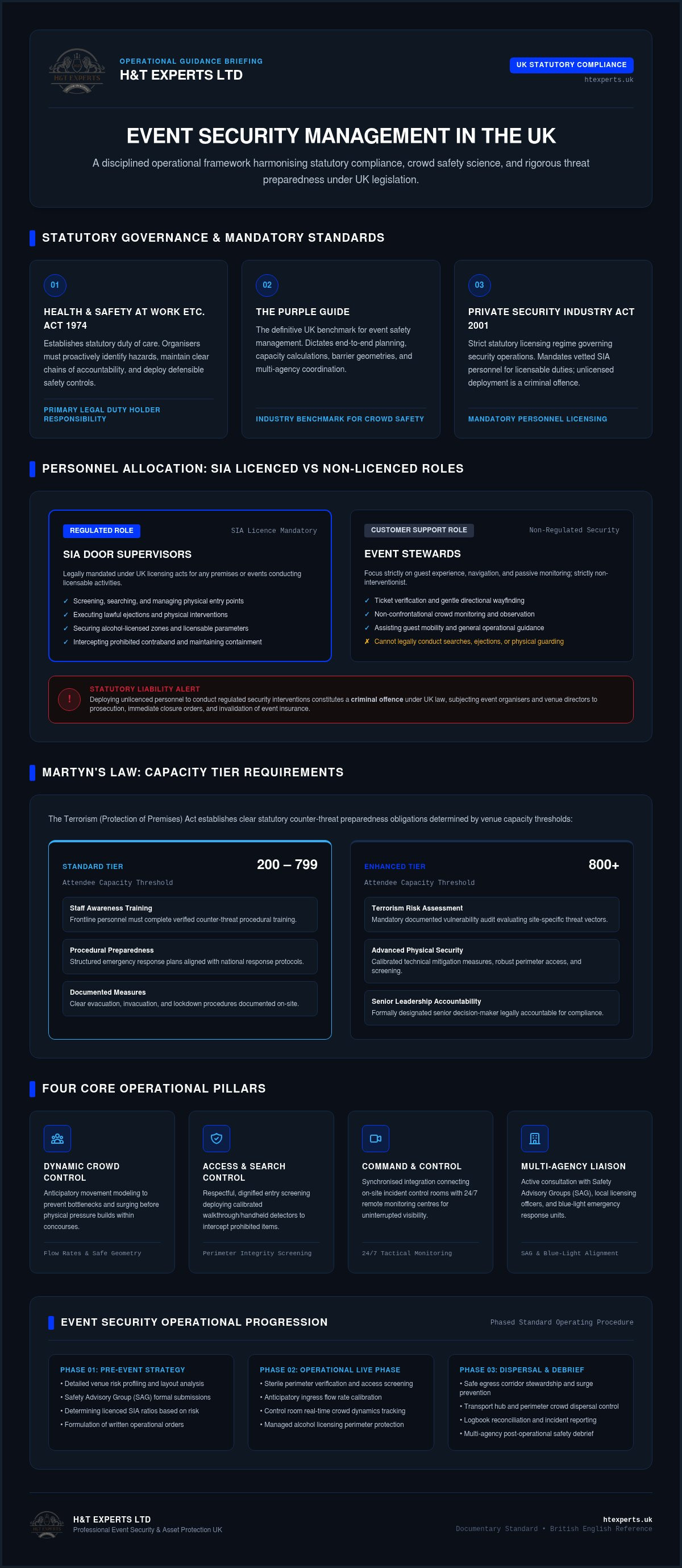
At its core, professional event security management UK organisers rely upon is a disciplined operational system. It unifies strategic risk assessment, perimeter control, and crowd safety to safeguard lives while preserving the event's atmosphere. Rather than simple physical presence, it provides end-to-end command and control across all phases of an operation. UK event security functions within strict statutory parameters, anchored by the Health and Safety at Work etc. Act 1974 and the industry-standard Purple Guide (The Event Safety Guide). These frameworks dictate that duty holders must proactively identify vulnerabilities, implement defensible risk controls, and maintain clear lines of accountability from planning through to post-incident debriefs.
Effective execution relies heavily on proven crowd control principles, transforming theoretical crowd dynamics into practical barrier configurations, managed flow rates, and safe access protocols. Every operational order must satisfy local licensing authorities and statutory safety groups, ensuring crowd safety remains paramount.
The Statutory Framework: SIA Standards and Venue Licences
Compliance begins with deploying correctly licenced personnel under the Private Security Industry Act 2001. Understanding the clear legal distinction between roles is critical for venue safety:
SIA Door Supervisors
Legally required for licensable activities, including screening entrants, searching individuals, managing ejections, and securing alcohol-licensed premises.
Event Stewards
Focus solely on customer service, ticket verification, wayfinding, and non-confrontational crowd monitoring; they cannot lawfully perform regulated security interventions.
Premises licences granted by local authorities frequently mandate specific SIA ratios based on guest volume, alcohol service, and venue layout. Deploying unlicensed personnel to perform licensable activities constitutes a criminal offence under UK law. This exposes event organisers, venue directors, and suppliers to severe statutory penalties, potential closure orders, and substantial reputational damage.
Martyn's Law and Public Safety Compliance
The legislative horizon demands heightened vigilance under Martyn's Law (the Terrorism (Protection of Premises) Act 2025). The statute establishes a clear two-tier structure for publicly accessible premises and events:
Standard Tier (200-799 capacity)
Mandates basic counter-threat procedural preparedness, including staff awareness training and structured emergency response plans.
Enhanced Tier (800+ capacity)
Requires thorough terrorism risk assessments, comprehensive mitigation plans, advanced physical security measures, and designated senior leadership accountability.
Meeting these standards requires demonstrable preparedness. Operators must document rigorous vulnerability audits, ensure frontline teams complete verified counter-terrorism awareness training, and implement clear protocols that integrate seamlessly with national emergency response frameworks.
Core Pillars of Professional Event Security Operations
Operational success hinges on dynamic crowd management. Effective crowd safety relies on anticipatory guidance rather than reactive intervention. When security teams anticipate movement patterns, they prevent surging, dangerous bottlenecks, and crowd distress before physical pressure builds. Deploying professional security guarding ensures that physical access points, high-footfall corridors, and perimeter fences remain firmly protected against unauthorised breaches.
Modern event security management UK frameworks balance on-site manned visibility with centralised command. On-site control rooms work hand in hand with remote 24/7 security monitoring facilities, ensuring uninterrupted operational oversight across every sector of a venue. Event planners seeking reliable site protection can partner with experienced UK security specialists to establish cohesive operational oversight before gates open.
Access Control, Search Procedures, and Contraband Interception
A secure perimeter requires respectful yet uncompromising entry screening. Checkpoint designs must follow established HSE event safety guidance to balance flow rates with security thoroughness:
Dignified Search Policies
Conduct transparent bag searches and deploy calibrated walkthrough or handheld metal detectors to intercept prohibited items without infringing on individual dignity.
Contraband Protocols
Establish clear legal workflows for isolating surrendered alcohol, recording illegal narcotics, and safely securing weapons for police collection.
Queue Management
Utilise serpentine barriers and rate-regulated turnstiles to pace footfall, preventing external crowd compression during peak arrival surges.
High ingress volume must never compromise thorough screening. Rate-regulated arrival lanes distribute pressure evenly across frontlines.
Control Room Protocols and Multi-Agency Liaison
Decisive command execution protects venues when unexpected incidents unfold. A unified event control cabin maintains operational control through three strict mechanisms:
Radio Discipline and Incident Logging
Use designated operational channels and formal, time-stamped incident logs to record every security alert and deployment.
Multi-Agency Integration
Co-locate security supervisors alongside venue operators, local police liaisons, and private medical providers to coordinate joint responses without delay.
Network Redundancy
Deploy back-up satellite links, direct-wire handsets, and independent radio frequencies to safeguard communications during public cellular outages.
Disciplined multi-agency coordination ensures that every operational decision remains fully auditable, rapid, and controlled.
Assessing Event Security Requirements: Scale, Risk, and Format
Every event presents a distinct threat landscape. A strategy designed for an enclosed corporate gathering will fail if applied to a multi-day greenfield festival. Calibrating an event security management UK plan requires balancing guest volume against environmental layout, audience demographics, and operational friction points. The goal is to establish adequate coverage without creating an oppressive atmosphere.
| Event Typology | Primary Threat Vectors | Staffing Composition | Operational Priorities |
|---|---|---|---|
| Corporate Summits | Corporate espionage, unauthorised press, delegate disruption | Discreet door supervisors, executive protection | Credential verification, secure private meeting rooms |
| Outdoor Festivals | Perimeter incursions, substance abuse, crowd surges | High-density SIA guards, perimeter response teams, stewards | Zone containment, dynamic egress flow, search lanes |
| Private Galas | Gatecrashers, high-value asset theft, press intrusion | Front-of-house SIA personnel, static perimeter guards | Guest-list authentication, asset surveillance, vehicular control |
Indoor Corporate Summits vs Outdoor Mass Gatherings
Enclosed corporate environments demand precision and professional discretion. Security personnel protect commercial intellectual property, manage sensitive VIP zones, and monitor restricted access corridors. Physical security remains largely unobtrusive, prioritising seamless digital badging and delegate credential verification over visible crowd barriers.
Outdoor greenfield gatherings present an entirely different operational reality. Securing expansive boundaries requires dedicated response units, search teams at primary transport arteries, and vigilant perimeter surveillance. Terrain instability, unpredictable British weather, and sprawling footprints create blind spots. Unforeseen bottle-necks can compromise perimeter integrity unless backed by disciplined mobile patrol units.
Determining Security Guarding to Attendee Ratios
A baseline ratio of 1 SIA guard per 100 attendees often satisfies standard premises licensing for low-risk gatherings. However, static ratios rarely account for real-world risks. The Security Industry Authority (SIA) sets strict licensing benchmarks, but exact deployment densities must adapt to operational catalysts:
Alcohol and Regulated Entertainment
Serving alcohol or extending operating hours increases behavioural volatility, often requiring elevated guard density around bar areas and stages.
Controversial Keynotes and Protests
High-profile public speakers or commercially sensitive exhibitions require dedicated tactical teams to manage peaceful assembly and rapid extraction.
Perimeter Vulnerabilities and Transport Hubs
Events adjacent to open public roadways or dense rail networks need reinforced access controls to prevent overcrowding outside the gates.
Factoring these catalysts into your vulnerability assessment ensures your operational deployment satisfies statutory Safety Advisory Groups while maintaining public safety.
Developing an Event Security Plan: Step-by-Step Operational Blueprint
Executing compliant event security management UK organisers can trust requires moving methodically from initial intelligence through to live deployment. A resilient plan leaves no room for improvisation when crowd density spikes or an alert sounds. Organisers who need an auditable, fully compliant plan should request an operational consultation with H&T Experts to ensure their deployment satisfies local licensing mandates.
This disciplined five-step operational blueprint provides complete site governance:
Step 1: Vulnerability Auditing
Conduct site-wide boundary inspections, identify blind spots, and produce dynamic risk assessments.
Step 2: Stakeholder Alignment
Engage with local authorities and compile comprehensive operational orders detailing chain of command.
Step 3: Personnel Mobilisation
Deploy vetted, SIA-licenced personnel backed by thorough site orientations and role allocations.
Step 4: Active Command Logging
Enforce strict surveillance, continuous patrol logging, and time-stamped incident tracking.
Step 5: Crisis De-escalation
Implement rapid containment protocols supported by specialist emergency security response capabilities.
Pre-Event Intelligence Gathering and SAG Presentations
Before physical barriers arrive on site, your operational plan must withstand multi-agency scrutiny. In the UK, major gatherings require presentation before the local Safety Advisory Group (SAG), which convenes police liaisons, fire and rescue officers, ambulance services, and local authority licensing officials.
Your documentation must incorporate actionable escalation matrices. Define clear threshold triggers that prompt specific actions, such as shutting entrance gates during platform crowding, diverting footfall if adverse weather damages grass parking, or initiating partial sector evacuations during external police alerts. Securing SAG approval hinges on demonstrating that your team can execute calm, decisive protocols without placing undue demand on public emergency services.
Briefings, On-Site Deployment, and Post-Event Auditing
A sound plan succeeds or fails on the briefing floor. Prior to each operational shift, lead supervisors must deliver structured briefings to all security guards and event stewards. These sessions establish primary radio channels, review dynamic search criteria, identify key egress routes, and outline child safeguarding protocols. Every operative must understand their exact sector, line of reporting, and rules of engagement for de-escalating disruptive behaviour.
Throughout the event, maintain an electronic, contemporaneous incident log. Recording the precise time, location, personnel involved, and outcome of each intervention creates an unassailable evidentiary trail. Conclude every deployment with an operational debrief to evaluate queue velocities, incident response times, and perimeter vulnerabilities, ensuring continuous refinement for future event cycles.
Selecting a Professional UK Event Security Partner
Selecting a security supplier is the single most critical procurement decision an organiser will make. When the safety of thousands rests on frontline leadership, partnering with a seasoned contractor separates controlled environments from vulnerable ones. Credible event security management UK providers bring verifiable pedigree, backed by over 25 years of operational leadership and field experience under decisive director-level oversight. Entrusting site safety to an established provider ensures that statutory compliance, tactical vigilance, and brand reputation remain protected under high-pressure conditions.
Key Criteria for Vetting Security Contractors
Vetting prospective security partners requires probing deeper than baseline pricing. Organisers must verify strict operational benchmarks to protect their venue against statutory liability:
SIA Approved Contractor Status
Confirm that the contractor holds SIA ACS accreditation, verifying independent quality auditing across management, training, and operational delivery.
Comprehensive Insurance Standards
Review comprehensive employer and public liability policies designed specifically to cover high-occupancy event operations.
Managerial Escalation
Ensure the provider maintains round-the-clock operational support, dedicated supervisory structures, and transparent reporting systems.
A dependable contractor guarantees continuous oversight, fielding licensed personnel who adapt swiftly to evolving on-site challenges.
The Value of Integrated Security and Operational Support
Juggling disparate third-party suppliers introduces logistical friction and command breakdowns during critical event phases. Unifying physical perimeter protection with specialist facility support streamlines site operations under a single, accountable management team.
Coordinating professional security guarding alongside specialist cleaning services accelerates post-event turnaround times and significantly reduces venue downtime. When trained security personnel control access corridors while coordinated specialist maintenance teams remediate waste and environmental hazards, premises integrity remains intact. This dual capability delivers a clean, secure venue ready for immediate operational handover without administrative friction.
Securing Operational Excellence for Your Next Event
Delivering a safe, legally compliant gathering demands far more than basic stewarding. Resilient event security management UK organisers rely on requires proactive risk audits, structured crowd dynamics, and absolute alignment with statutory Purple Guide and Martyn's Law standards. When your operational blueprint unites robust perimeter control with calm, visible leadership, attendee safety and venue reputation remain secure from start to finish.
You shouldn't have to navigate complex Safety Advisory Group scrutiny or unpredictable operational risks without seasoned specialists at your side. Backed by over 25 years of operational experience, our vetted, highly disciplined security personnel deliver seamless site protection and 24/7 national response capability across the country. Take complete command of your venue safety today. Secure your event with H&T Experts and ensure your next gathering operates flawlessly under every standard.
Frequently Asked Questions
What is the difference between an event steward and an SIA licensed security guard in the UK?
SIA licensed security guards hold statutory authority under the Private Security Industry Act 2001 to conduct licensable activities. These include physical bag searches, screening, conflict intervention, and ejections. Event stewards handle customer care, ticket checks, wayfinding, and passive observation. Stewards cannot legally execute physical restraint, intervene in violent altercations, or manage entry control where alcohol licensing mandates SIA door supervision. Using stewards for licensable duties is a criminal offence.
What are the legal requirements for security under the UK Purple Guide?
The Purple Guide provides the recognised benchmark for UK event safety, establishing that organisers owe a statutory duty of care under the Health and Safety at Work etc. Act 1974. It requires duty holders to conduct documented risk assessments, calculate safe crowd capacities, and appoint competent security management. It also dictates formal command structures, dynamic crowd monitoring, and clear operational coordination with statutory bodies, ensuring crowd safety protocols remain fully auditable.
How will Martyn's Law affect event security management for UK venues?
Martyn's Law mandates counter-terrorism preparedness across publicly accessible premises. Under this framework, event security management UK professionals must adapt operations depending on capacity. Venues hosting 200 to 799 attendees fall under the Standard Tier, requiring procedural staff training and basic incident response plans. Venues holding 800 or more enter the Enhanced Tier, requiring formal terrorism risk assessments, advanced physical security measures, and designated senior operational accountability to satisfy statutory regulators.
How many security guards are legally required for an event in the UK?
UK law does not enforce a rigid statutory ratio across all gatherings. While local licensing authorities often recommend a baseline of 1 SIA-licensed guard per 100 attendees, mandatory staffing levels depend on your premises licence conditions. Exact security density is determined through risk assessments evaluating crowd demographics, venue geography, high-risk speakers, and whether alcohol is served. Safety Advisory Groups will review these assessments before granting operational approval.
Can event security guards conduct physical searches of attendees and their bags?
Yes, provided searching is a clearly stated condition of entry displayed on tickets and venue signage. Security personnel cannot physically force a search without consent; however, they possess the full legal right to refuse entry to anyone who declines. SIA-licensed guards must conduct bag and pat-down searches professionally and respectfully, adhering to strict civil liberty standards, equal opportunities legislation, and documented search escalation protocols.
What should be included in an Event Security Management Plan?
A comprehensive plan details command hierarchies, vulnerability assessments, and dynamic crowd circulation calculations. For robust event security management UK deployments, it must outline SIA guard allocations, search procedures, perimeter protection plans, and communication matrices linking venue control with emergency services. It should also incorporate contingency plans for adverse weather, overcrowding, and major incidents, providing an auditable operational order that satisfies Safety Advisory Groups and licensing magistrates.
What happens if an unexpected emergency or threat occurs during an event?
On-site security command immediately initiates pre-agreed major incident protocols. Lead supervisors coordinate with emergency services, using dedicated radio channels and time-stamped incident logs. Frontline security guarding teams secure critical egress routes, guide attendees calmly away from hazard zones, and implement controlled sector evacuations. Rapid emergency security response protocols ensure incidents are contained quickly, preserving life and preventing secondary crowd crushing or perimeter collapse.





Ready to Experience Unparalleled Security Solutions?
H&T Experts Ltd is here to ensure your peace of mind. Connect with us today and take the first step towards a safer tomorrow.