

Hospital Security Guard Services: UK Buyer's Guide 2026
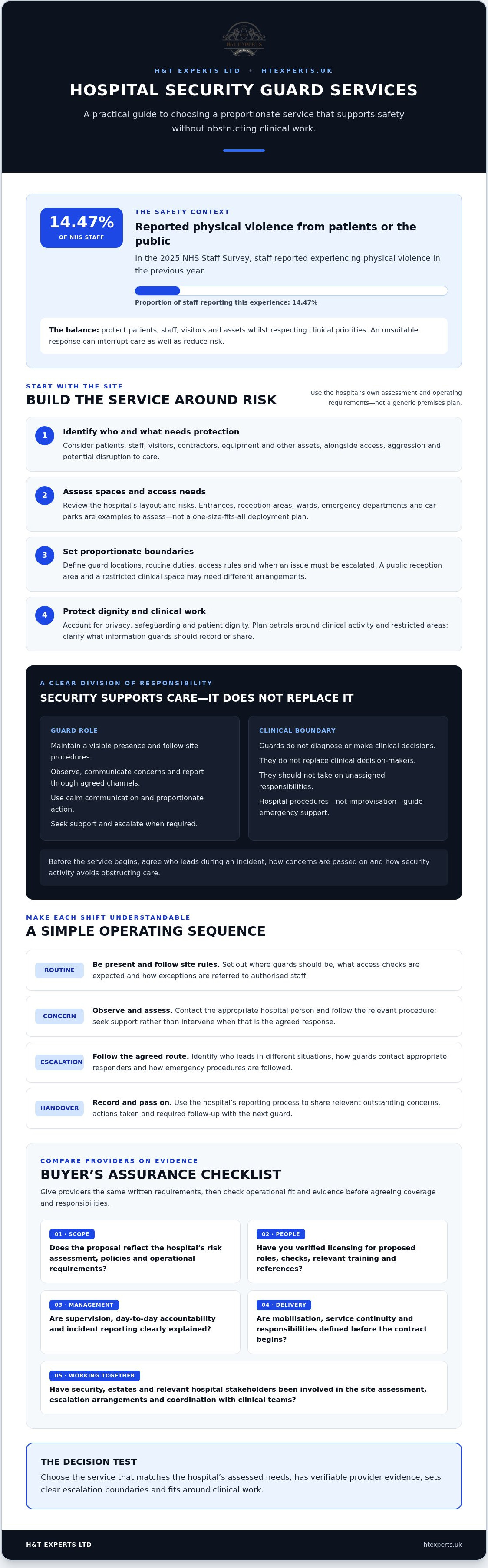
In the 2025 NHS Staff Survey, published in March 2026, 14.47% of NHS staff said they had experienced physical violence from patients or the public in the previous year. Protecting people matters, but hospital security must also respect clinical priorities. A response that is not suited to the setting can interrupt care as well as reduce risk.
How can you choose hospital security guard services that help keep patients, staff, visitors and assets safe without obstructing clinical work? Start with a proportionate service based on the hospital’s own risk assessment, clear escalation boundaries and accountable day-to-day management.
This 2026 buyer’s guide explains how to assess provider standards, SIA licensing for proposed roles, relevant training, supervision, incident reporting and service continuity. It also sets out what to ask about mobilisation, responsibilities and how guarding should work alongside clinical teams and wider security procedures. Use it to compare providers on evidence and operational fit, then define expectations before the contract begins.
Key Takeaways
• Identify what the service needs to protect through a site-specific risk assessment, including access, disruption and asset protection.
• Set expectations for routine duties, incident response and emergency support, in line with hospital policies and escalation routes.
• Compare hospital security guard services against the same written requirements, and verify licensing, checks, training and references.
• Involve security, estates and relevant hospital stakeholders in the site assessment before agreeing coverage, responsibilities and reporting.
• Use a final assurance checklist to check that provider evidence, leadership and continuity arrangements match the hospital’s needs.
Hospital security guard services: what should the service protect?
Hospital guarding is a people-led service that supports site safety and agreed procedures. A security guard may maintain a visible presence, manage access in line with site rules and report concerns through established channels. In a hospital, these duties should reflect clinical priorities rather than be copied from a generic premises security plan.
Risks to consider can include unauthorised access, aggression, disruption to care and the protection of equipment or other assets. These are prompts to assess where a calm, proportionate security response could support people and help hospital operations continue, not reasons for an alarmist approach.
Patients may be unwell, distressed or vulnerable; staff need to deliver care, often under pressure; and the site may remain active around the clock. Clear boundaries are therefore essential. The hospital’s risk assessment, policies and operational requirements should define the service scope, including guard locations, expected duties and when an issue must be escalated.
Which hospital people, spaces and activities need consideration?
Begin with patients, staff, visitors and contractors, then identify how their needs and permitted access differ. Entrances, reception areas, wards, emergency departments and car parks are useful examples to assess, but the right arrangements depend on the hospital’s layout and risks. A public reception area and a restricted clinical space should not automatically have identical access rules.
Procedures should also protect privacy, safeguarding and patient dignity. For example, a guard responding to a concern on a ward may need to account for patient confidentiality and the presence of clinical staff. The service specification should state how guards report concerns, whom they contact and what information they should record or share.
How should guarding support care without disrupting it?
Patient-facing security calls for calm communication and proportionate action. Guards should understand the agreed response to different situations, including when to seek support rather than intervene. Their role is to follow hospital procedures and escalation routes, not to diagnose, make clinical decisions or replace clinical decision-makers.
Before the service begins, agree how guards will coordinate with hospital managers, clinical teams and relevant emergency procedures. Clarify who leads during an incident, how concerns are passed on and how security activity can avoid obstructing care. These arrangements turn a general security presence into a service with defined responsibilities and a practical fit for the hospital.
What should hospital security guards do during a shift?
Set out shift duties in the service specification and link them to the hospital’s risk assessment and policies. This gives guards a clear brief: where to be present, which procedures to follow, what they can act on and when to escalate. Without that clarity, routine presence and access control can be confused with incident response or emergency support, which may have different instructions and decision-makers.
A well-defined shift combines observation, communication and accountable action. Guards may notice a developing concern, pass information to the appropriate hospital contact and record what happened. Their role is to follow agreed procedures, not to make clinical decisions or take on responsibilities that have not been assigned to them.
How do guards handle access, patrols and daily interactions?
Visitor guidance, contractor checks and access procedures should follow the hospital’s instructions. Agree which areas are restricted, what checks are expected and how exceptions are referred to authorised staff. Plan patrol routes and timing around clinical activity, restricted areas and patient privacy, rather than treating the whole site as a uniform circuit.
Consistency matters at shift change. A handover should pass on relevant outstanding concerns, actions already taken and any required follow-up, using the hospital’s agreed reporting process. This helps the next guard continue the work without relying on informal updates or assumptions.
How should incidents and escalation be managed?
Set out a clear sequence for incidents: observe and assess, contact the right person, follow the relevant hospital procedure, escalate when required and complete an accurate report. The process should identify who leads in different situations and how guards contact appropriate responders. In an emergency, guards should follow the hospital’s established procedures rather than improvise or delay clinical response.
Technology can support communication and information-sharing, but it does not replace trained personnel or accountable on-site judgement. The service specification should explain how any tools fit into reporting and escalation, and who is responsible for acting on the information received.
Before appointing a provider, verify the Security Industry Authority (SIA) licence requirements for each proposed role, and check that the assigned duties match those requirements. Do not rely on a general assurance when role-specific details can be confirmed. The National Association for Healthcare Security (NAHS) can also provide useful sector context when assessing a provider’s approach to healthcare security.
For hospitals assessing security guarding services, check whether the proposed shift plan, supervision and escalation arrangements can be matched clearly to site policies. Confirm responsibilities before mobilisation, then review reports and handovers to ensure the service operates as specified.
How to compare hospital security guard services and providers
Compare every provider against the same written brief. Set out the hospital’s risks, required coverage, duties, escalation arrangements and expected outcomes before reviewing proposals. This makes it easier to distinguish evidence of capability from general assurances, and helps ensure that differences between bids reflect service fit rather than different assumptions about the requirement.
What evidence should a hospital request from a security provider?
Request evidence that can be checked against the specification, including relevant policies, training records, management and supervision arrangements, and sample incident reports. For proposed roles, check SIA licence status and verify the applicable requirements against current guidance. Ask providers to explain recruitment checks and healthcare-relevant training, then establish what is evidenced, what remains outstanding and who is responsible for follow-up.
Training claims should relate to the proposed duties. The Core Skills Training Framework (CSTF) can help buyers consider health-sector training expectations, but a framework reference does not prove that every proposed guard has completed relevant training. Request records and assess whether they meet the hospital’s requirements. Healthcare references can also be useful, provided the provider can substantiate them and the hospital can establish what work they cover.
Use a simple evidence register to keep the assessment auditable:
| Evidence supplied | Evidence outstanding | Hospital evaluation |
|---|---|---|
| Policies, training records and sample reports received | Role-specific licence checks or documents still requested | Does the evidence meet the written requirement? |
| Named supervisor and proposed management process | Absence cover or shift continuity details to confirm | Are ownership and arrangements clear and workable? |
| Relevant references provided | Scope or contact details awaiting verification | Do references support the specific claims made? |
How can a buyer judge service quality and accountability?
Set measurable standards for agreed coverage, supervisory contact, incident communication and report completion. Where the hospital sets a timeframe for passing on information, define how performance will be demonstrated. Ask who owns day-to-day issues, how concerns reach provider management and how service reviews will identify and address recurring problems.
Also examine shift cover and absence arrangements. A proposal should explain how the provider will notify the hospital of a coverage issue, who makes decisions and how continuity will be managed under the contract. For broader guarding considerations beyond healthcare, see this professional security guarding guide. Use the same evidence-led approach to assess hospital security guard services, recording both strengths and unresolved questions before selecting a provider.
How to specify and mobilise hospital security guard services
Reliable mobilisation begins before the first shift. Start with a documented site assessment involving security, estates and appropriate hospital stakeholders, so the proposed service reflects actual risks, operational needs and site policies. Use the findings to define required locations, coverage periods, duties and boundaries. The specification should state where guards are expected to be present and which tasks remain the responsibility of hospital staff.
What belongs in a hospital guarding service specification?
Make the requirements clear enough for both the provider and hospital team to apply consistently. Set out required posts, patrol areas, operating hours and approved duties. Identify who can authorise changes, who receives escalations and how incidents reach hospital decision-makers. Include expectations for role-relevant training, supervision, records, confidentiality and performance reviews. Check contractual terms and applicable regulatory details against current guidance before agreeing the service.
Useful specification headings include:
Coverage and locations
Posts, patrol areas, coverage periods and arrangements for any changes.
Responsibilities
Permitted duties, boundaries, hospital contacts and escalation routes.
Assurance
Training evidence, supervision, reporting, confidentiality and review arrangements.
Define how service performance will be reviewed, including which records the provider supplies, who considers them and how concerns are raised and tracked. This makes the specification a working reference, not just a document used during procurement.
How should a new guarding service be introduced?
Agree mobilisation responsibilities and named operational contacts on both sides before the service starts. Plan site familiarisation around access arrangements, restricted areas, communication channels, reporting procedures and relevant emergency processes. Confirm how concerns are reported, how urgent matters are escalated and whom to contact if planned cover is disrupted.
Build a clear handover between mobilisation and live operation. The hospital and provider should confirm that guards understand their agreed duties, know where to find current procedures and can reach the appropriate contacts. Set a review schedule to check whether arrangements remain aligned with hospital operations, and document how amendments are approved. For related planning, see this emergency security response guide.
Good mobilisation depends on defined responsibilities, not assumptions. If you are assessing a provider, review H&T Experts’ security guarding services and consider how the proposed arrangements can be checked against the hospital’s documented needs.
Choosing a hospital security partner: assurance and next steps
The right provider is the one whose verifiable evidence matches the hospital’s documented requirements. A polished proposal is not enough. Decision-makers need to understand who will supervise the service, how issues will be handled and how performance will remain visible after appointment. Keep a record of the evidence received, outstanding gaps and the decision each item supports.
What questions should procurement teams resolve before appointment?
Confirm who supervises guards, manages incidents and is accountable for day-to-day delivery. Establish how the provider will notify the hospital about cover changes, report concerns and take part in performance reviews. If a credential, training record, reference or other assurance remains outstanding, name who will verify it and set a clear point for resolution before contract award.
How can a provider relationship remain accountable over time?
Agree regular reviews against the service standards in the contract. Consider coverage records, incident reports and recurring themes alongside feedback from hospital staff. Provide a clear route for staff to raise concerns, identify who follows up and record agreed actions. Reviews should prompt practical adjustments when risks or operational needs change, with changes authorised through the agreed process.
Assess company-wide experience on its own terms. For example, H&T Experts states that it has over 25 years of operational experience, but that does not establish hospital-specific experience or healthcare credentials. Ask for relevant evidence and verify any healthcare-sector claims before relying on them.
Before appointment, use this final checklist:
Credentials
Have applicable role requirements and supporting evidence been checked?
Healthcare fit
Can the provider demonstrate how its proposed arrangements meet the hospital’s specific needs?
Leadership
Are supervision, incident ownership and escalation responsibilities clear?
Reporting
Are reporting routes, records and review expectations agreed?
Continuity
Are cover changes, service disruption and follow-up responsibilities defined?
If important evidence remains unverified, resolve the gap before committing. For hospitals assessing hospital security guard services, a transparent discussion of site requirements can help establish whether the proposed arrangements are a suitable fit. Discuss your security requirements with H&T Experts.
Make your next security decision with confidence
Effective hospital security starts with a clear understanding of what the site needs and how the service should support care. Choose hospital security guard services by comparing providers against documented requirements, then verify their evidence, accountability arrangements and ability to deliver the agreed scope.
Keep the decision grounded in evidence. H&T Experts states it has over 25 years of operational experience and provides security guarding, 24/7 security monitoring and emergency security response nationally across the UK. Consider this company-wide experience separately from hospital-specific expertise, which buyers should verify directly.
Discuss your hospital security requirements with H&T Experts to explore whether its proposed service arrangements fit your documented needs.
Frequently Asked Questions
What do hospital security guards do?
Hospital security guards carry out duties agreed with the hospital to support site safety and established procedures. Depending on the service specification, this may include maintaining a visible presence, guiding visitors, following access arrangements, observing potential concerns and reporting incidents. Their actions should respect patient privacy and clinical priorities. Guards follow agreed escalation routes and support hospital procedures, but do not replace clinical staff or make clinical decisions.
Do hospital security guards need an SIA licence?
Some guarding roles require an appropriate Security Industry Authority (SIA) licence, depending on the duties performed and whether they involve licensable activity. Hospitals should check the current SIA requirements for each proposed role rather than relying on a general statement that staff are licensed. Ask the provider to identify which licence applies, verify the status of relevant guards and confirm that their assigned duties match the role.
What training should hospital security guards have?
Training should match the guard’s duties and the hospital environment. Ask for evidence relevant to communication, de-escalation, incident reporting, safeguarding, confidentiality and the site’s emergency procedures. Confirm how training prepares staff to interact respectfully with patients and coordinate with clinical teams. If a provider refers to healthcare-specific or other formal training, request records and check that the content and currency meet the hospital’s documented requirements.
Can hospital security guards restrain patients?
There is no blanket permission for guards to restrain patients. Any physical intervention must be considered within applicable law, the hospital’s policies, the guard’s assigned role and verified training. The priority should be to follow agreed procedures, seek clinical input and use de-escalation where appropriate. Hospitals should define who makes decisions, when emergency responders are contacted and how any incident is documented and reviewed.
How should hospitals assess security guard providers?
Assess providers against one written specification covering site risks, duties, coverage, supervision, escalation and reporting. Verify applicable SIA licences, recruitment checks, training evidence and any healthcare references rather than accepting unsupported claims. Establish who manages day-to-day issues, how staff absences or service disruption are handled, and how performance is reviewed. Record the evidence received and gaps to resolve before contract award.
How much do hospital security guard services cost?
There is no single price for hospital security guard services. Cost depends on the agreed scope, including posts, coverage periods, shift patterns, supervision and mobilisation requirements. Ask providers to price the same written specification and show what is included, such as management, reporting and arrangements for cover changes. This helps procurement teams compare like with like, identify exclusions and assess value without relying on a headline figure alone.
What should a hospital security service specification include?
A useful specification sets out the site assessment, required locations and coverage periods, approved duties and role boundaries. It should name hospital and provider contacts, explain authorisation and escalation routes, and define expectations for supervision, training evidence, handovers, incident records and confidentiality. Include how service disruption is reported, who can approve changes and how performance will be reviewed. These details give both parties a clear operational reference.
Other Services





Ready to Experience Unparalleled Security Solutions?
H&T Experts Ltd is here to ensure your peace of mind. Connect with us today and take the first step towards a safer tomorrow.