

Front of House Security: UK Corporate Buying Guide
What if your corporate entrance could feel welcoming to employees and visitors while still controlling who gains access? That balance is central to front of house security for corporate buildings. Reception teams are often expected to create a positive first impression, while security responsibilities call for clear procedures to manage visitors, access concerns and incident escalation.
Too little control can leave gaps, while poorly designed measures may disrupt daily operations. The right arrangement should reflect your building, its risks and what staff can reasonably manage. This guide compares front-of-house security options and explains how to assess staffing, provider capability, procedures and supporting technology. It also considers how on-site guarding may work alongside monitoring and defined escalation routes. Use the practical criteria to clarify responsibilities, oversight and response expectations, then choose a proportionate service that protects access without compromising a professional welcome.
Key Takeaways
• Set clear entrance objectives so front of house security for corporate buildings supports a professional welcome as well as controlled access.
• Assess how people, documented procedures and suitable technology can work together to meet your site’s needs.
• Compare reception-led, security-led and combined models against visitor experience, oversight and incident escalation.
• Use a structured provider assessment to clarify training, supervision, reporting and cover arrangements before appointment.
• Consider whether security guarding, monitoring or emergency response fits your requirements. H&T Experts Ltd reports over 25 years of experience.
What does front of house security for corporate buildings need to achieve?
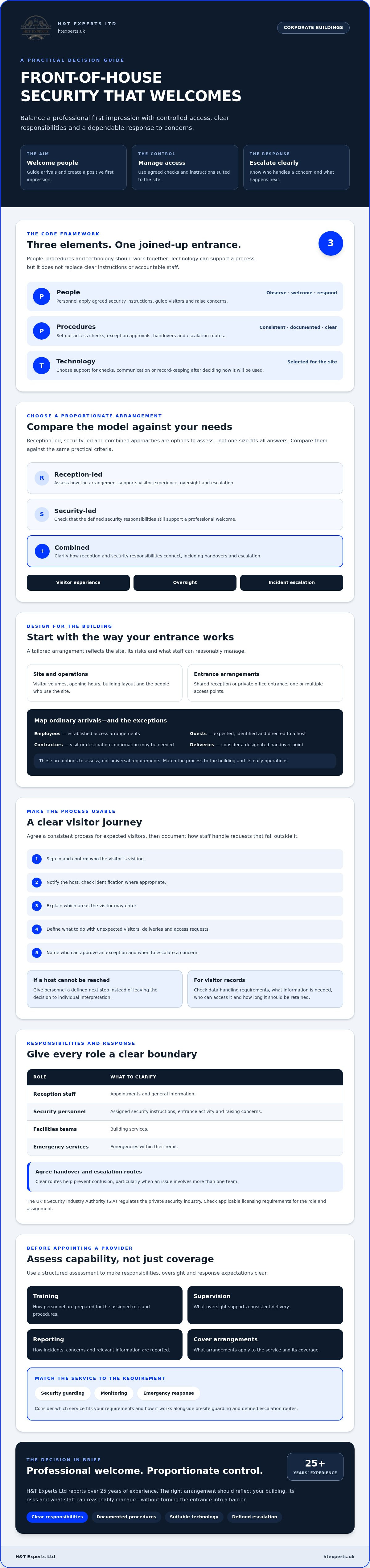
Front-of-house security for corporate buildings should control access without turning the welcome into a barrier. A practical buying framework starts with the site’s access needs, defines who is responsible for each task, and selects a service that supports both visitor experience and a clear response to concerns.
Front-of-house security is the people, procedures and oversight used to manage a building’s entrance, guide visitors and respond to access or safety concerns. It differs from reception-only duties because security responsibilities may include observing entrance activity and applying agreed access procedures. It also differs from general guarding, which may cover wider areas or duties rather than focusing on the arrival point.
What responsibilities can front-of-house security cover?
Depending on the assignment, personnel may greet and direct visitors, observe activity around the entrance, and follow agreed steps for checking access or raising concerns. Write down the precise scope. For example, instructions can explain what to do if a visitor arrives without an expected appointment or someone tries to follow an authorised person through a controlled entrance.
Set clear boundaries between roles. Reception staff may manage appointments and provide general information; facilities teams oversee building services; security personnel follow their assigned security instructions. Emergency services handle emergencies within their remit. Agreeing handover and escalation routes helps prevent confusion, especially when an issue involves more than one team. Providers should also explain role-specific requirements: the UK's Security Industry Authority (SIA) regulates the private security industry, and applicable licensing requirements should be checked for the role and assignment.
Why does the entrance need a tailored security approach?
Entrances differ in how they operate. Visitor volumes, opening hours, building layout and the people using the site all affect what is proportionate. A shared reception for several businesses may need a different process from a private office entrance. A building with multiple access points may also need clear instructions on which doors visitors should use.
Different users may need different routes through the process. Employees might follow established access arrangements, while guests may need to be expected and directed to a host. Contractors could require confirmation of their visit or destination, and deliveries may need a designated handover point. Treat these as options to assess, not universal requirements.
Start by mapping ordinary arrival patterns and likely exceptions. Then define the welcome, access checks and escalation steps that fit the site. The aim is not maximum intervention at every door. It is a dependable entrance service with responsibilities matched to the building and its daily operations.
How should front-of-house security combine people, procedures and technology?
Effective front-of-house security depends on three elements working together: trained personnel who can assess what is happening, documented procedures that support consistent decisions, and technology selected for the site’s actual requirements. A system may record an access event, but staff still need to understand what it means and what to do next.
Technology supports, but does not replace, clear procedures and accountable staff. This principle helps keep front of house security for corporate buildings proportionate. Avoid choosing systems before deciding how they will be used. Start with the entrance process, then identify where technology could make checks, communication or record-keeping more reliable.
What should a visitor access procedure include?
Agree a consistent process for expected visitors. Depending on the site, this could include signing in, confirming who they are visiting, notifying their host, checking identification where appropriate, and explaining which areas they may enter. Set out how staff should handle unexpected visitors, deliveries and access requests. Specify who can approve an exception and when to escalate a concern.
Visitor records need careful management. Before choosing a sign-in method, check current data-handling requirements, what information the site needs to collect, who can access it and how long it should be retained. Explain what personnel should do if a host cannot be reached, rather than leaving the decision to individual interpretation.
How can security technology support the entrance team?
Access control may help apply permissions at selected doors; a visitor management system may support sign-in and host notification; and CCTV may provide visibility of an entrance or help clarify an incident. These are possible measures, not a standard package. Suitability depends on the building layout, existing arrangements and operational needs.
Define the human responsibilities around each system. Who monitors alerts? Who can approve access? What happens if a system is unavailable? How are incidents recorded and passed to the responsible contact? CCTV can provide context, but it cannot replace a trained person’s judgement or an agreed response procedure. Check current guidance on surveillance and personal data handling before setting up or changing systems.
For provider checks, consult the SIA register of approved contractors and establish which credentials are relevant to the proposed service. Where remote oversight may be appropriate, review 24/7 security monitoring guidance as one option, not an assumed requirement. H&T Experts provides security guarding, monitoring and emergency response. Explore its security services when considering what may suit your site.
Which front-of-house security model suits your corporate building?
The right model depends on how the entrance operates and what decisions need to be made there. A site with predictable arrivals may need a different arrangement from a busy building with several user groups, multiple access points or regular exceptions. Compare options against actual coverage, visitor experience, oversight and escalation needs rather than assuming one model suits every site.
| Model | Coverage | Visitor experience | Oversight and escalation |
|---|---|---|---|
| Reception-led | Reception manages arrivals and agreed access steps during its operating hours. | Can provide a familiar, service-focused welcome. | Confirm who handles security concerns and who takes over when reception is unavailable. |
| Security-led | Security personnel focus on entrance activity and the site’s security instructions. | A visible security presence may suit some settings; clear communication helps maintain a professional welcome. | Agree supervision, reporting and the route for escalating incidents. |
| Combined | Reception and security functions are assigned to suitable personnel, with responsibilities defined. | Can support visitor assistance and controlled access if roles are coordinated. | Document handovers, decision-making authority and escalation routes to avoid gaps. |
These are operating approaches, not fixed staffing prescriptions. A combined arrangement does not automatically mean separate people for every task. Appropriate coverage depends on the site’s requirements. For wider context on on-site duties and guarding arrangements, see this guide to professional security guarding.
When might an on-site security presence be appropriate?
Consider on-site personnel where access arrangements are complex, visitors arrive regularly, or staff need to make immediate observations and follow site-specific procedures. Someone at the entrance can assess context that an alert alone may not explain, such as an unexpected request or uncertainty about where a visitor should go. Define the responsibilities and coverage required for the assignment. Do not treat any staffing level as a universal recommendation.
When can monitoring and access technology add value?
Monitoring and access systems may support agreed oversight, including outside the periods when reception is staffed, if that arrangement suits the site. Remote monitoring can complement on-site personnel, but it does not automatically replace someone who needs to observe or act at the entrance. Establish who receives alerts, confirms events and initiates the next action. For planning escalation steps, consult this guidance on emergency security response.
Use these comparisons to identify where a model might leave uncertainty: who welcomes visitors, who controls access, and who is accountable when something needs attention? Clear answers help you select front of house security for corporate buildings that fits both the operating environment and the expected standard of welcome.
How can you assess front-of-house security providers before appointing one?
Assess providers against a written brief, not just a headline proposal. A structured review helps establish whether the proposed front of house security for corporate buildings matches your entrance requirements and makes responsibilities clear before the service begins.
Define the site requirements.
Record entrance locations, expected visitor patterns, operating hours, key access procedures and situations that need escalation. Note where reception, facilities and security responsibilities meet.
Test the proposed duties.
Ask the provider to explain what personnel will do during routine arrivals and when an access concern arises. Check that duties, boundaries, reporting lines and accountability will be documented before service commencement.
Review training and site briefing.
Ask how personnel are prepared for the assignment, including how they will learn the building layout, local instructions and relevant contact routes. Check current Security Industry Authority requirements for the proposed roles rather than relying on assumptions about licensing.
Clarify supervision and cover.
Ask who oversees delivery, how performance concerns are raised, and how the provider would manage absence cover or operational changes. Confirm the arrangements proposed for your site instead of assuming a particular level of cover.
Agree reporting and review.
Request examples of reporting formats and supervisory checks. Establish how incidents and recurring issues are recorded, communicated and followed up. Agree how the service will be reviewed against the brief.
What should a security service proposal make clear?
A useful proposal sets out operating hours, assigned duties, reporting lines and escalation responsibilities in plain language. It should explain how personnel will be briefed on the building and its procedures, who provides oversight, and how issues such as absence, performance concerns or changes to site instructions will be managed. Check that the written proposal and agreed service documents describe the same arrangement.
How should you assess service quality and accountability?
Look for evidence of a consistent management process, not vague assurances. Ask to see sample reports, understand how supervisory checks are carried out, and clarify who reviews incident records and tracks follow-up actions. These details help you judge whether concerns will reach the right people and be addressed through an agreed route.
For wider procurement checks, read this guidance on reliable security company selection. Once you have defined your requirements, review H&T Experts Ltd’s security guarding services.
How can H&T Experts help plan front-of-house security for your building?
A suitable service starts with your building’s requirements, not a preset package. Before discussing front-of-house security for corporate buildings, clarify the duties expected at the entrance, who the security team reports to, and how concerns should be escalated. This gives both parties a clear basis for considering whether security guarding, monitoring or emergency response is relevant to your needs.
What information should you prepare before requesting a quote?
A concise site brief helps make the discussion specific. Include how the building is used, its entrance arrangements, operating hours and the usual processes for visitors, contractors and deliveries. Note any existing access systems or monitoring arrangements, along with the current route for reporting and escalating incidents.
Identify what is not working as intended. For example, you may need clearer reporting, more consistent application of entrance procedures or a defined contact for access concerns. Record operational constraints too, such as busy arrival periods or the need to maintain a discreet, professional welcome. The more clearly you describe current arrangements and gaps, the easier it is to assess a proportionate service proposal.
What can H&T Experts bring to the discussion?
H&T Experts provides security guarding, 24/7 security monitoring and emergency security response. The company reports over 25 years of experience, and its director, Jamie Treloar, has over 25 years of operational experience. H&T Experts also describes its teams as trained professionals using technology-integrated surveillance. These are relevant areas to discuss, but the appropriate combination depends on your site and the arrangements that can be agreed.
Use the initial conversation to clarify what personnel would be responsible for, how reporting lines would work, and which situations should trigger escalation. Ask how any proposed monitoring or response arrangements relate to your existing procedures. Confirm site-specific duties and availability directly rather than assuming every service or configuration applies to every building.
A clear brief also helps you compare a proposal against your priorities: controlled access, a professional welcome, accountable oversight and defined response routes. H&T Experts can consider your stated requirements in relation to its security services, without presuming that every site needs the same arrangement.
Prepare your site information and discuss corporate building security requirements with H&T Experts. You can request a quote based on the needs and service scope you have identified.
Set a clear standard for your building’s entrance
Effective front of house security for corporate buildings balances a professional welcome with controlled access. The right approach depends on your site, so define responsibilities, reporting lines and escalation routes before choosing a service model. Then assess providers on how clearly they explain staffing, procedures and oversight.
People, procedures and suitable technology should work together. Monitoring can complement on-site security where appropriate, but responsibilities for alerts and follow-up need to be clear. A proportionate arrangement helps protect the entrance without creating unnecessary friction for employees and visitors.
H&T Experts Ltd states that it has over 25 years of experience. Its services include security guarding, 24/7 monitoring and emergency response, delivered by trained professionals using technology-integrated methods. The right combination depends on your building’s requirements.
To discuss an arrangement based on your site’s needs, contact H&T Experts about corporate building security and request a quote. Set out your priorities and responsibilities to help assess a controlled entrance that remains professional and welcoming.
Frequently Asked Questions
What does front-of-house security for a corporate building involve?
Front-of-house security focuses on managing activity at a building’s main entrance and reception area. Depending on the agreed assignment, it can include greeting and directing visitors, applying access procedures, observing activity and escalating concerns. Duties should be defined for the site, including who authorises access and receives reports. This work is not automatically equivalent to reception duties, general guarding across a wider site or remote CCTV monitoring, which have distinct functions.
Do corporate buildings need a security guard at reception?
Not every corporate building needs a security guard at reception. The appropriate arrangement depends on access requirements, visitor activity, operating hours, site procedures and the level of human oversight needed. Compare a security-led presence, reception-led processes and a combined approach against those requirements. Assess the building first, then ask providers to explain how their proposed duties address its needs, including who handles access concerns and how they are escalated.
Can CCTV replace front-of-house security personnel?
CCTV can support observation and incident review, but it does not automatically replace a person who welcomes visitors, applies site procedures or makes an on-the-spot judgement. Whether remote monitoring, on-site personnel or a combination is suitable depends on the building and its agreed operating arrangements. Before deciding, confirm who monitors systems, receives and assesses alerts, and takes responsibility for the next action if an incident or access concern is identified.
What should I check when choosing a front-of-house security provider?
Ask providers to set out duties, operating hours, reporting lines, supervision and incident escalation arrangements. Check how personnel will be briefed on the building and its procedures, and how absence cover or operational changes will be managed. Verify current Security Industry Authority requirements for the roles proposed. Finally, compare the service proposal with your visitor processes and site needs, rather than relying on general assurances that do not explain responsibilities.
How can front-of-house security remain welcoming to visitors?
Use a clear visitor process that explains how guests are greeted, directed and given access. Personnel should understand the building’s procedures and communicate them consistently, so checks feel orderly rather than arbitrary. Discuss visitor types, host notification and how exceptions should be handled with the provider. The aim is controlled access without unnecessary friction. Reviewing feedback and incident records can help identify where instructions or visitor processes need refinement.
Should front-of-house security cover out-of-hours periods?
That depends on the building’s operating pattern, access arrangements and oversight requirements. Some sites may need a presence during busy visitor periods, while others may consider monitoring or an agreed response arrangement outside normal hours. Set out the periods to be covered, responsibilities, alert recipients and escalation route in the service plan. Do not assume a provider’s general monitoring service includes a particular site arrangement; confirm the proposed scope directly.
What information should I provide when requesting a corporate security quote?
Share the building’s use, entrance layout, operating hours, visitor and contractor processes, and any existing access or monitoring systems. Explain the duties you expect, your reporting requirements and known operational constraints, such as busy arrival periods. This gives the provider useful context to discuss a suitable service scope. Before service begins, ensure proposed responsibilities, coverage and escalation arrangements are documented and understood by the relevant parties.
Other Services




Ready to Experience Unparalleled Security Solutions?
H&T Experts Ltd is here to ensure your peace of mind. Connect with us today and take the first step towards a safer tomorrow.