

Logistics and Transport Security Solutions: A UK Business Guide
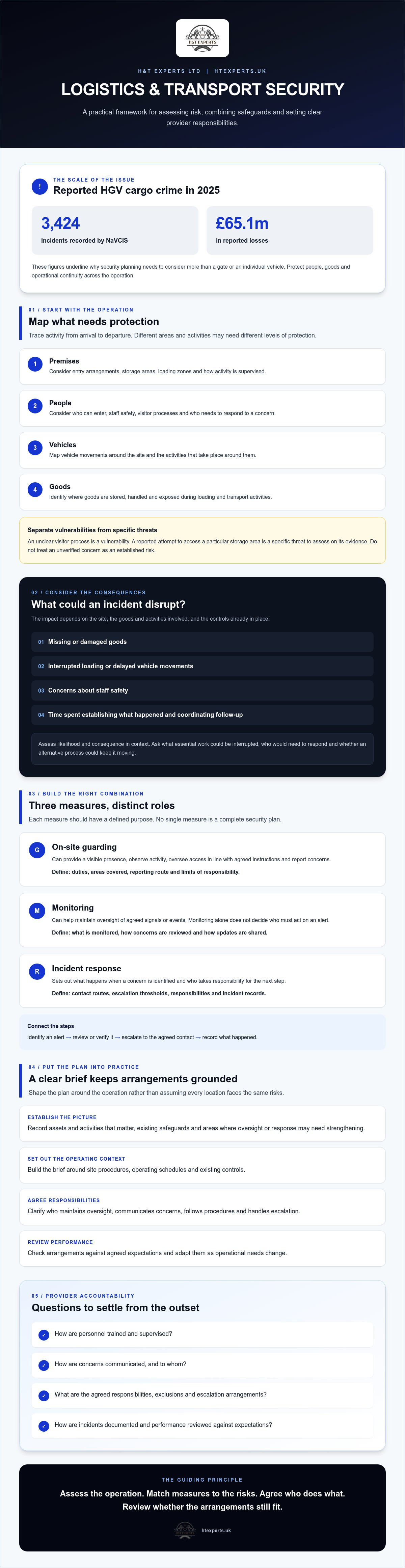
NaVCIS recorded 3,424 incidents of HGV cargo crime in 2025, with reported losses of £65.1 million. That figure underlines why logistics and transport security solutions need to protect more than a gate or an individual vehicle. A useful plan considers risks across premises, staff, vehicles and goods, and sets out what happens when a concern is reported.
If you’re responsible for a logistics or transport operation, unauthorised access, theft and disruption can affect staff safety and business continuity. Choosing the right balance of on-site guarding, monitoring and response takes careful thought. In particular, check how a provider will maintain oversight, communicate concerns and follow agreed procedures.
This guide explains how to assess transport-related risks, compare practical security measures and set expectations for provider accountability. You’ll learn how trained personnel, monitoring and defined response arrangements can work together, and what to check when evaluating a provider. The aim is to shape a plan around your operation, with responsibilities and communication agreed from the outset.
Key Takeaways
• Map threats across premises, people, vehicles and goods. Different operational areas may need different levels of protection.
• Assess logistics and transport security solutions by their purpose, coverage and escalation arrangements. Guarding, monitoring and response have distinct roles.
• Build a practical security brief around your assets, site procedures, operating schedules and existing controls.
• Ask providers how they train and supervise personnel, communicate concerns and document responsibilities, exclusions and incident escalation.
• Review performance against agreed expectations so your security arrangements remain accountable as operational needs change.
Logistics and transport security solutions: which risks should businesses assess?
Logistics and transport security solutions are coordinated measures to protect people, goods and operational continuity across premises and transport activities. Depending on the risks and existing controls, they may combine site procedures, security guarding, monitoring and incident response. They are distinct from freight forwarding and transport management, which organise the movement of goods, and from cybersecurity, which addresses digital systems and information.
Supply chain security covers a broad range of activities and potential vulnerabilities. For a useful foundation, see this Overview of supply chain security. For practical planning, focus on where your own operation is exposed rather than assuming every site faces the same risks.
Which assets and activities need protection?
Map the operation from arrival to departure. Consider who can enter, where goods are stored, how loading areas are supervised, and how staff and vehicles move around the premises. A warehouse with restricted entry, for example, has a different operating profile from a busy vehicle yard where loading and vehicle movements take place throughout the day.
Separate routine vulnerabilities from specific, documented threats. An unclear visitor process is a vulnerability; a reported attempt to access a particular storage area is a specific threat that should be assessed on its evidence. This distinction helps direct attention and resources without treating an unverified concern as an established risk.
How can security incidents affect operations?
An incident could lead to missing or damaged goods, interrupted loading, delayed vehicle movements or concerns about staff safety. Managers may also need to preserve information, establish what happened and coordinate follow-up, taking time away from routine duties. The impact depends on the site, the goods and activities involved, and the controls already in place.
Assess both likelihood and consequence in context. Ask what an incident could interrupt, who would need to respond and whether an alternative process could keep essential work moving. This links security planning to business continuity without assuming every location needs the same measures.
A clear assessment gives you a sound basis for choosing protection. Record the assets and activities that matter, note existing safeguards and identify where oversight or response arrangements may need strengthening. Then match those needs with suitable people, monitoring and response measures.
How logistics security solutions combine people, monitoring and response
These measures work best when each has a defined role. On-site guarding can provide a visible presence and direct observation. Monitoring can help maintain oversight of agreed signals or events. Response arrangements set out what happens when a concern is identified. The right combination depends on your risk assessment, site procedures and operating needs. No single measure should be treated as a complete security plan.
Transport operations have specific security considerations, including the movement and storage of goods and activity around vehicles. The Geography of Transport Systems discusses these in its overview of transport safety and security. For a business, the practical question is how people, monitoring and escalation can support its own controls.
What can on-site security guarding contribute?
A guard may provide a visible presence, observe activity, oversee access in line with agreed instructions and report concerns. Set out the duties for each site and assignment, including the areas covered, reporting route and limits of responsibility. Guarding can support operational controls, but it can’t guarantee incidents won’t occur or replace sound site procedures. For more on the role and selection of guarding, see this professional security guarding guide.
How do monitoring and response arrangements connect?
Monitoring and response are related, but distinct. A useful process identifies an alert, reviews or verifies it, escalates it to the agreed contact and records what happened. Continuous monitoring doesn’t, by itself, establish who decides an alert needs action or who is responsible for taking that action. Confirm these steps in advance, including contact routes, escalation thresholds and how updates are shared. The 24/7 security monitoring guide offers further context on monitoring arrangements.
Technology can support oversight by helping people identify activity that needs attention. It can’t automatically interpret every situation or make operational decisions. Trained human judgement matters when information is unclear, an alert needs context or the response depends on site procedures. Ask how the provider’s people and technology work together, and how responsibility is maintained from the initial alert through to communication and follow-up.
H&T Experts offers security guarding, 24/7 security monitoring and emergency security response. Assess these measures against your own risks, then confirm the scope, oversight and responsibilities you require. To review the provider’s security services, visit H&T Experts’ security services.
How to compare logistics and transport security solutions fairly
Compare measures against the same operational requirements, not just their names. A guard, a monitoring service and an emergency response arrangement have different functions. None is automatically sufficient for every site. Consider combining measures only where the risk assessment identifies complementary needs.
| Measure | Purpose and potential coverage | Oversight and escalation | What it cannot do alone |
|---|---|---|---|
| Security guarding | Provides an on-site presence for agreed areas and duties, such as observing activity or overseeing access. | Check who supervises the assignment, how observations are reported and who receives them. | Doesn’t guarantee incidents will be prevented or replace site procedures and operational controls. |
| Security monitoring | Supports oversight of agreed information or alerts, subject to the service scope. | Confirm how alerts are reviewed, communicated and escalated, and to whom. | Doesn’t, by itself, determine what action is appropriate or ensure someone on site will act. |
| Emergency security response | Provides a response arrangement for incidents within the agreed scope. | Clarify activation, contact routes, responsibilities and updates during an incident. | Doesn’t replace prevention, routine site controls or a clearly defined escalation process. |
When should a business consider guarding, monitoring or both?
Start with operating hours, site access patterns and documented risks. A location with regular staff presence and controlled entry may have different oversight needs from an area with periods of limited on-site activity. Consider combined measures if they address distinct gaps, such as the need for both a visible presence and an agreed process for reviewing alerts. There’s no suitable package without understanding the specific site and its controls.
What should buyers check before appointing a provider?
Ask for evidence and clear answers rather than assuming a provider has transport-sector expertise. Check the proposed team’s relevant training, how supervision works, what reports you’ll receive and how concerns are escalated. Confirm applicable SIA licensing requirements for the specific guarding role, and agree contractual responsibilities before work begins.
Request a written scope that sets out duties, coverage, exclusions, reporting routes and escalation arrangements. Agree how performance will be reviewed, what will be reported and how issues will be followed up. The Chartered Institute of Logistics and Transport (CILT) is a useful professional reference for logistics and transport context, but check provider claims and capabilities directly.
H&T Experts offers security guarding, 24/7 security monitoring and emergency security response. Assess each service against your requirements rather than assuming specialist transport experience. You can review H&T Experts’ security services as part of your provider comparison.
How to plan and implement security for transport operations
A clear implementation process turns your risk assessment into practical instructions, agreed responsibilities and a way to review delivery. Use these steps to develop a security plan that reflects how the operation actually runs.
Define what needs protection.
Record key people, goods, premises, vehicle areas and activities. Distinguish confirmed incidents or vulnerabilities from concerns that still need assessment.
Document how the site operates.
Note operating schedules, access points, loading activity, staff movements and existing controls. Include relevant site procedures so proposed security arrangements support routine work.
Identify gaps and requirements.
Compare current controls with the risks identified. Decide what oversight, guarding or response arrangements may be appropriate, without assuming one measure suits every location.
Agree responsibilities and communication.
Set out who receives reports, who assesses an alert, how concerns are escalated and who makes operational decisions. Record contact routes and the information required in incident updates.
Review performance and revise the plan.
Set review points for service delivery, incident reporting and changes to site procedures or operating patterns. Use documented findings to update the brief when risks or controls change.
What information belongs in a security brief?
Give a prospective provider a practical account of the site, including operating hours, access points, activities, existing controls and required coverage. Add relevant incident procedures, key contacts, reporting expectations and escalation routes. Be precise about what is known and what still needs investigation. This helps prevent assumptions from becoming contractual expectations and gives both parties a sound basis for agreeing the service scope.
For response planning, clarify how the arrangement is activated, what information needs to be shared and who is responsible for follow-up. The emergency security response guide provides further context when setting these expectations.
How should businesses review security performance?
Agree how often the service and its reporting will be reviewed, and identify which records or updates will inform those discussions. Check whether agreed duties are being delivered, whether incident information reaches the right people and whether escalation procedures remain suitable. Don’t treat unverified response times or targets as guaranteed outcomes. Define any performance measures in writing, including how they will be assessed and what happens if concerns arise.
Keep the brief current as operating schedules, site procedures or identified risks change. For help assessing security guarding, monitoring or emergency response against your requirements, review H&T Experts’ security services.
Choosing a logistics and transport security provider with confidence
A credible provider should explain how its proposed service relates to your assessed risks, who is responsible for delivery and how concerns will be communicated. Don’t assume general security experience automatically means specialist transport-sector expertise. Ask for evidence relevant to the assignment, and make sure the agreed scope is clear before work begins.
What evidence should a security provider explain clearly?
Ask how personnel are trained and briefed for the proposed duties, who supervises them and how changes to instructions are shared. Find out how incidents, concerns and service issues are recorded, who receives reports and what escalation route applies. Before appointment, verify relevant licences, insurance and other credentials for the service and role. For guarding, check applicable SIA licensing requirements rather than assuming they are the same for every assignment.
Useful questions include:
• What experience can you demonstrate that is relevant to this assignment?
• How will staff be briefed on site procedures and their responsibilities?
• Who is the named point of contact for routine updates and urgent concerns?
• What information will reports contain, and how will service issues be followed up?
How can a provider support an accountable working relationship?
Agree named responsibilities and contact routes before mobilisation. The written scope should state duties, coverage, exclusions, reporting expectations and how concerns will be escalated. Set review arrangements too: who attends, which records are considered and how agreed actions are tracked. This creates a practical audit trail and reduces the risk of different expectations about what the service includes.
Operations change. Agree how updates to schedules, site procedures or identified risks will be raised, assessed and reflected in the service scope. Confirm who can authorise changes and how the provider will communicate any resulting adjustments. Clear ownership matters as much as a clear initial brief.
H&T Experts provides security guarding, 24/7 security monitoring and emergency security response across the UK. Its company information describes trained professionals and over 25 years of operational experience. Consider these points alongside your requirements, while confirming the proposed duties, oversight and relevant experience for your operation. Don’t infer transport-specific credentials that haven’t been verified.
With expectations documented and responsibilities agreed, you can assess whether a provider is equipped to support your logistics and transport security solutions. To discuss your security requirements, contact H&T Experts.
Build a security plan with clear accountability
Effective logistics and transport security solutions start with the risks specific to your operation. Match measures to the people, goods, premises and activities that need protection, then define who is responsible for oversight, reporting and escalation. A written scope and regular reviews help keep expectations clear as operations change.
Guarding, monitoring and response serve different purposes, so assess each against your requirements rather than relying on a single measure by default. When comparing providers, look for trained personnel, clear communication and transparent responsibilities.
H&T Experts provides professional security guarding, 24/7 monitoring and emergency security response, delivered by trained professionals using technology-integrated services. Its company information also describes over 25 years of operational experience. Consider these points alongside the scope and experience relevant to your needs.
Take the next step with a clear understanding of your priorities. Discuss your security requirements with H&T Experts and work towards a practical, accountable plan for your operation.
Frequently Asked Questions
What are logistics and transport security solutions?
Logistics and transport security solutions are coordinated measures to protect people, goods and operations across premises and transport activities. They may include security guarding, monitoring, emergency response and site procedures, selected to address risks identified for a particular operation. They’re separate from freight forwarding or transport management, which organise the movement of goods, and from cybersecurity, which focuses on digital systems and information.
What security risks should logistics businesses assess?
Assess risks across site access, goods storage, loading areas, staff safety and vehicle movements. Consider how visitors are managed, where goods are held and how activity is overseen during different operating periods. Record known incidents and documented threats separately from general vulnerabilities, such as unclear access procedures. The risk profile depends on the site, operating model and existing controls, so don’t assume every depot faces the same exposure.
Can CCTV monitoring replace on-site security guarding?
No. CCTV monitoring may help provide oversight of agreed areas or activity, but it doesn’t automatically provide an on-site presence, interpret every situation or carry out site duties. Security guarding may contribute direct observation, access oversight and reporting, subject to the agreed assignment. Assess the purpose and limitations of each measure. If you consider both, define responsibilities, alert handling and communication arrangements.
How do security monitoring and emergency response work together?
Monitoring can identify or review an alert, while an emergency response arrangement sets out what happens when an incident requires action. Agree the stages in advance: how alerts are checked, who is contacted, who decides whether to escalate and how updates are shared. Confirm activation routes and responsibilities in writing. Monitoring alone doesn’t establish who should act, and response arrangements need clear information and contact details to work effectively.
What should I ask a logistics security provider before appointing them?
Ask what relevant experience they can demonstrate, how personnel are trained and supervised, and how staff are briefed on your site procedures. Clarify what reports you’ll receive, how incidents and service issues are recorded, and who handles escalation. Request a written scope covering duties, coverage, exclusions and responsibilities. For guarding roles, check applicable SIA licensing requirements, and verify relevant insurance and credentials before appointment.
How can a business decide which transport security measures it needs?
Begin with a site-specific assessment of the assets, activities and operating patterns that need protection. Review existing controls, documented incidents, access arrangements and periods when oversight may differ. Then compare potential measures by purpose, coverage, supervision and escalation. Don’t choose a standard package before confirming the risks. A written brief helps providers assess the requirement and makes it easier to compare proposed services against the same needs.
Does every logistics site need 24/7 security monitoring?
No. Appropriate monitoring coverage depends on the site’s risk assessment, operating schedule, access patterns and existing controls. Consider what activity needs oversight outside normal operations, what an alert should trigger and who would receive it. Then confirm whether the proposed service scope addresses those needs. Continuous monitoring shouldn’t be assumed necessary for every location or treated as a substitute for clear escalation and response arrangements.
Other Services




Ready to Experience Unparalleled Security Solutions?
H&T Experts Ltd is here to ensure your peace of mind. Connect with us today and take the first step towards a safer tomorrow.