

Security Services Contract: A Professional Framework for UK Asset Protection
A security services contract that merely guarantees a physical presence is not a protective strategy; it's a significant operational liability. In an era where the UK private security market is valued at nearly £9 billion, simply 'having guards' is no longer enough to satisfy insurers or regulators. You likely feel the constant pressure to balance rising costs against the need for uncompromising safety. It's frustrating when performance remains opaque and the fear of SIA non-compliance lingers in the background of your operations.
This article provides the professional framework you need to master the essential components of a robust security services contract. By the end of this guide, you'll understand how to ensure accountability, maintain strict legal compliance, and achieve operational excellence without falling victim to hidden costs in rolling agreements. We'll examine the critical clauses that define high-calibre protection, from precise liability management to the integration of advanced surveillance technology. You'll gain the clarity required to hold providers to the highest standards, ensuring your organisation's assets remain truly secure under a disciplined and transparent partnership.
Key Takeaways
• Distinguish between a basic guarding agreement and a sophisticated asset protection framework to ensure your provider delivers measurable value.
• Identify the mandatory personnel standards and vetting requirements that must be enshrined within your security services contract to guarantee SIA compliance.
• Weigh the benefits of fixed-term stability against rolling contract flexibility to determine which model best serves your organisation's financial and operational needs.
• Master the technicalities of risk mitigation by verifying efficacy clauses and ensuring liability insurance limits meet the standard £10 million threshold.
• Learn how integrating 24/7 monitoring with manned guarding creates a synergistic approach to safety that eliminates transparency gaps.
Understanding the Security Services Contract in the UK
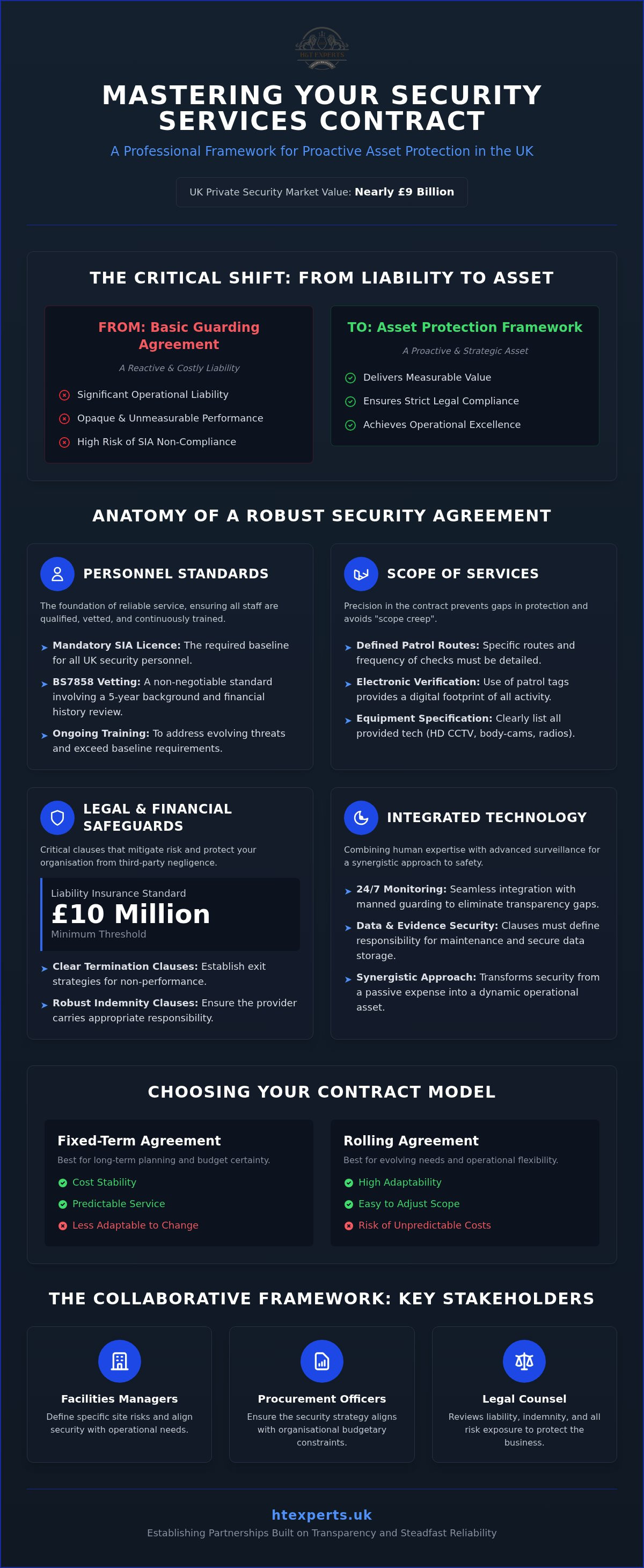
A professional security services contract is far more than a procurement formality; it's a legally binding Service Level Agreement (SLA) that defines the perimeter of your organisation's safety. Many businesses mistakenly settle for a basic "guarding agreement" that merely places a body at a gate. This is a reactive approach. A true asset protection framework is proactive, integrating human expertise with rigorous oversight to safeguard property, personnel, and reputation. It transforms security from a passive expense into a dynamic operational asset.
In the UK, mitigating corporate liability requires documented evidence of due diligence. A robust security services contract establishes clear lines of command and defines emergency protocols long before a crisis occurs. It ensures that when an incident happens, the response is immediate, disciplined, and follows a pre-approved hierarchy of actions. This level of preparation is essential for maintaining the integrity of your site whilst protecting the organisation from the fallout of operational failures.
The Strategic Importance of Contractual Clarity
Clarity is the primary defence against "scope creep," where undefined duties gradually inflate costs and dilute service quality. A precise document ensures you receive exactly what you pay for, with no room for ambiguity. Beyond operational efficiency, a well-defined contract can lead to measurable insurance premium reductions. Underwriters recognise the reduced risk profile of a site governed by a comprehensive agreement. Relying on verbal agreements or informal handshakes in commercial security is a high-risk strategy that leaves your organisation vulnerable to significant legal and financial exposure.
Key Stakeholders in the Contracting Process
The Security Industry Authority (SIA) licence serves as the mandatory baseline for all personnel, but a professional contract must go further. Facilities managers and procurement officers must collaborate to ensure the document reflects the specific risks of the site, rather than relying on generic templates. This partnership ensures that operational needs align with budgetary constraints. Additionally, legal counsel is vital for reviewing liability and indemnity clauses. They ensure the provider carries the appropriate weight of responsibility for their delivery, protecting your business from the consequences of third-party negligence. At H&T Experts, we believe this collaborative approach is the only way to establish a partnership built on transparency and steadfast reliability.
Essential Components of a Robust Security Agreement
A comprehensive security services contract must move beyond vague generalities to provide a granular blueprint of operational expectations. Without specific detail, accountability becomes impossible to enforce. Every robust agreement should clearly define the equipment provided, such as high-definition CCTV, body-worn cameras, and encrypted radio systems. It must also specify who retains responsibility for maintenance and data storage, ensuring that evidence remains admissible and secure. Termination clauses are equally vital; they protect your organisation by establishing clear exit strategies for non-performance. This ensures you aren't trapped in a failing partnership whilst your assets remain at risk.
Personnel standards are the foundation of any reliable service. Your contract should mandate that all staff hold a valid SIA licence and have undergone rigorous BS7858 vetting. This British Standard is non-negotiable for professional firms, involving a five-year background check and financial history review. At H&T Experts, we ensure our team exceeds these baselines through ongoing training that addresses evolving threats. If you require a partner that prioritises these rigorous standards, consider how H&T Experts can secure your premises through disciplined management.
Defining the Scope of Guarding and Response
Precision in the scope of services prevents gaps in protection. Your agreement should detail specific patrol routes and the frequency of checks, often verified through electronic patrol tags that provide a digital footprint of activity. Linking professional security guarding to your site’s unique vulnerabilities ensures that resources are deployed where they are needed most. The contract must also explicitly outline emergency security response protocols. These instructions dictate how guards should behave during fire alarms, medical emergencies, or security breaches, leaving no room for hesitation or error during a crisis.
Accountability through KPIs and Reporting
Transparency is maintained through measurable Key Performance Indicators (KPIs). These should include strict response times for alarm activations and deadlines for incident reporting. A professional provider will supply daily occurrence logs and weekly management summaries to keep you informed of all site activity. Modern contracts now leverage technology to provide real-time oversight, allowing clients to verify guarding activity through cloud-based reporting systems. This data-driven approach ensures that operational excellence is not just a promise, but a documented reality that justifies your investment. By establishing these metrics early, you create a culture of high performance and constant readiness.
Evaluating Contract Types: Fixed-Term vs. Rolling Agreements
Selecting the appropriate structure for a security services contract is a critical decision for any procurement officer or facilities manager. Fixed-term agreements provide the bedrock of financial predictability, allowing organisations to lock in rates and secure long-term commitment from a provider. Conversely, rolling agreements offer the agility needed for rapidly changing environments, though they demand more vigilant performance oversight. For short-term projects or immediate crises, ad-hoc or emergency contracts provide rapid deployment without the constraints of a multi-year commitment. Each model has its merits, but the choice must align with your organisation's risk tolerance and budgetary cycle.
Fixed-Term Contracts and Long-Term Stability
Multi-year agreements are often the most cost-effective way to manage security guarding requirements. By committing to a longer duration, organisations can often negotiate lower hourly rates as the provider can amortise recruitment and training costs over a greater period. However, these contracts must not be static. It's essential to include price review clauses that account for legislative changes. For instance, as of 1 April 2026, the National Living Wage rose to £12.71 per hour for individuals aged 21 and over. Without a mechanism to adjust for these statutory increases, the quality of personnel may decline as the provider's margins are squeezed. Always ensure a "break clause" is present, typically at the 12 or 24-month mark, to maintain leverage and ensure the provider remains focused on operational excellence.
The Complexity of TUPE in Security Tendering
Transitioning between providers introduces the legal complexities of the Transfer of Undertakings (Protection of Employment) regulations, commonly known as TUPE. When a contract changes hands, the incoming provider is generally obligated to take on the existing security staff under their current terms and conditions. This process requires meticulous management to avoid legal disputes and ensure a seamless handover. A well-structured security services contract must account for these staff transfers to prevent operational disruption. Choosing a professional security service provider with a dedicated HR and legal team is the most effective way to mitigate these risks.
Whilst TUPE presents administrative challenges, it offers a significant advantage: staff continuity. Guards with years of site-specific knowledge often possess invaluable insights into a building's vulnerabilities and emergency protocols. Retaining this expertise, whilst integrating the fresh leadership and advanced technology of a partner like H&T Experts, ensures that security integrity is never compromised during the transition. A disciplined approach to TUPE ensures that your organisation remains compliant whilst maintaining a steadfast, vigilant presence on-site.
Risk Mitigation: Compliance, Insurance, and Indemnity
Risk mitigation is the cornerstone of any professional partnership. Whilst many organisations focus on the hourly rate, the true value of a security services contract lies in its ability to shield your business from catastrophic financial loss. A well-drafted agreement doesn't just describe a service; it acts as a formal risk transfer mechanism. It ensures that if a breach occurs, the financial and legal burden rests with the provider rather than your organisation. This protection is only possible when the contract includes specific, non-negotiable clauses regarding insurance and indemnity structures.
Insurance Requirements for Commercial Security
General business insurance is fundamentally insufficient for the unique risks of the security industry. A professional provider must hold Public and Employers Liability Insurance with limits that reflect modern litigation costs. In the UK, a £10 million limit is the recognised industry standard. Your security services contract must explicitly require an "Efficacy Clause." This specialised cover ensures the provider is protected specifically for the failure to prevent a loss. Without it, an insurer might refuse a claim if a guard fails to detect an intruder or a fire. You should also verify that "wrongful arrest" and "professional indemnity" are included in the policy. We recommend conducting annual insurance certificate reviews to ensure that cover remains continuous and hasn't lapsed or been reduced.
Operational Compliance and Health & Safety
Legal safety is as important as physical safety. Every security services contract must mandate strict adherence to the Health and Safety at Work Act 1974. The provider must integrate their own Method Statements and Risk Assessments (RAMS) into your site’s existing safety framework. This synergy ensures that security personnel operate without creating new hazards for your staff or visitors. It's vital that site-specific Assignment Instructions (AIs) aren't left to gather dust. These documents should be reviewed quarterly to reflect changing site layouts or emerging threats.
Accountability is maintained through rigorous testing. You should ensure the provider conducts regular, documented penetration tests to verify that personnel are following the agreed protocols. This proactive approach identifies weaknesses before they can be exploited by real-world threats. If you're concerned about the robustness of your current arrangements, you can contact H&T Experts for a professional assessment of your security framework. Our commitment to operational excellence ensures that your compliance isn't just a tick-box exercise, but a steadfast shield for your assets.
Partnering with H&T Experts for Contractual Excellence
H&T Experts Ltd brings over 25 years of operational experience to the table when drafting your security services contract. We don't believe in generic templates that leave your organisation exposed to ambiguity or hidden liabilities. Instead, we prioritise absolute transparency through clear, performance-based SLAs that define success in measurable terms. Our management-heavy approach ensures that the rigorous standards promised in the boardroom are actually delivered on the ground. By managing our own staff rather than sub-contracting, we maintain total control over training, leadership, and professional discipline.
One of our unique advantages is the ability to provide integrated facility management. By combining our core guarding capabilities with specialist cleaning services UK, we offer a streamlined point of contact that improves site efficiency. This synergy reduces the administrative burden on your procurement team whilst ensuring that every aspect of your site’s maintenance and safety is handled with the same level of professional pride. We operate with a "no hidden costs" policy, ensuring that your budget remains stable and your protection remains uncompromising.
A Tailored Approach to UK Asset Protection
Every site possesses a unique risk profile that demands a bespoke response. We move beyond "one size fits all" solutions to create site-specific security protocols that address your particular vulnerabilities. This includes a strategic balance between human expertise and advanced surveillance technology. We help you navigate the security guard vs CCTV only debate by designing a hybrid model that maximises coverage whilst respecting your budgetary constraints. The H&T Experts guarantee is simple: we provide a steadfast, serious, and prepared response to any potential threat, ensuring your peace of mind through constant readiness.
Next Steps: Requesting a Professional Consultation
Moving to a new security services contract shouldn't be a source of operational anxiety. We conduct a complimentary site security audit to identify gaps in your current protection before we ever propose a contract. This audit allows us to understand your specific needs and demonstrate how our integrated approach can enhance your safety. Our transition process is designed to be seamless and risk-free, handling all TUPE requirements and staff inductions with professional precision. Contact our team today to request a transparent, comprehensive quote that reflects the true value of high-calibre protection and operational excellence.
Securing Your Assets through Contractual Rigour
A robust security services contract is the foundation of any resilient asset protection strategy. It transforms a simple guarding presence into a disciplined, transparent, and legally compliant operation. By prioritising precise KPIs and comprehensive insurance clauses, you ensure that accountability is never left to chance. Effective agreements mitigate liability whilst providing the flexibility needed to adapt to evolving UK regulations and site-specific requirements.
H&T Experts brings over 25 years of operational experience to every partnership. Our team of SIA licensed professionals operates with national UK coverage, ensuring that your protocols are delivered with unwavering reliability. We don't just provide a service; we act as a vigilant guardian for your organisation's peace of mind, balancing high-stakes responsibility with a composed, business-like delivery.
Secure your assets with a professional security services contract from H&T Experts today. Our experts are ready to conduct a thorough audit and draft an agreement that prioritises your safety above all else. Take the first step toward operational excellence and long-term stability.
Frequently Asked Questions
What is the standard length for a security services contract in the UK?
Most security services contract structures in the UK are fixed-term agreements lasting between 12 and 36 months. This duration provides the stability necessary for the provider to invest in site-specific training and recruitment. Whilst longer terms often secure more competitive hourly rates, they should always include a break clause at the 12-month mark. This ensures you maintain operational leverage if service standards fail to meet the agreed KPIs.
Does a security services contract include the cost of CCTV equipment?
A standard agreement typically focuses on personnel and monitoring rather than equipment retail. Whilst some providers offer a managed service where CCTV hardware is leased as part of the monthly fee, most organisations purchase equipment separately to maintain ownership. It's essential to define in the agreement who is responsible for the maintenance and data compliance of any surveillance technology used on-site to avoid operational gaps.
What happens if a security guard fails to turn up for a shift under the contract?
If a guard fails to report for a shift, the provider is contractually obligated to deploy a relief officer within a specified timeframe, usually 60 to 90 minutes. Your agreement should include Liquidated Damages clauses that penalise the provider for uncovered hours or late arrivals. Professional firms use real-time check-in technology to identify no-shows immediately, ensuring that your site’s protection is never compromised by individual absence or negligence.
How does TUPE affect my ability to change security companies?
The Transfer of Undertakings (Protection of Employment) regulations mean that existing security staff generally transfer to the new provider on their current terms. This protects workers' rights but requires the incoming company to conduct thorough due diligence on pay rates and pension liabilities. It ensures site-specific knowledge is retained whilst allowing you to introduce the superior management and technology-integrated solutions offered by a more capable professional partner.
Are all security companies in the UK required to be SIA approved?
Every individual security guard must hold a valid SIA licence, which costs £204 as of April 2026. Whilst the SIA’s Approved Contractor Scheme (ACS) is technically voluntary for businesses, it is considered the industry benchmark for quality and compliance. You should only partner with ACS-accredited firms to ensure they meet rigorous standards for staff vetting and operational management. This accreditation is a vital indicator of a provider's professional integrity.
Can I include specialist cleaning requirements in my security contract?
Yes, you can integrate specialist cleaning requirements into a comprehensive framework if your provider possesses the necessary expertise. H&T Experts specialises in both disciplines, allowing you to streamline facility management under a single point of accountability. This integrated approach improves communication and ensures that cleaning staff and security personnel work in synergy to maintain a safe, professional, and well-managed environment for your organisation and its visitors.
How often should a security services contract be reviewed for compliance?
You should review your security services contract at least once a year or whenever significant legislative changes occur. For example, the National Living Wage increase to £12.71 in April 2026 necessitated immediate adjustments to many agreements. Regular reviews ensure that your insurance cover, such as Public Liability limits, remains adequate and that the service scope continues to align with your site’s evolving risk profile and operational needs.
What are the most common hidden costs in a security agreement?
Hidden costs often arise from undisclosed charges for uniform, specialist equipment, or mandatory training like first aid. Some providers may also attempt to pass on the costs of SIA licence renewals or TUPE administrative fees during a contract handover. A transparent agreement should clearly state that the hourly rate is inclusive of all overheads. This ensures there are no surprises in your monthly invoicing and maintains a partnership built on trust.





Ready to Experience Unparalleled Security Solutions?
H&T Experts Ltd is here to ensure your peace of mind. Connect with us today and take the first step towards a safer tomorrow.