

Preventing Internal Theft in Warehouses: A Professional Guide to UK Asset Protection
What if your most significant security risk isn't the intruder at the perimeter, but the person holding the keys? For many UK warehouse managers, the challenge of preventing internal theft in warehouses is complicated by the need to maintain a positive, productive atmosphere. You've likely experienced the frustration of unexplained stock discrepancies and the nagging suspicion of insider collusion within large-scale facilities. It's a high-stakes responsibility that requires a steady, professional hand to manage without compromising staff morale.
This guide provides a multi-layered strategy to secure your operations against internal threats whilst maintaining a disciplined workplace culture. We'll outline how to establish a clear protocol for incident response and implement robust oversight that acts as a permanent deterrent. You'll discover how the synergy between SIA-licensed personnel and 24/7 monitoring creates a secure environment where accountability is the standard. We'll move from identifying common vulnerabilities to explaining the practical application of advanced asset protection, ensuring your warehouse remains a safe and profitable centre of excellence.
Key Takeaways
• Identify the specific financial risks posed by opportunistic, systematic, and collusive threats to target your asset protection strategies more effectively.
• Discover how to deploy advanced surveillance and AI analytics to eliminate blind spots in high-value areas and monitor suspicious movement patterns in real-time.
• Implement the 'Double-Check' principle and blind inventory counts as essential operational workflows for preventing internal theft in warehouses.
• Establish a secure whistleblowing programme and understand the legal parameters for staff searches to ensure a robust and compliant internal investigation process.
• Learn the strategic advantages of integrating professional security guarding and 24/7 monitoring to create a permanent deterrent against insider collusion.
The Landscape of Internal Warehouse Theft in the UK
The UK supply chain faces a persistent challenge that erodes profitability from within. Internal theft isn't always a dramatic heist; it's often a quiet, incremental loss that accumulates over months. Relying on standard monthly inventory counts is no longer sufficient for preventing internal theft in warehouses. These traditional methods are often too slow to detect sophisticated patterns or are easily circumvented by staff who understand the specific gaps in your operational schedule.
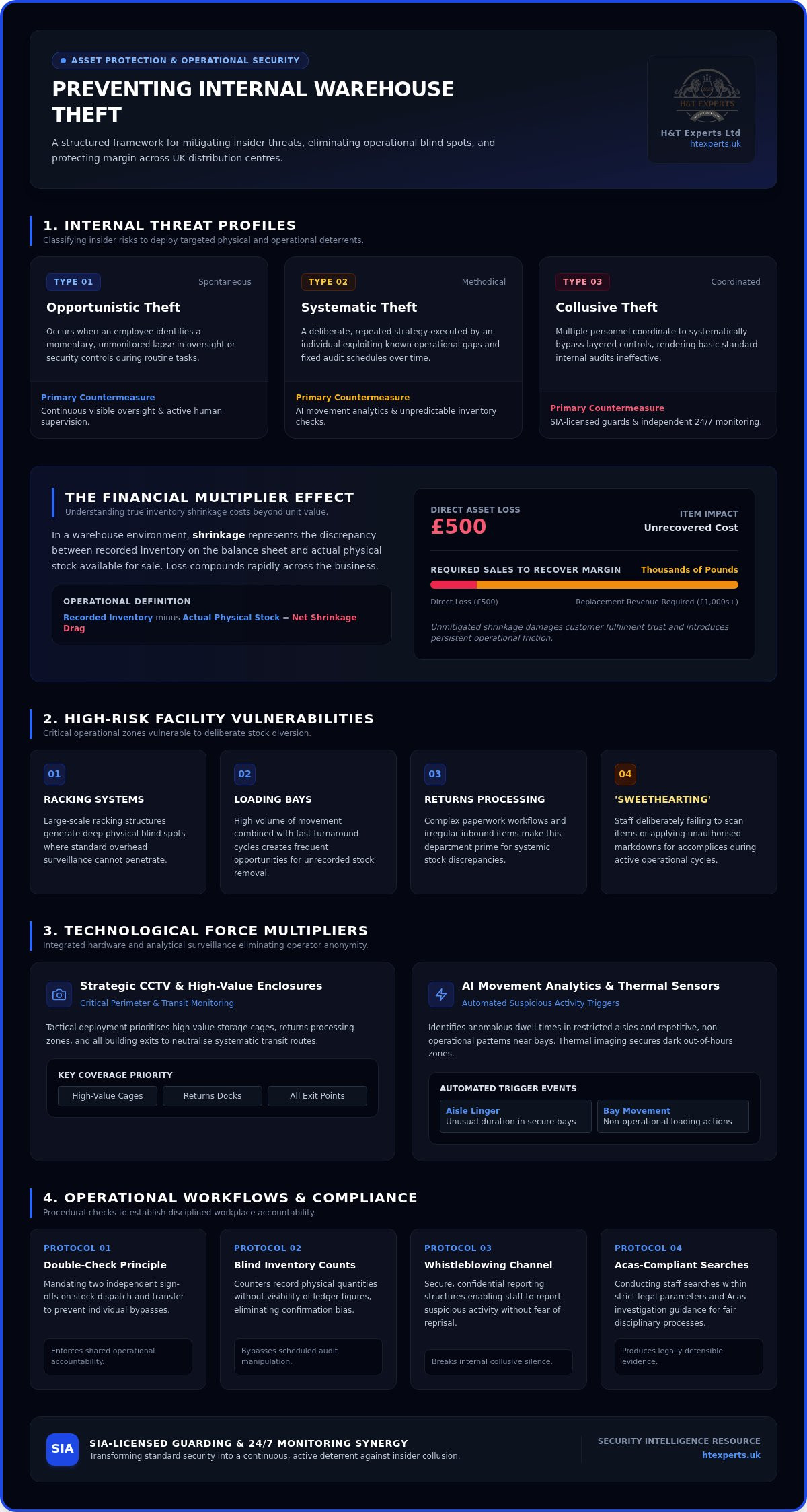
To manage risk effectively, you must understand the three primary profiles of internal threats. Opportunistic theft occurs when a staff member sees a momentary gap in oversight. Systematic theft involves a deliberate, repeated strategy by an individual to remove stock. The most damaging, however, is collusive theft, where multiple employees coordinate to bypass layered physical security controls. This level of insider cooperation can render basic internal audits useless, as those responsible for the checks may be the ones facilitating the loss.
How does visible oversight change behaviour? It creates a psychological deterrent that shifts the workplace culture. When employees know that professional guarding and 24/7 monitoring are active, the perceived risk of detection increases. It moves the environment from one of laxity to one of rigorous accountability, where the temptation to act is outweighed by the certainty of being caught.
Common Vulnerabilities in Modern Distribution Centres
Large-scale racking systems often create deep blind spots that standard surveillance cannot cover. High-risk zones like the loading bay and returns processing are particularly susceptible because of the high volume of movement and the complexity of the paperwork. One specific concern is 'sweethearting', where staff purposely fail to scan items or apply unauthorised markdowns for accomplices. Without active human oversight and SIA-licensed personnel, these subtle actions frequently go unnoticed during the busy shift cycle.
The True Cost of Employee Theft
The impact of lost stock extends far beyond the cost of the item itself. You must consider the 'multiplier effect', where the loss of a £500 item requires thousands of pounds in new sales just to recover the lost margin. This creates a significant drag on operational efficiency and can ultimately damage customer trust if orders cannot be fulfilled due to stock errors. In a warehouse context, shrinkage is defined as the difference between the recorded inventory on the balance sheet and the actual physical stock available for sale.
Deploying Advanced Technological Deterrents
Technology serves as a force multiplier for your security personnel. It transforms a passive observation role into an active, preventative operation. When your objective is preventing internal theft in warehouses, your hardware must be deployed with tactical precision. It isn't enough to simply record; you must monitor. Strategic CCTV placement is critical. You should prioritise coverage of high-value cages, returns processing areas, and every exit point. These are the zones where systematic theft is most likely to occur. Integrating these deterrents is the most effective way of preventing internal theft in warehouses, as it removes the anonymity that dishonest staff rely on.
Modern AI analytics now identify suspicious movement patterns that might escape a tired human eye. For instance, if an individual spends an unusual amount of time in a restricted aisle or makes repetitive, non-operational movements near a loading bay, the system triggers an alert. This synergy between software and human response ensures that potential issues are addressed before stock leaves the building. If an incident does occur, high-definition footage is vital for following Acas guidance on workplace investigations, as clear evidence is the foundation of any fair disciplinary process.
Smart Surveillance and Real-Time Alerts
Effective asset protection requires constant readiness. Thermal imaging and motion sensors provide essential out-of-hours protection, alerting remote teams to unauthorised activity in pitch-black environments. By utilising remote CCTV monitoring, you reduce the reliance on excessive on-site hardware while maintaining a higher level of oversight. This approach ensures that every square metre of your distribution centre is under professional scrutiny. It's a stable, scalable solution that offers immediate peace of mind for site managers.
Access Control and Biometric Solutions
Physical keys are an operational liability. They are easily lost, stolen, or duplicated. Replacing them with digital fobs or biometric scanners creates a rigorous audit trail for every door opening and rack access. You can restrict high-value areas to specific authorised personnel, ensuring that accountability is baked into your daily workflows. This data integrates seamlessly with 24/7 security monitoring UK, providing a comprehensive view of who is moving what, and when. If you're looking to upgrade your site's resilience, partnering with a specialist like H&T Experts Ltd can ensure your technology works in harmony with your guarding team.
Refining Operational Workflows to Eliminate Blind Spots
Operational logic is as vital as surveillance hardware. If your workflows are flawed, even the most advanced cameras only record your losses rather than stopping them. A primary strategy for preventing internal theft in warehouses involves the "Double-Check" principle. By segregating picking and packing duties, you ensure that no single employee has total control over an order from shelf to dispatch. This creates a natural layer of accountability where errors or deliberate discrepancies are caught by a second pair of eyes. It's a simple, methodical shift that removes the opportunity for independent action.
Blind inventory counts offer a more rigorous alternative to standard stocktakes. In a blind count, the staff member isn't told how many items should be on the shelf. This prevents "pencil-whipping," where staff simply tick boxes to match the expected numbers. It forces an honest physical count, making it much harder to hide systematic shrinkage over time. Managing damaged goods and returns requires similar discipline. These items are often treated with less care, creating an opportunity for "stashed" stock to be removed under the guise of waste. You must standardise these processes to ensure every item is tracked until it's either resold or destroyed.
Integrating Security into the Picking Process
Modern Warehouse Management Systems (WMS) should be configured to flag suspicious quantity adjustments. If a picker frequently reduces the count of high-value items, the system must trigger an immediate supervisor alert. Weight-checks at the packing station provide another layer of verification; any deviation from the expected weight of an order suggests a missing or additional item. To maintain site discipline, many UK facilities now mandate clear-bag policies for personal items. This simple rule reduces the chance of small, high-value goods being concealed whilst on the warehouse floor.
Loading Bay and Perimeter Integrity
The loading bay is the "last mile" of your internal process and often the most vulnerable. It's the point where internal collusion frequently manifests. Utilising professional security guarding for gatehouse and loading bay oversight ensures that every vehicle movement is logged and every seal is verified. It's also essential to partner with providers who adhere to the SIA Approved Contractor Scheme. This guarantees that the personnel protecting your perimeter are vetted to national standards. Regular perimeter checks are necessary to prevent "stashing," where items are hidden near fences or in external bins for later retrieval by accomplices. This constant readiness ensures your facility remains a secure centre of operations.
Developing a Robust Reporting and Investigation Framework
A clear, structured framework is the backbone of any strategy for preventing internal theft in warehouses. It provides managers with the confidence to act and employees with the certainty that rules are applied fairly. A vital component is the establishment of a confidential whistleblowing programme. Honest staff are often the first to notice irregularities, yet they may hesitate to report a colleague without a secure, anonymous channel. By providing this, you empower your team to protect the business interests without fear of social repercussion or retaliation.
When suspicion turns into an investigation, you must adhere strictly to UK employment law. Searching staff or their lockers is only permissible if you have a clearly defined policy within their contract of employment. Even then, searches must be conducted with professional discretion and ideally in the presence of a witness. Violating these protocols doesn't just damage morale; it can lead to costly tribunal claims that far outweigh the value of the stolen stock. Using a composed, business-like approach during these interactions maintains the discipline of the facility whilst protecting the rights of all personnel.
Data logs from your access control systems and Warehouse Management Systems (WMS) serve as your primary evidence. These digital fingerprints provide an objective account of who accessed specific zones or adjusted inventory levels at the precise time of the loss. When these logs are reviewed alongside high-definition surveillance, they create a compelling case that's difficult to dispute during disciplinary hearings. This methodical use of data ensures that decisions are based on facts rather than intuition.
Creating a Culture of Transparency
Security shouldn't be a hidden agenda. It must be communicated clearly during the staff induction process. When new hires understand that security protocols are there to protect the integrity of the whole team, it fosters a mindset of collective responsibility. Consistent enforcement is essential. If rules are only applied sporadically, they lose their deterrent value and breed resentment amongst the workforce. A stable, observant management presence ensures that these standards are upheld every day.
Incident Response and Crisis Management
Speed and composure are critical when a theft is discovered. Your first step's to secure the scene and preserve any physical or digital evidence. You must then decide whether to involve the police or handle the matter internally. Generally, large-scale systematic theft or evidence of outside criminal influence requires a formal police report. For immediate assistance in managing these high-pressure situations, you can rely on an emergency security response to stabilise your site and prevent further loss.
Establishing these frameworks is a cornerstone of preventing internal theft in warehouses, ensuring that every incident is met with a disciplined, pre-planned response. If you need to refine your site's reporting protocols or require a partner that takes its obligations seriously, contact H&T Experts Ltd for a professional consultation on comprehensive asset protection.
Partnering with Security Experts for End-to-End Prevention
Managing a large-scale distribution centre is a complex task where security often competes with productivity. Outsourcing your asset protection to a specialist ensures that security remains a dedicated, uncompromised priority. H&T Experts Ltd integrates over 25 years of operational experience into your site protocol, moving your facility from reactive monitoring to proactive loss prevention. This shift is essential for preventing internal theft in warehouses, as it establishes a permanent deterrent that discourages dishonest behaviour before it manifests. You gain a partner that takes its obligations seriously, operating with the integrity and transparency required in a high-stakes industry.
Operational excellence is often found in the details. There's a strategic synergy in combining security and cleaning services under a unified management structure. Cleaning staff frequently work in sensitive areas or during quiet shift periods; having these individuals vetted and managed alongside your security team closes potential gaps in oversight. It ensures that every person on your floor adheres to the same rigorous standards of accountability. This comprehensive approach simplifies your supply chain management whilst strengthening your site's overall resilience against internal threats.
The H&T Experts Methodology
The H&T Experts methodology begins with a comprehensive site risk assessment. We identify the specific theft triggers inherent in your layout, from blind spots in racking to vulnerabilities in the loading bay. Our personnel aren't generalists. We provide SIA-licensed guards trained specifically for the logistics sector. These professionals understand the nuances of warehouse operations and are prepared for any situation. By ensuring 24/7 accountability through managed technology solutions, we provide a constant, vigilant presence that protects your assets around the clock.
Long-Term Value and ROI of Professional Security
The financial justification for professional security's clear. Reduced shrinkage pays for the security contract fees over time, often resulting in a significant net gain for the business. Professional asset protection is the most reliable method for preventing internal theft in warehouses over the long term. Beyond the balance sheet, the peace of mind afforded to directors is invaluable. Knowing that an emergency security response is always ready provides a level of stability that internal teams often can't match. We invite you to request a professional consultation for your facility to discover how a multi-layered strategy can secure your future.
Securing Your Supply Chain Excellence
Effective asset protection is never a single action; it's a continuous commitment to operational discipline and sophisticated oversight. By integrating advanced technological deterrents with rigorous "double-check" workflows, you create an environment where accountability is the standard. These layered methods are the most reliable way of preventing internal theft in warehouses whilst maintaining a workplace culture rooted in integrity and transparency. When your facility operates with this level of precision, shrinkage stops being an inevitable cost of doing business and becomes a manageable risk.
H&T Experts Ltd brings over 25 years of operational experience to your site, providing SIA-licensed security professionals and 24/7 monitoring capabilities. Our rapid emergency security response ensures that your distribution centre remains protected under any circumstances. It's time to move beyond reactive measures and establish a permanent deterrent that safeguards your profitability. Secure your warehouse with H&T Experts’ professional security solutions to ensure your operations remain resilient and efficient. We are ready to help you build a safer, more transparent future for your logistics business.
Frequently Asked Questions
What are the first signs of internal theft in a warehouse?
The earliest indicators of internal theft include consistent stock discrepancies during cycle counts and an unusual amount of damaged goods in specific zones. You might also notice employees lingering in high-value areas without operational reasons or unexplained changes in staff behaviour. Frequent "system errors" that require manual inventory adjustments should also be investigated immediately. These subtle signs often precede larger, systematic losses if they aren't addressed with professional oversight.
Can I legally search employee bags in the UK?
Yes, you can legally search employee bags provided you have a clear written policy in their employment contract or staff handbook. Without this prior consent, a search could be considered a breach of privacy or even an assault. It's essential to conduct these searches fairly and consistently, ideally using SIA-licensed security personnel to ensure the process remains professional and legally compliant during any internal investigation or routine spot check.
How does CCTV monitoring help prevent theft by staff?
Professional CCTV monitoring acts as a powerful psychological deterrent by removing the anonymity required for dishonest acts. When integrated with 24/7 monitoring services, it allows for real-time detection of suspicious movement patterns, such as staff accessing restricted zones out of hours. High-definition footage also provides the objective evidence needed for disciplinary procedures, ensuring that preventing internal theft in warehouses is based on verifiable facts rather than suspicion.
What is the role of a security guard in preventing internal shrinkage?
An SIA-licensed security guard provides a vigilant, physical presence that deters opportunistic theft and insider collusion. Their role includes conducting regular perimeter checks, monitoring loading bay activity, and verifying vehicle seals during dispatch. By maintaining a disciplined atmosphere and enforcing site protocols, they ensure that every movement of stock is accounted for, providing a level of hands-on management that technology alone simply cannot achieve in a busy environment.
How can a Warehouse Management System (WMS) help catch thieves?
A Warehouse Management System (WMS) identifies internal theft by tracking every inventory adjustment to a specific user ID and timestamp. It can flag unusual patterns, such as a high volume of "lost" items or frequent quantity reductions at the picking stage. By reviewing these digital logs alongside surveillance footage, you can pinpoint exactly when and where discrepancies occurred, making it an essential tool for preventing internal theft in warehouses.
Should I use covert cameras to catch internal theft?
Covert cameras should only be used as a last resort and must comply with strict UK data protection laws, including the GDPR. Their use is generally only justifiable if you've a strong suspicion of serious criminal activity and overt cameras would undermine the investigation. You must conduct a formal impact assessment before deployment. In most cases, visible, professional monitoring is a more effective long-term deterrent for maintaining site standards.
How do I deal with collusion between staff members?
Dealing with collusion requires segregating duties so that no single group has total control over a workflow. For example, ensuring that pickers and packers are rotated frequently prevents the formation of dishonest partnerships. Implementing random spot checks by independent security personnel also breaks the sense of security that colluding staff might feel. A culture of collective responsibility, supported by a confidential whistleblowing programme, is vital for exposing these internal threats.
What happens during an emergency security response alert?
When an emergency security response alert's triggered, a highly-trained team is dispatched immediately to your facility to secure the premises. They assess the situation, preserve evidence, and stabilise the site to prevent further loss or unauthorised access. This rapid intervention is critical during high-stakes incidents, providing the composed leadership needed to manage the crisis whilst ensuring the safety of all personnel and the security of your high-value assets.




Ready to Experience Unparalleled Security Solutions?
H&T Experts Ltd is here to ensure your peace of mind. Connect with us today and take the first step towards a safer tomorrow.