

Construction Site Security Guide for Site Managers
What if the greatest threat to your project's completion date isn't the British weather or a fractured supply chain, but the very perimeter you believe is secure? As a site manager, you're already navigating the rising costs of plant hire and the volatile price of materials like copper. You understand that a single incident of arson or a targeted theft doesn't just lose you equipment. It triggers a cascade of project delays and complex health and safety investigations regarding unauthorised trespassers.
This guide provides a definitive framework for construction site security. You'll learn how to organise a robust, multi-layered strategy that protects your workforce and your bottom line. We'll examine how to harden your site boundaries, leverage professional guarding to reduce insurance premiums, and implement 24/7 monitoring to ensure zero downtime. By the end of this article, you'll have a clear plan to transform your site from a vulnerable target into a secure, disciplined environment where operational excellence is the standard.
Key Takeaways
• Understand why plant machinery and fuel are high-value targets and how to mitigate the significant financial impact of site theft.
• Learn to identify critical blind spots in your site perimeter through a formalised and methodical risk assessment process.
• Discover how to apply the 'Onion' principle to construction site security by implementing multi-layered physical and technical barriers.
• Establish clear operational protocols for emergency security response to ensure rapid incident management and minimal project downtime.
• Identify the essential criteria for selecting a national partner, focusing on SIA licensing and the operational efficiency of integrated services.
Identifying Vulnerabilities: Why Construction Site Security is Critical
Effective construction site security isn't merely a perimeter fence or a locked gate. It's a disciplined, comprehensive system of physical barriers and procedural controls designed to safeguard your assets, your reputation, and your workforce. In a demanding industry where margins are tight, leaving a site exposed is an invitation to both opportunistic and organised criminal elements. A secure site is an organised site, and a lack of oversight suggests a lack of operational control that thieves are quick to exploit.
Managing a project requires a constant state of readiness. Beyond the direct loss of property, site managers must contend with the complex legal landscape of Construction Site Safety and Security. If a trespasser enters your site and sustains an injury, the burden of proof regarding your safety measures falls on you. Security incidents don't just cost money; they erode the confidence of stakeholders and trigger investigations that can stall a project for weeks.
Common Targets for Opportunistic and Organised Crime
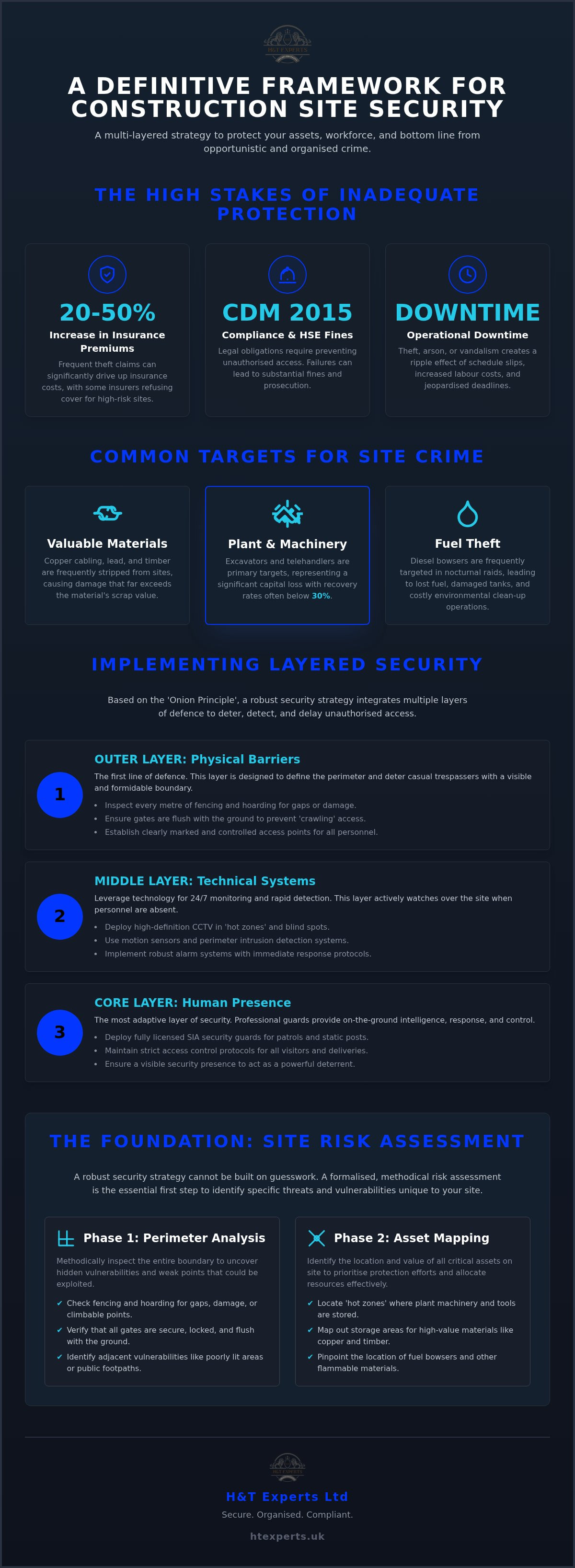
Criminal groups in 2026 are increasingly sophisticated, often scouting sites for specific high-value assets. You must understand what they're looking for to protect it effectively:
Valuable materials
Copper, lead, and timber have seen volatile price increases. Electrical cabling and piping are often stripped from partially completed structures, causing damage that far exceeds the material's scrap value.
Plant and machinery
Large equipment like excavators and telehandlers are primary targets. With recovery rates for stolen heavy equipment often sitting below 30%, a single theft represents a permanent and significant capital loss.
Fuel theft
Diesel bowsers are frequently targeted during nocturnal raids. These incidents aren't just about the lost fuel; the resulting damage to tanks and environmental spills can lead to costly clean-up operations.
The Hidden Costs of Inadequate Protection
The true price of a security breach isn't found on a receipt for stolen tools. It's found in the long-term operational impact on your business. Insurance premiums can climb by 20% to 50% following frequent theft claims, and some insurers may even refuse cover for high-risk sites that lack documented construction site security protocols.
Regulatory compliance is another critical factor. Under the Construction (Design and Management) Regulations 2015 (CDM 2015), you have a legal obligation to prevent unauthorised access to your site. Failure to meet these standards can result in substantial HSE fines and even criminal prosecution in the event of a fatality. Finally, the operational downtime caused by arson or vandalism creates a ripple effect. When a site is compromised, your schedule slips, your labour costs rise, and your ability to deliver on time is jeopardised.
How to Conduct a Comprehensive Site Risk Assessment
A robust strategy for construction site security cannot be built on guesswork. It requires a formalised, methodical risk assessment that precedes any equipment installation or guard deployment. Without this initial audit, you're likely to misallocate resources, leaving high-value assets exposed whilst over-protecting low-risk areas. A professional assessment identifies the specific threats unique to your location and project type, ensuring your security budget is spent where it delivers the highest return on protection.
Your evaluation must extend beyond the site boundary. Researching local crime statistics and identifying adjacent vulnerabilities, such as poorly lit alleyways or public footpaths, is essential. This environmental scan allows you to set clear security objectives that adapt as the build progresses. For instance, the security requirements for a vacant lot during the groundworks phase differ significantly from a site housing completed units full of high-end fixtures and fittings.
Step-by-Step Site Survey Methodology
Conducting a thorough walk-through is the only way to uncover hidden vulnerabilities. The Security Industry Association provides global benchmarks for these standards, which should be applied to your local UK context through the following phases:
Phase 1: Perimeter analysis.
Inspect every metre of fencing and hoarding for gaps, damage, or points that could be easily scaled. Check that gates are flush with the ground to prevent 'crawling' access.
Phase 2: Asset mapping.
Identify the 'hot zones' where plant machinery, fuel bowsers, and materials like copper are stored. These should be positioned in the centre of the site, away from the perimeter.
Phase 3: Lighting and visibility.
Assess the site at dusk. Ensure there are no shadows or blind spots where intruders could hide, particularly around site offices and storage containers.
Phase 4: Access control.
Audit the flow of personnel. Determine how many entry points are strictly necessary and how you'll verify the identity of every contractor and delivery driver.
Documenting Your Security Plan
Once the survey is complete, the findings must be formalised into a cohesive strategy. A 'Security Phase Plan' is a live document that evolves with the build, reflecting new risks as the project moves from shell to fit-out. This plan shouldn't just sit in a folder; it must assign clear accountability. Every member of the management team should know exactly who is responsible for the final lockdown each evening and who manages the keys. If you require expert guidance in establishing these protocols, professional security consultants can provide the oversight needed to ensure no detail is overlooked.
Implementing Layered Security: Physical, Technical, and Human
A single barrier is merely a delay; a multi-layered strategy is a solution. The most effective construction site security protocols follow the 'Onion' principle, creating concentric circles of protection that an intruder must breach to reach your assets. Each layer serves a specific purpose: to deter, to detect, to delay, and ultimately, to respond. By the time a criminal reaches your high-value plant machinery, they should have already triggered multiple alerts whilst facing physical obstacles that make the attempt economically unviable.
Physical barriers form your first line of defence. Robust timber hoarding and anti-climb paint provide a psychological and physical deterrent to opportunistic trespassers. However, these barriers must be supported by technical and human oversight to be truly effective. If your perimeter is breached, how quickly can you verify the threat and initiate a response? This synergy between hardware and personnel defines a modern security posture.
Technological Integration and Monitoring
Technology provides the constant oversight that human eyes cannot maintain alone across a sprawling site. Remote CCTV monitoring, linked to an off-site Alarm Receiving Centre (ARC), ensures that every movement is analysed in real-time by trained professionals. This system eliminates the 'blind spots' identified in your initial survey and provides the evidentiary trail required for insurance claims and police investigations.
Motion sensors and PIDs
Peripheral Intrusion Detectors are essential for large perimeters where traditional fencing may be vulnerable.
Forensic marking
Utilising SmartWater or similar forensic solutions allows you to link stolen materials directly back to your site, making them far harder for criminals to sell on the black market.
24/7 Monitoring
Constant surveillance ensures that your site is never truly 'unattended', even during holiday shutdowns or weekends.
The Vital Role of Manned Guarding
Whilst technical solutions offer excellent detection, professional security guarding remains the ultimate deterrent and the only method for immediate physical resolution. Manned guarding is an SIA-licensed activity that provides immediate on-site intervention. A visible, uniformed presence signals to organised criminal groups that your site is a high-risk target with active oversight.
The choice between static guarding and mobile patrols depends on your site's scale and risk profile. Static guards provide a permanent anchor for security operations, whilst mobile patrols offer a cost-effective way to secure multiple access points on a larger project. Regardless of the method, ensuring your personnel are SIA licensed is a non-negotiable standard for accountability and professional conduct. Guards do more than watch gates; they manage access control, conduct fire marshaling duties, and provide the human intelligence necessary to adapt to emerging threats on the ground.
Operational Management: Protocols for Incident Response
A sophisticated construction site security strategy is only as effective as the response it triggers. When an alarm sounds or a breach is visualised on CCTV, the subsequent minutes determine the extent of the loss. Establishing a clear, non-negotiable chain of command ensures that every alert is handled with discipline rather than panic. This operational readiness transforms a potential crisis into a managed incident, protecting both your assets and your legal standing. Accountability must be absolute; every person on the site should know exactly who to contact the moment a vulnerability is spotted.
Central to this response is the integration of emergency security response protocols. Rapid intervention by trained professionals can prevent a minor trespass from escalating into a significant theft or arson event. Every action taken during a breach must be documented in a comprehensive 'Security Log'. This record serves as vital evidence for police investigations and insurance claims, proving that you maintained rigorous oversight and followed established safety procedures. It's not just about stopping a crime; it's about proving your professional diligence after the fact.
Developing an Incident Response Plan
Your response plan should be a tactical document known to all key personnel. It must outline immediate actions to be taken the moment an intruder is detected, from isolating power to notifying the relevant authorities. When liaising with emergency services, your team must be prepared to provide up-to-date site maps and gate access codes immediately. Following any incident, a post-breach review is essential. This allows you to identify how the security layer was compromised and update your risk assessment to prevent a recurrence. Constant improvement is the hallmark of a secure project.
Maintaining Site Professionalism
The visual state of your project communicates a powerful message to potential intruders. A clean, well-organised site suggests a high level of management and vigilance, which acts as a psychological deterrent to opportunistic thieves. Conversely, a site cluttered with debris or marked by graffiti signals a lack of oversight, making it a more attractive target for criminal activity. This is rooted in the 'broken window' theory; neglect in one area often invites further, more serious breaches of your perimeter.
This is where specialist cleaning plays a critical role in security management. Removing signs of trespass or vandalism quickly prevents the perception that your site is an easy target. Maintaining visible, high-quality signage that warns of CCTV and active guarding further reinforces the message of total site control. If you require a partner to manage both your tactical guarding and the professional standards of your site, you can consult with our security specialists to develop a unified operational plan that leaves nothing to chance.
Choosing a National Security Partner for Your Project
Selecting the right partner for construction site security is a decision that impacts your project's insurance standing, health and safety compliance, and overall timeline. Whilst many providers offer localised services, a national partner provides the consistency and resource depth required for firms managing multiple sites across the UK. You need a partner capable of scaling their response, whether you're overseeing a small residential development or major national infrastructure projects that span several years.
Efficiency is significantly enhanced through the use of integrated security and cleaning services. By consolidating these essential site functions under a single management structure, you reduce administrative friction and ensure that professional standards are maintained across all operational fronts. A site that is both physically secure and professionally maintained presents a formidable deterrent to criminal elements whilst providing a safer environment for your workforce.
Evaluating Provider Credentials
Your due diligence should begin with a rigorous check of a provider's credentials. It's essential to verify their status within the SIA Approved Contractor Scheme (ACS), which serves as a benchmark for quality and professional standards in the UK security industry. Beyond licensing, you must assess their capacity for 24/7 operational support. A security firm that lacks a dedicated monitoring centre or an immediate response capability cannot provide the 'always-on' protection that modern construction projects demand. Always request a bespoke security quote that reflects the specific risks identified in your site survey rather than accepting a generic, off-the-shelf solution.
The H&T Experts Difference
H&T Experts Ltd leverages over 25 years of operational experience to protect high-stakes assets across the United Kingdom. Our approach isn't transactional; it's a partnership rooted in duty and reliability. We understand that security needs evolve as a build progresses, which is why we tailor our solutions to the unique lifecycle of your project, from the initial groundworks to the final fit-out.
SIA Licensed Personnel
Every guard is vetted and trained to the highest industry standards for guarding and monitoring.
Rapid Response
Our emergency security response teams are prepared to intervene the moment a breach is detected.
National Reach
We provide consistent protection for projects across the country, ensuring your standards never drop regardless of location.
Investing in high-calibre site security delivers a measurable return through reduced insurance premiums and the prevention of costly project delays. If you're ready to secure your site with a partner that values accountability and excellence, contact our specialist team today for a comprehensive consultation.
Protecting Your Assets Through Operational Excellence
A robust strategy for construction site security is not a luxury; it's a fundamental management discipline. By conducting methodical risk assessments and implementing the 'Onion' principle of layered protection, you move from a reactive posture to one of constant readiness. Integrating technical surveillance with professional guarding and specialist cleaning doesn't just deter crime; it reinforces the professional standards of your entire project. This systematic approach ensures that your plant, materials, and workforce remain protected against the evolving threats of 2026.
Choosing a partner with a proven track record is the final step in securing your project's continuity. H&T Experts Ltd brings over 25 years of operational experience and national UK coverage to every site we manage. Our integrated approach to guarding and specialist cleaning provides the oversight necessary to maintain zero downtime and reduced insurance premiums. We're prepared to help you establish a secure, disciplined environment for your next build. Secure your site with a professional quote from H&T Experts Ltd and ensure your project reaches completion without compromise.
Frequently Asked Questions
What is the most effective way to secure a construction site perimeter?
The most effective method is a multi-layered strategy that combines physical barriers with technical oversight. High-quality timber hoarding and anti-climb paint provide the initial deterrent, whilst 24/7 monitoring ensures any breach is immediately detected. This 'Onion' principle forces intruders to navigate several obstacles, significantly increasing the likelihood of detection and making your site an unattractive target for organised criminal groups.
Are construction site security guards better than CCTV cameras?
Neither is objectively 'better' as they fulfil distinct roles within a construction site security framework. CCTV cameras provide constant surveillance and evidentiary records, but they cannot physically intervene during a breach. Professional security guards provide a visible deterrent and the capability for immediate on-site response. For maximum protection, site managers should integrate both to ensure detection leads to swift resolution.
How much does construction site security typically cost for a UK project?
Security costs for a UK project are determined by the site's risk profile, location, and the duration of the build. Factors such as the number of SIA-licensed guards required and the complexity of the technical monitoring system will influence the final budget. It's standard practice to allocate a specific percentage of the total project contract value to security to ensure high-value plant and materials are adequately protected.
What are the legal requirements for construction site security in the UK?
The primary legal requirement is found within the Construction (Design and Management) Regulations 2015 (CDM 2015). Under these regulations, the principal contractor must take all reasonable steps to ensure the site is secure and prevent unauthorised access. Failure to maintain these standards can lead to significant fines from the Health and Safety Executive (HSE) and potential criminal liability if an unauthorised person is injured on your premises.
Can security guards also assist with site health and safety checks?
Yes, SIA-licensed security guards often perform dual roles that support site health and safety protocols. Beyond their primary security duties, they can conduct fire marshal inspections, check that perimeter fencing remains compliant, and monitor the use of personal protective equipment (PPE) at access points. This integrated approach ensures that your security personnel contribute directly to the broader safety culture and operational efficiency of the project.
What happens if a trespasser is injured on my construction site?
Under the Occupiers' Liability Act 1984, site managers owe a duty of care even to trespassers. You must be able to demonstrate that you took reasonable steps to discourage unauthorised entry and warned of specific hazards. If a breach occurs and a trespasser is injured, a documented construction site security plan and active guarding presence serve as critical evidence that you fulfilled your legal obligations to secure the site.
How quickly can a rapid security response team arrive on-site during an alert?
Arrival times for an emergency security response depend on the provider's national network and the site's proximity to response hubs. A professional partner with national coverage aims to have personnel on-site as quickly as possible following a verified alert from a monitoring centre. This rapid intervention is designed to mitigate damage from arson or vandalism and prevent organised thieves from removing high-value plant machinery from the site.
Does my insurance require a specific type of security guarding?
Many commercial insurance policies mandate specific security measures as a condition of cover. Insurers often require that any guarding personnel are SIA licensed and that technical systems meet British Standards for monitoring. Implementing a documented security strategy can lead to premium reductions of 10% to 25%, whilst failing to meet these requirements may result in claims being rejected or premiums increasing by up to 50% following an incident.





Ready to Experience Unparalleled Security Solutions?
H&T Experts Ltd is here to ensure your peace of mind. Connect with us today and take the first step towards a safer tomorrow.