

Commercial Deep Cleaning Costs UK: A Professional Guide to Specialist Pricing (2026)
What if the lowest quote for your facility's maintenance is actually the most expensive risk your business will take this year? Establishing accurate commercial deep cleaning costs UK wide requires looking beyond simple hourly rates to the rigorous standards that keep a site operational and compliant. You've likely encountered the frustration of opaque pricing structures and the looming worry that hidden fees for specialist equipment or emergency call-outs might surface long after the work begins. It's a common concern for those tasked with maintaining high-stakes environments where safety is non-negotiable.
This guide provides the professional clarity you need to budget with precision, ensuring you receive the high-quality results an accredited provider must deliver. We'll examine the critical variables that dictate 2026 pricing models, including the impact of updated GB CLP hazard standards and the mandatory Digital Waste Tracking Service. By understanding these factors, you can move from a position of uncertainty to one of composed authority. We'll preview how a unified approach to security and sanitation creates a more resilient business environment, protecting both your staff and your bottom line.
Key Takeaways
• Learn to distinguish between standard janitorial maintenance and high-intensity specialist sanitation to ensure your facility meets 2026 regulatory standards.
• Identify the primary operational variables, such as hazardous waste disposal and ceiling height, that influence commercial deep cleaning costs UK wide.
• Compare different pricing models, from fixed project fees for emergencies to square metre rates for industrial units, to select the most transparent structure for your budget.
• Recognise why the lowest quote often represents a significant liability risk and how proper accreditation protects your organisation from non-compliance penalties.
• Understand the operational efficiency gained by integrating emergency security response with specialist cleaning for rapid, secure post-incident recovery.
Defining the Scope and Baseline for Commercial Deep Cleaning Costs
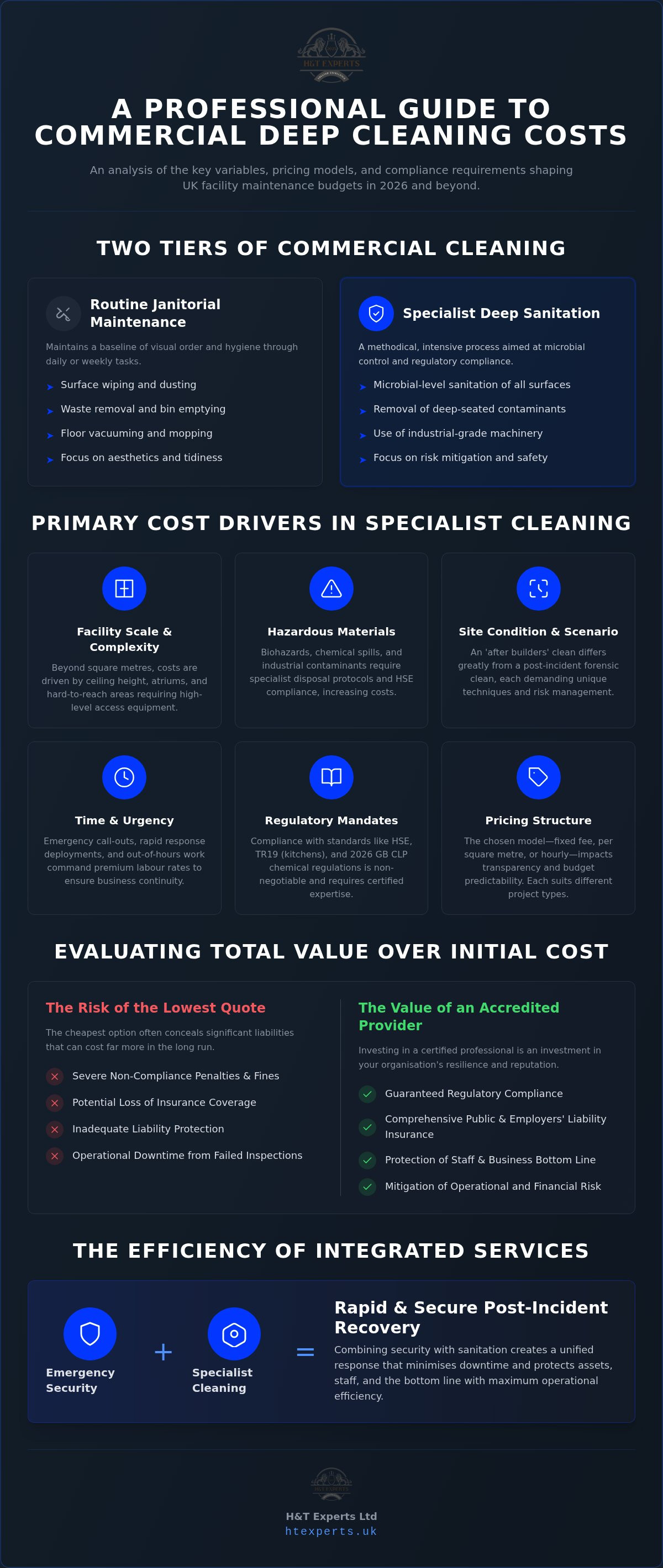
Hygiene in a professional environment is not a cosmetic luxury; it's a foundational requirement for operational safety. To understand What is Commercial Cleaning? in a specialist context, one must look beyond the daily janitorial tasks that keep an office tidy. A true deep clean involves the methodical sanitation of every surface, including ventilation systems and hard-to-reach structural areas that routine maintenance ignores. Whilst residential benchmarks often focus on aesthetics, commercial standards are dictated by microbial control and structural integrity.
Why do commercial deep cleaning costs UK businesses face differ so significantly from domestic rates? The answer lies in the scale of risk and the sophistication of the response. Specialist providers carry extensive public and employers' liability insurance, use industrial-grade machinery, and deploy chemicals that meet rigorous safety standards. This service is essential across high-stakes sectors, including industrial manufacturing plants, corporate headquarters, and healthcare facilities, where a single hygiene failure can lead to catastrophic downtime. Professional cleaning at this level is an investment in risk mitigation.
The Difference Between Routine and Specialist Sanitation
Daily cleaning maintains a baseline of order through surface wiping and waste removal. In contrast, the specialist cleaning services UK firms rely on focus on microbial-level sanitation and the removal of deep-seated contaminants. High-traffic environments accumulate pathogens and particulates in areas that standard maintenance never reaches. Specialist teams utilise heavy-duty machinery, such as steam cleaners and high-pressure extractors, to ensure a sterile environment. This level of intervention is necessary to maintain the health of both the workforce and the facility itself.
Regulatory Drivers for Commercial Deep Cleaning
The Health and Safety Executive (HSE) sets clear expectations for workplace cleanliness that go far beyond simple aesthetics. UK hygiene standards, including the TR19 requirements for kitchen extract systems and the 2026 GB CLP chemical regulations, create a complex landscape for facility managers. Non-compliance is a significant financial risk that can result in heavy fines or the loss of insurance coverage. Accurate budgeting for commercial deep cleaning costs UK must account for these regulatory demands, as professional compliance prevents the legal penalties and operational shutdowns that follow a failed inspection.
Primary Cost Drivers for Specialist Sanitation and Maintenance
Calculating commercial deep cleaning costs UK businesses must budget for requires an analysis of variables that extend far beyond simple floor area. Whilst square footage provides a baseline, the vertical volume of a facility often dictates the total labour hours required. High-ceilinged industrial units or tiered corporate atriums necessitate specialist high-level access equipment and extended safety protocols. These physical dimensions directly influence the deployment of personnel and the duration of the project.
Hazardous waste removal and biohazard sanitation represent significant cost escalations. Unlike standard refuse, substances such as bodily fluids, chemical spills, or industrial contaminants require disposal in strict accordance with the UK Health and Safety Executive (HSE) guidelines. The condition of the premises also plays a decisive role. An "after builders" clean focuses on fine particulate dust, whereas a post-incident recovery clean involves the meticulous removal of biological or forensic markers. Each scenario demands a different level of technical proficiency and risk management.
Time-sensitive requirements also impact the final quote. Emergency call-outs or rapid-response deployments for site restoration naturally command a premium. Out-of-hours work, often necessary to prevent business interruption, involves higher labour rates to compensate for unsociable hours. When operational continuity is at stake, the speed and reliability of the response are as critical as the cleaning itself.
Specialist Equipment and Consumables
Industrial-grade machinery is a prerequisite for specialist sanitation. The project fee accounts for the operation of high-pressure steam cleaners, air scrubbers, and industrial extractors capable of removing deep-seated contaminants. Hospital-grade disinfectants and chemicals compliant with 2026 GB CLP standards are more expensive than domestic alternatives but are essential for microbial-level hygiene. When high-level access is required, the hire and operation of cherry pickers or scissor lifts add a necessary layer of logistical cost to the final quote.
Labour Expertise and Accreditation
The value of a specialist clean is rooted in the competence of the operatives. Highly trained professionals command higher rates than general janitorial staff because they possess the technical knowledge to handle hazardous materials and operate complex machinery safely. Many of these specialists operate under professional security guarding standards, ensuring a disciplined approach to site safety. Vetting and background checks are mandatory for personnel entering sensitive commercial zones, providing an additional layer of oversight and reliability. For organisations requiring immediate site restoration, our specialist cleaning teams are prepared to deploy rapidly to mitigate further operational loss.
Pricing Structures: Fixed Fees, Hourly Rates, and Square Metre Calculations
The pricing landscape for specialist sanitation is diverse. Providers typically utilise three primary models to calculate commercial deep cleaning costs UK firms must manage. Choosing the right structure depends on the project's scope, the level of biohazard risk, and the desired speed of execution. Transparent, itemised quotes are the only way to avoid hidden charges for equipment or consumables. A professional proposal should clearly delineate labour, machinery hire, and chemical costs.
The "Price per Square Metre" model is the standard for large-scale industrial warehouses and distribution centres. This provides a clear, scalable metric for budgeting. Conversely, the "Hourly Rate" model offers flexibility for recurring maintenance where the workload might fluctuate. For specialist deep cleaning, these rates in 2026 typically range from £15 to £50 per hour. This reflects the higher technical skill and training required compared to standard janitorial work. Adhering to British Adult Institute of Cleaning Science (BICSc) standards ensures that these hours are utilised efficiently and safely, maintaining a disciplined focus on high-quality results.
When to Choose Fixed-Price Contracts
Fixed-price contracts are most effective for one-off emergency interventions or comprehensive site restorations. They offer financial certainty by capping the total expenditure, which is vital for corporate budgeting. This model shifts the focus from time spent to the quality of the outcome. The provider becomes accountable for delivering a specific standard of sanitation, regardless of unforeseen complications. Understanding the specialist cleaning quote process helps facility managers identify which costs are included, such as PPE and chemical disposal. This ensures that the final invoice aligns with the initial agreement.
Understanding Square Metre Benchmarks
In 2026, baseline commercial deep cleaning often starts from approximately £3.00 per square metre. However, this figure increases significantly for high-risk zones such as commercial kitchens or laboratories. These areas require intensive degreasing or microbial-level disinfection, which consumes more resources per metre. To calculate a realistic budget, use your facility's floor plan as a guide. You should always apply a premium for zones requiring TR19 or clinical-grade compliance. Accuracy at the budgeting stage prevents operational delays and ensures that the sanitation levels meet the rigorous requirements of your industry.
Evaluating Total Value: Compliance, Accreditation, and Operational Risk
Selecting a provider based solely on the lowest quote is a strategy fraught with hidden liabilities. In the context of commercial deep cleaning costs UK businesses must recognise that a cut-price service often indicates a lack of proper accreditation, inadequate insurance, or poorly trained staff. When sanitation involves hazardous materials or high-value industrial assets, the "cheapest" option can quickly become the most expensive mistake your organisation makes. True value is found in the provider’s ability to manage complex risks without compromising your operational continuity.
Professional firms maintain comprehensive public and employers’ liability insurance, providing a necessary safety net for your business. This coverage is not a mere formality; it's a guarantee that any accidental damage to sensitive equipment or injury on-site is managed by the provider, not your internal budget. A high level of discipline is required to maintain these standards. Adopting the meticulous mindset of a reliable security company ensures that every cleaning operative is observant, vetted, and fully aware of their responsibilities within a high-stakes environment.
The Cost of Non-Compliance
Inadequate workplace hygiene carries severe legal and financial repercussions. Regulatory bodies can impose substantial fines for failures in health and safety, whilst a single hygiene-related incident can devastate your brand’s reputation and staff morale. Specialist firms mitigate this risk by providing audit-ready documentation and certificates of completion. This trail of accountability is essential for internal audits and insurance renewals. It proves that your facility meets the rigorous 2026 UK standards, protecting you from the legal fallout of a failed inspection.
Experience as a Cost-Saving Factor
Twenty-five years of operational experience translates into a "right-first-time" delivery that standard cleaning crews cannot match. Veteran teams understand the nuances of different surfaces and the chemical sensitivities of industrial machinery. This expertise prevents the costly damage that often occurs when inexperienced staff use the wrong equipment or concentrations of chemicals. A methodical, veteran-led approach ensures that complex sites are sanitised efficiently, reducing the need for repeated attempts and minimising downtime. For a bespoke assessment of your facility’s requirements, contact our team for specialist cleaning solutions that prioritise both safety and efficiency.
Post-Incident Recovery: The Cost-Efficiency of Integrated Specialist Services
The aftermath of a site incident, whether a physical breach or a hazardous accident, creates immediate operational paralysis. The true financial impact is measured in hours of lost productivity and the escalating risk of secondary damage. When calculating commercial deep cleaning costs UK, many facility managers overlook the inherent efficiency of a unified response. Managing separate contractors for security and sanitation often leads to communication gaps, delayed handovers, and redundant administrative fees. Choosing integrated security and cleaning ensures that the transition from crisis management to site restoration is seamless and cost-effective.
This synergy creates a safer environment for restoration to begin. Security personnel secure the perimeter and preserve the scene, whilst specialist cleaning teams deploy immediately to neutralise hazards. This combined approach eliminates the friction of coordinating multiple vendors, ensuring that 2026 compliance standards are met without unnecessary delays. It's a methodical transition from protection to restoration, designed to protect your bottom line from the compounding costs of an idle facility.
Rapid Recovery and Business Continuity
Downtime is the most significant hidden cost in any emergency scenario. An emergency security response protects the physical asset, but the site remains functionally useless until professional sanitation is complete. Integrated services reduce this downtime by allowing cleaning teams to work in tandem with security protocols. A single point of contact for facilities management simplifies the logistical burden, removing the need for repetitive site inductions and conflicting schedules. This streamlined workflow ensures your business resumes operations in the shortest possible timeframe, mitigating the long-term financial fallout of an incident.
Total Incident Management Framework
A professional recovery project follows a disciplined lifecycle that prioritises safety and transparency. It begins with a rapid assessment of the risk, followed by immediate security deployment to stabilise the environment. Once the site is secure, specialist sanitation teams execute a methodical deep clean, concluding with a formal handover and audit-ready documentation. This framework combines human intelligence with advanced methodology to deliver superior results that standard janitorial firms cannot achieve.
H&T Experts Ltd leverages over 25 years of experience to act as a vigilant guardian for your organisation. We provide a stable force in a demanding industry, ensuring your assets are protected and your facilities are restored to the highest standards. Seek a partner that offers safety, reliability, and specialist expertise to manage your commercial deep cleaning costs UK effectively. For a comprehensive recovery solution, contact our team to discuss how our integrated services can safeguard your business continuity.
Securing Your Facility’s Operational Future
Accurate budgeting for specialist sanitation requires a shift in perspective. We've established that 2026 regulatory standards and physical site variables are the true drivers of project value. Relying on a provider who prioritises compliance over the lowest quote is the only way to protect your organisation from hidden liabilities and operational downtime. Navigating commercial deep cleaning costs UK effectively means seeking a partner who understands the critical link between site security and microbial-level hygiene.
H&T Experts Ltd provides this stability through over 25 years of specialist operational experience. Our integrated security and sanitation solutions offer nationwide UK coverage for commercial and industrial firms, ensuring a disciplined and methodical approach to site restoration. Managing these complex risks requires a seasoned partner committed to your peace of mind. Request a Specialist Cleaning Quote from H&T Experts Ltd today to ensure your facility remains a safe, compliant, and productive environment. Professionalism and readiness are just a consultation away.
Frequently Asked Questions
What is the average hourly rate for commercial deep cleaning in the UK for 2026?
Determining commercial deep cleaning costs UK wide requires an assessment of the technical requirements and the level of risk involved. Rates for specialist sanitation are typically higher than standard janitorial fees because they account for industrial machinery, hospital-grade chemicals, and trained operatives. In 2026, these costs are influenced by the complexity of the task, such as high-level access or biohazard removal. You should expect a premium for services that require specific certifications or out-of-hours deployment to maintain business continuity.
How is a specialist deep clean different from a regular office clean?
Regular office cleaning focuses on daily maintenance tasks like vacuuming, dusting, and surface wiping to maintain a tidy appearance. A specialist deep clean is a high-intensity intervention that targets microbial-level sanitation and hard-to-reach structural areas. It involves industrial equipment like air scrubbers and high-pressure steam cleaners. Whilst routine cleaning manages visible dirt, specialist sanitation addresses deep-seated contaminants and ensures your facility meets rigorous 2026 health and safety standards for workplace hygiene.
Do commercial cleaning costs include the removal of hazardous waste?
Hazardous waste removal is usually treated as a specialist addition to a standard deep cleaning quote. Because the 2026 Digital Waste Tracking Service requires real-time recording of all waste movements, providers must follow strict legal protocols for disposal. This involves specialized containers, protective gear, and dedicated transport. If your site requires the removal of biological hazards or chemical spills, ensure these costs are itemised in your initial proposal to avoid unforeseen surcharges during the project.
Why do industrial cleaning quotes vary so much between providers?
Variations in quotes often reflect the depth of the provider's expertise and the quality of their equipment. A lower quote might indicate a lack of proper accreditation or the use of general cleaning staff rather than trained specialists. Factors such as ceiling height, the condition of the premises, and the requirement for GB CLP-compliant chemicals also influence the price. Veteran firms with 25 years of experience often provide more accurate, all-inclusive quotes that reflect the true cost of a right-first-time delivery.
Is it more cost-effective to have a fixed-price contract or pay an hourly rate?
Fixed-price contracts are generally more cost-effective for one-off projects or emergency site restorations. This model provides financial certainty and holds the provider accountable for the final outcome rather than just the time spent on-site. Hourly rates are better suited for recurring specialist maintenance where the workload is unpredictable. For high-stakes environments, a fixed-price agreement ensures that the job is completed to a specific standard of sanitation without the risk of escalating labour costs.
What hidden costs should I look for in a specialist cleaning quote?
You should carefully review your quote for surcharges related to specialist machinery hire, such as cherry pickers or industrial air scrubbers. Other potential hidden costs include out-of-hours premiums, emergency response fees, and the cost of consumables like PPE or hospital-grade disinfectants. Ensure that waste disposal fees are clearly stated, especially given the strict UK regulations regarding hazardous materials. A transparent, itemised quote from a reputable provider should leave no ambiguity regarding these essential operational expenses.
How often should a UK commercial premises undergo a professional deep clean?
The frequency depends on your industry and the usage of your facility. For example, the TR19 standard requires kitchen extraction systems to be cleaned every three to twelve months based on usage hours. High-traffic corporate offices or industrial plants may require a comprehensive deep clean annually to maintain air quality and structural integrity. Regular assessments by a specialist provider help you determine a schedule that ensures continuous compliance with UK Health and Safety Executive expectations.
Can integrated security and cleaning services really save my business money?
Integrated services generate significant savings by reducing the administrative burden and logistical friction of managing multiple vendors. When a single partner handles both emergency security response and specialist cleaning, you benefit from a faster handover and reduced downtime. This synergy allows for shared site inductions and coordinated schedules, ensuring your facility is secured and sanitised in a single, streamlined operation. It's a highly efficient approach that protects your assets whilst minimising the total cost of incident recovery.

Ready to Experience Unparalleled Security Solutions?
H&T Experts Ltd is here to ensure your peace of mind. Connect with us today and take the first step towards a safer tomorrow.