

Access Control Guard Duties: Professional UK Guide (2026)
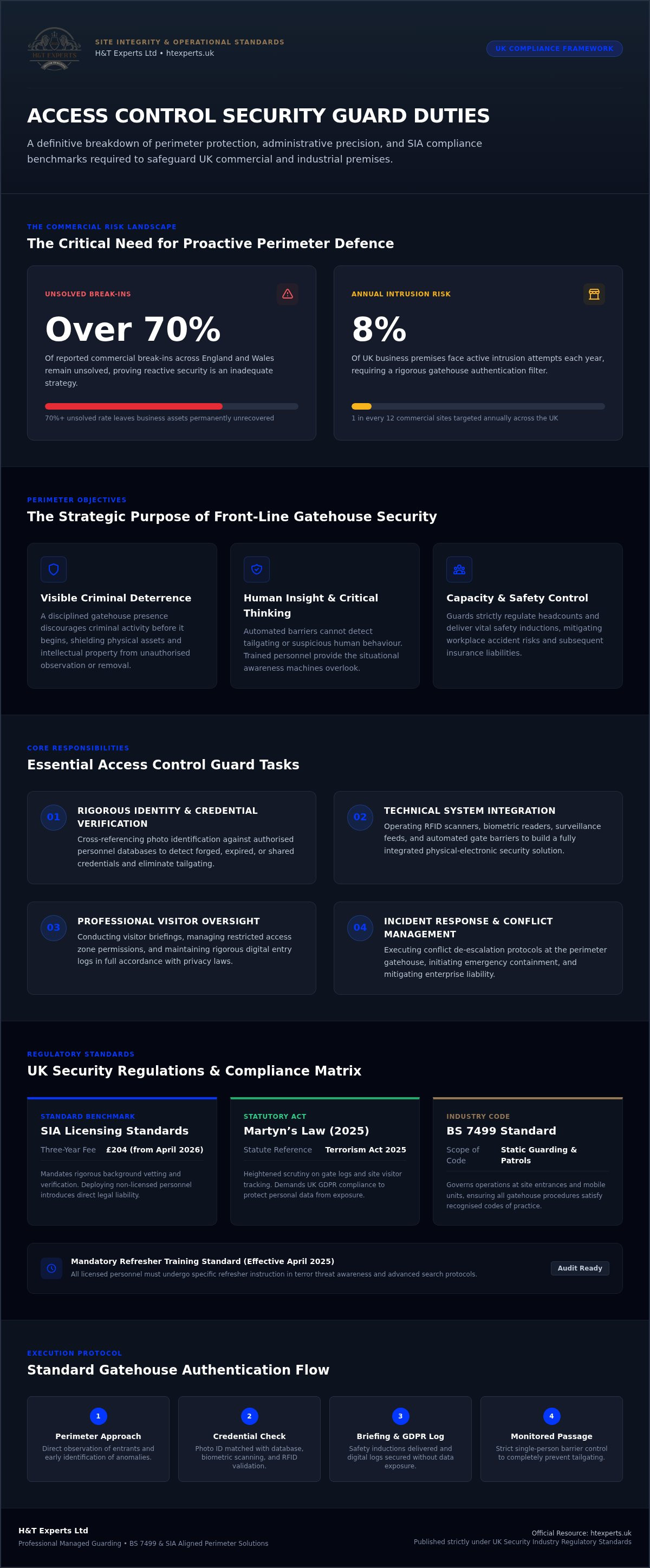
Did you know that over 70% of reported commercial break-ins across England and Wales remain unsolved? This data confirms that reactive security is a failed strategy that leaves your business vulnerable. To counter this, defining specific access control security guard duties is essential for any organisation that prioritises prevention over recovery. When your perimeter is breached, the damage to your assets and professional reputation is often already irreversible. You require a proactive barrier that identifies threats before they ever cross the threshold.
Managing a site entrance is your most critical line of defence against unauthorised entry, liability risks, and inconsistent visitor management. You deserve the peace of mind that comes from a disciplined, observant presence at your gates. This professional guide provides a definitive breakdown of responsibilities to ensure your UK premises remain secure, compliant, and expertly managed throughout 2026. We'll examine a clear checklist of guard tasks, the synergy between human expertise and advanced technical systems, and the latest SIA compliance requirements following the implementation of Martyn’s Law.
Key Takeaways
• Understand why professional access control serves as the primary line of defence for UK commercial sites, balancing physical vigilance with administrative precision.
• Identify the essential access control security guard duties required for rigorous identity verification and visitor management whilst maintaining high professional standards.
• Discover how modern guards integrate with sophisticated technology, including biometric systems and surveillance, to provide a comprehensive and responsive security solution.
• Master the protocols for immediate incident response and conflict de-escalation at the perimeter to mitigate liability and ensure the safety of your personnel.
• Ensure your site operations align with the latest SIA standards and 2026 regulations to maintain a fully compliant and professionally managed environment.
Defining the Role: Why Professional Access Control is Mandatory
Access control is the cornerstone of site integrity. It acts as the primary filter for every individual attempting to cross your perimeter. Defining the specific access control security guard duties for your site is the first step in building a resilient defence. Effective management of these points requires a unique blend of physical vigilance, administrative accuracy, and professional conduct. For UK commercial and industrial sites, this role is no longer a luxury; it's an operational necessity.
A security professional at the gatehouse represents your brand's first interaction with the public. They ensure that physical access control systems are not just automated barriers but managed security environments. Without this human oversight, technology remains vulnerable to tailgating and system bypasses. A guard provides the critical thinking necessary to identify suspicious behaviour that a machine might overlook.
The Strategic Purpose of Perimeter Security
The primary objective is clear: deterrence. A visible, disciplined guard discourages criminal activity before it begins. Beyond simple theft prevention, these professionals protect your intellectual property and physical assets from unauthorised observation or removal. They also play a vital role in health and safety. By strictly controlling site capacity and ensuring all entrants are briefed on safety protocols, guards help you maintain legal compliance in high-risk industrial settings. This proactive approach reduces the risk of onsite accidents and subsequent insurance claims.
Regulatory Compliance and SIA Standards
In the UK, the Security Industry Authority (SIA) sets the benchmark for professional standards. As of April 2026, the standard three-year licence fee is £204, reflecting the rigorous vetting and training required for the role. Deploying non-licensed personnel isn't just a security risk; it's a massive legal liability for your firm. Professional access control security guard duties include adhering to BS 7499, which governs static guarding and mobile patrols. This ensures that every action taken at your gatehouse meets recognised industry codes of practice.
Compliance also extends to data management. Since the rollout of the Terrorism (Protection of Premises) Act 2025, also known as Martyn’s Law, the scrutiny on entry logs has intensified. Guards must manage visitor data whilst remaining fully compliant with UK GDPR. This prevents sensitive information from being exposed to subsequent visitors, a common failure in traditional paper-based systems. Hiring an expert partner ensures your site remains a secure, legally sound environment that is prepared for any regulatory audit.
Core Operational Duties: From Identity Verification to Visitor Management
The modern gatehouse is a high-stakes environment where precision is the only acceptable standard. Professional access control security guard duties extend far beyond merely opening a barrier; they involve a rigorous process of authentication and oversight. In an era where 8% of UK business premises face intrusion attempts annually, your front-line personnel must operate with absolute clarity and discipline. This role is the essential filter that separates authorised personnel from potential threats.
Identity Verification and Credential Checks
Verification is the most frequent task performed at any entry point. Guards must cross-reference photo identification against authorised personnel databases to prevent credential sharing or tailgating. This process requires a keen eye for detail to identify forged or expired documents, often supported by technical aids like RFID scanners or biometric readers. All personnel must adhere to the latest Security Industry Authority licensing standards, which as of April 2025, mandate specific refresher training in terror threat awareness and advanced searching. For high-security zones, guards manage restricted access lists, ensuring that only those with specific clearance levels can proceed beyond the primary reception.
Professional Visitor Management
A security guard is frequently the first person a visitor encounters. They must balance a welcoming demeanour with a steadfast commitment to site safety. This includes briefing every guest on site-specific health and safety protocols and ensuring they are issued with the correct temporary credentials. Since the UK GDPR / Data Protection Act 2018, traditional paper sign-in books have become a liability. Modern guards instead administer digital terminals that protect visitor privacy. If an individual is denied entry, the guard must escort them off-site with calm authority, preventing any potential escalation whilst maintaining the professional reputation of your business.
Effective perimeter management also includes the issuing and reclaiming of security passes. Every badge must be accounted for to prevent unauthorised re-entry. Beyond this, guards perform authorised searches of bags and vehicles. These searches are conducted under strict Assignment Instructions (AIs) and follow "See, Check and Notify" (SCaN) protocols. This level of oversight is particularly vital during the 2026 transition window for Martyn’s Law, as businesses prepare for mandatory counter-terror enforcement. If you want to ensure your premises are protected by highly trained specialists, H&T Experts provides the national coverage and expertise required to manage these complex responsibilities.
The Technical Edge: Managing Modern Entry Systems and Surveillance
Modern security is a hybrid of human expertise and advanced technology. The scope of access control security guard duties has expanded to include the management of sophisticated hardware and software. Guards are no longer passive observers; they are active operators of integrated CCTV, biometric, and RFID systems. This technical edge ensures that your premises are protected by multiple layers of verification, reducing the risk of unauthorised entry. By monitoring alarm panels in real-time, guards can respond to technical alerts immediately, preventing minor glitches from becoming major security vulnerabilities.
Surveillance and Monitoring Integration
Visual verification is the first step in any secure entry process. Guards use high-definition CCTV feeds to scrutinise individuals and vehicles before they even reach the intercom. This allows for the identification of suspicious behaviour patterns, such as loitering or hostile reconnaissance, well in advance of a potential breach. By linking on-site guarding with professional 24/7 security monitoring UK, businesses benefit from an unbroken chain of oversight. If a local guard is occupied with a physical vehicle search or a complex visitor briefing, the remote monitoring centre maintains eyes on the remaining cameras. This synergy ensures that no blind spots are exploited during high-traffic periods.
System Maintenance and Manual Overrides
Technology is a powerful tool, but it is not infallible. A critical part of access control security guard duties involves maintaining the operational integrity of automated barriers and turnstiles. Guards perform routine checks on electronic locking mechanisms and sensor alignments to identify wear or tampering before a failure occurs. When technical glitches or power outages inevitably happen, the guard’s ability to execute manual override procedures is vital. This prevents site gridlock whilst maintaining a secure perimeter through rigorous manual verification methods. It's during these system downtimes that the presence of a trained professional becomes most valuable, as they step in to provide the security that automated systems can no longer offer.
Following the NPSA Automatic Access Control Systems guidance, professional guards are trained to handle biometric or RFID failures with absolute precision. They don't simply bypass the system for convenience; they implement pre-agreed contingency plans that involve secondary identification checks and manual logging. Any fault is reported to facilities management with precise technical detail, ensuring that repairs are prioritised and system downtime is minimised. This proactive management of system health prevents the "security gaps" that frequently occur when automated systems are left unmonitored or poorly managed during a malfunction. A guard's readiness to transition between automated and manual modes is what keeps a site truly resilient.
Incident Response and Conflict Management at the Perimeter
Perimeter security is defined by how a professional handles the unexpected. Whilst automated systems provide data, only a trained human can manage the complexities of a physical confrontation or a security breach. Access control security guard duties include the immediate identification of unauthorised entry attempts and the execution of a controlled, proportionate response. This readiness ensures that potential threats are neutralised before they can impact your core operations or personnel safety. A composed, business-like delivery during a crisis instills immediate confidence in your staff and visitors alike.
De-escalation and Conflict Resolution
Conflict at the gatehouse often arises from denied entry or credential disputes. A professional guard maintains a steadfast and calm demeanour, even when faced with aggressive behaviour. They use authoritative verbal commands and tactical positioning to de-escalation tensions without resorting to unnecessary physical force. This disciplined approach protects your organisation from the significant liability risks associated with poorly managed altercations. If a situation surpasses the guard's immediate control, they are trained to trigger an emergency security response. This ensures that specialist reinforcements arrive quickly to manage high-stakes crises with the weight of experience.
Emergency Protocol Execution
During a critical incident, the access point becomes the command hub for site safety. Guards must execute pre-planned lockdown procedures, securing all gates and turnstiles to prevent further intrusion. In the event of a fire or medical emergency, their role shifts to managing assembly point access and clearing paths for emergency vehicles. Liaising with the police or ambulance service requires clear, concise communication and the provision of accurate site data. Following any incident, the guard produces a detailed, evidence-grade report as part of their access control security guard duties. These documents are vital for management reviews and police investigations, especially since over 70% of commercial break-ins in England and Wales remain unsolved due to a lack of actionable evidence.
Your business deserves a security partner that prioritises proactive crisis management and operational excellence. If you require a team that combines human vigilance with rigorous emergency protocols, contact H&T Experts today to secure your national UK premises with SIA-licensed professionals.
Choosing Excellence: The H&T Experts Approach to Managed Guarding
H&T Experts Ltd brings over 25 years of operational leadership to the private security sector. We understand that access control security guard duties are not a "one size fits all" solution. Instead, we develop bespoke security protocols that address the specific vulnerabilities of your national UK premises. Our commitment to rigorous SIA training ensures that every operative is prepared for the high-stakes environment of modern security guarding. By choosing a partner with a proven track record, you instill immediate confidence in your stakeholders and ensure your assets remain managed by a capable entity.
The Value of Experienced Leadership
Jamie Treloar’s extensive experience informs every aspect of our guard training and deployment strategy. We don't simply provide a presence; we provide a disciplined force that values hands-on management and clear lines of responsibility. This level of leadership is critical when defining the exact parameters of access control security guard duties for complex industrial sites or corporate headquarters. Selecting a reliable security company is a fundamental step in long-term risk mitigation. We provide bespoke duty rosters that ensure your site is never left vulnerable during shift changes, high-traffic periods, or technical system maintenance. Our focus on operational excellence means we are always prepared for any situation, providing a stable force in a demanding industry.
Seamless Facility Integration
Our approach to site management is both comprehensive and methodical. We recognise that security is often part of a wider facilities requirement. By combining our guarding expertise with specialist cleaning services UK, we allow clients to consolidate their site management needs under one authoritative expert. This synergy creates a more organised, transparent, and secure environment. We maintain 24/7 accountability through digital reporting and constant management oversight, ensuring that every patrol and entry log is verified. Our national UK coverage allows us to scale our services to meet your requirements, regardless of the complexity of the site. You can request a professional consultation for your premises today to experience a partnership rooted in duty, reliability, and professional pride.
Securing Your Perimeter for 2026 and Beyond
Establishing a resilient defence requires more than just a physical presence; it demands a synergy between human expertise and advanced technology. Professional access control security guard duties are the cornerstone of this approach, ensuring that your site remains compliant with the latest SIA standards and Martyn's Law regulations. By prioritising rigorous identity verification and technical system management, you mitigate liability and protect your most valuable assets. You deserve a security partner that operates with the weight of experience and a commitment to operational excellence.
H&T Experts provides the stability and readiness your organisation needs to thrive in a demanding industry. With over 25 years of experience, our SIA-licensed guards deliver national UK emergency response capabilities that ensure your premises are managed by a capable entity. We take our obligations seriously, providing a disciplined force that values transparency and integrity. Request a Professional Security Consultation from H&T Experts today to fortify your perimeter. Your peace of mind is our primary objective, and we are prepared to secure your site with steadfast authority.
Frequently Asked Questions
What are the primary duties of an access control security guard?
The primary responsibilities involve the verification of identity for all individuals attempting to enter a site. This includes authenticating employee credentials, managing digital visitor logs, and issuing temporary security passes. Guards also monitor perimeter surveillance feeds and perform vehicle or bag searches to prevent the entry of prohibited items. Their presence ensures that every person on your premises is authorised and accounted for at all times.
Do access control guards in the UK need an SIA licence?
Yes, any individual performing licensable security activities at your site must hold a valid Security Industry Authority (SIA) licence. As of April 2026, the standard three year licence fee is £204. Guards must also complete mandatory refresher training in terror threat awareness and first aid before renewal. Hiring non-licensed personnel is a criminal offence and creates significant legal and insurance liabilities for your organisation.
Can a security guard legally search my bag or vehicle at a checkpoint?
Guards can legally conduct searches if it is a condition of entry specified in the site's Assignment Instructions. Whilst guards do not possess police powers, they can refuse entry to any individual who declines a search. This is a fundamental part of access control security guard duties in high-security environments. All searches must be conducted professionally and in accordance with established human rights and data protection legislation.
How does an access control guard handle a technical system failure?
When electronic barriers or biometric systems fail, the guard immediately transitions to manual verification protocols. This involves physically checking identification against authorised lists and using manual overrides for gates. The guard provides the critical human oversight needed to maintain a secure perimeter during system downtime. They also report the fault to facilities management with precise detail to ensure that repairs are prioritised and site security is never compromised.
What is the difference between a receptionist and an access control guard?
A receptionist focuses on administrative hospitality and guest services, whereas an access control guard is a trained security professional focused on risk mitigation. Guards are SIA-licensed to manage conflict, perform searches, and execute emergency response protocols. Whilst a receptionist may sign in guests, a guard is responsible for the physical integrity of the perimeter and the immediate response to any unauthorised entry attempts or security breaches.
How do security guards manage unauthorised entry attempts?
Guards identify unauthorised attempts through surveillance or physical observation and intercept the individual immediately. They utilise professional de-escalation techniques to manage the situation whilst maintaining a steadfast and calm demeanour. If the individual refuses to leave, the guard follows pre-planned protocols to escalate the matter to emergency services. Every incident is recorded in a detailed, evidence-grade report to support potential police investigations or internal management reviews.
Are guards trained to use CCTV and biometric systems?
Yes, modern security professionals are specifically trained to operate integrated surveillance, biometric readers, and RFID entry systems. They use these tools to verify identity and spot suspicious behaviour patterns before granting access. This technical proficiency is a core component of access control security guard duties in 2026. The synergy between human expertise and advanced technology ensures that your site benefits from multiple layers of verification and constant, reliable oversight.
How does access control improve overall site health and safety?
Access control improves safety by ensuring that only authorised, safety-briefed individuals enter high-risk or sensitive areas. Guards manage site capacity, verify that contractors possess the correct permits to work, and ensure that all entrants are aware of emergency assembly points. In the event of a fire or site-wide evacuation, guards play a lead role in directing personnel and clearing paths for emergency vehicles. This rigorous oversight reduces the risk of accidents and liability.




Ready to Experience Unparalleled Security Solutions?
H&T Experts Ltd is here to ensure your peace of mind. Connect with us today and take the first step towards a safer tomorrow.