

A Comprehensive Guide to Professional Alarm Response Services in 2026
If an intruder triggers your business alarm at 3:00 AM, is your most valuable employee’s life worth the cost of a false alert? It's a sobering question that many directors avoid until a crisis occurs. You likely recognise the persistent anxiety of managing out-of-hours security, especially when internal key holding arrangements feel fragile or unsafe. Relying on untrained staff to provide alarm response services is not just a personal concern; it’s a significant legal liability that can lead to devastating consequences for your reputation and your people.
Implementing a professional security protocol provides a definitive solution to these operational vulnerabilities. In this guide, you'll learn how to protect your assets and fulfil your legal duty of care by adopting an expert-led approach. We will examine the transition from unreliable internal systems to 24/7 monitored protection, ensuring your organisation remains compliant with BS 7984-1:2016 standards. This overview details the practical steps required to secure your premises whilst maintaining the absolute safety of your workforce.
Key Takeaways
• Identify the physical and legal risks associated with internal key holding and why "DIY" security often fails to meet Duty of Care obligations.
• Understand the operational mechanics of professional alarm response services, including the synergy between 24/7 monitoring and physical SIA-licenced intervention.
• Compare the efficiency of expert mobile patrols against internal staff to see how professional response minimises operational downtime and improves safety.
• Learn the essential steps for implementing a robust protocol, from conducting site-wide risk assessments to verifying BS 7984-1:2016 compliance.
• Gain insights into selecting a reliable security partner with the national coverage and decades of experience required to manage complex UK sites.
The Risks of Internal Alarm Response: Why DIY Security Fails
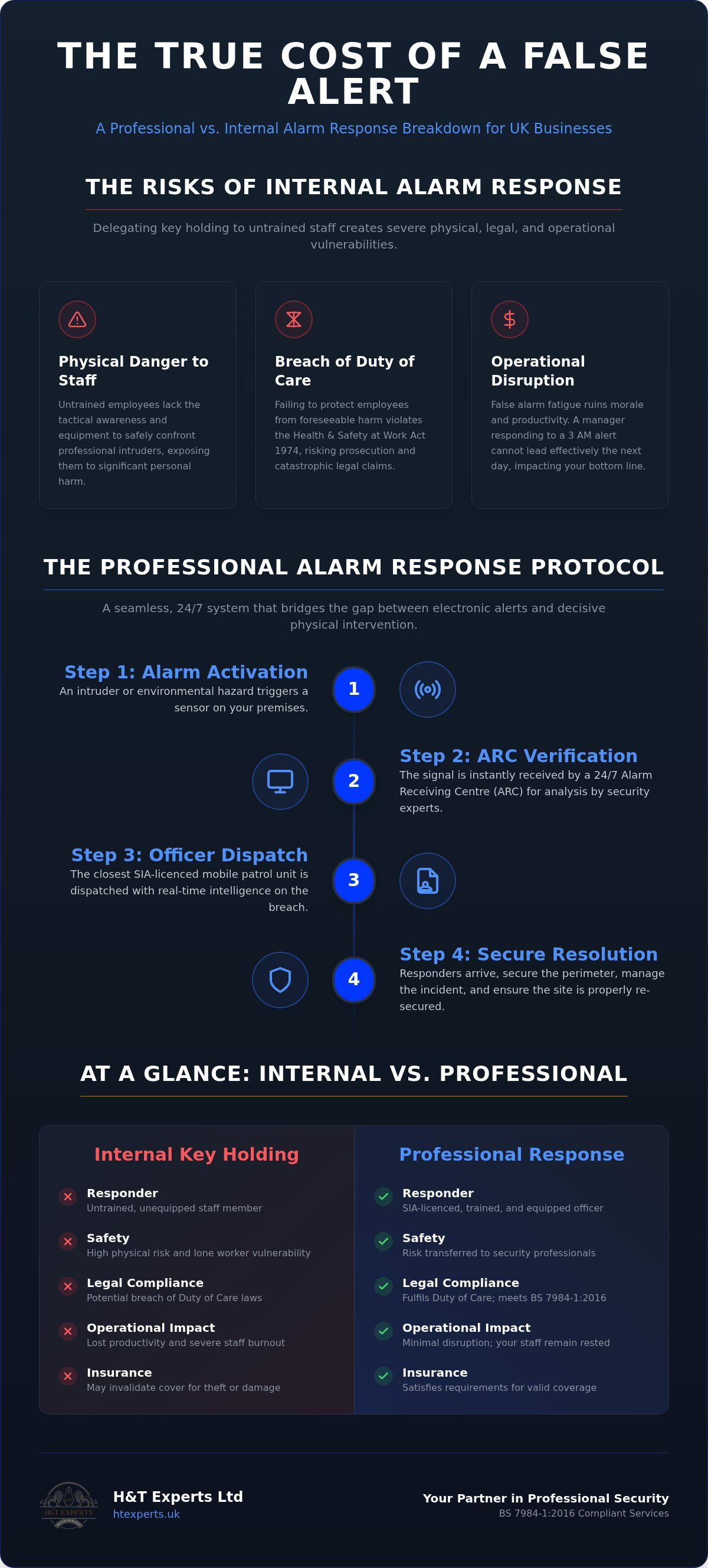
Many organisations mistakenly treat out-of-hours security as a secondary administrative task. They delegate key holding to a local manager or a willing employee, operating under the assumption that most alerts are merely technical glitches. This is a high-risk strategy. When you ask an untrained staff member to attend a site alone in the darkness, you're exposing them to significant physical danger. They lack the tactical awareness, conflict resolution training, and protective equipment needed to safely handle a professional intruder or a violent confrontation.
Relying on internal staff for alarm response services doesn't just risk physical harm; it compromises your entire business structure and legal standing. You're effectively asking a civilian to perform the role of a first responder without the necessary tools or backup.
Understanding Your Legal Duty of Care
Under the Health and Safety at Work etc. Act 1974, your organisation holds a non-delegable duty to protect employees from foreseeable harm. Sending a manager to investigate a potential crime scene at midnight is a fundamental breach of modern safety protocols. If a staff member is injured during such an event, the financial impact of insurance claims can be catastrophic, often leading to premiums that far exceed the cost of professional security. More importantly, the Corporate Manslaughter and Corporate Homicide Act 2007 creates a clear pathway for criminal prosecution if a gross breach of duty leads to a fatality. Professional intervention transfers this operational liability to qualified experts who are specifically trained to manage these high-stakes environments.
The Hidden Costs of Unprofessional Response
The true cost of a DIY approach is often buried in your balance sheet through lost productivity and staff turnover. False alarm fatigue rapidly erodes employee morale. A manager who spends their night investigating a faulty sensor won't be capable of leading a team effectively the following morning. There are also specific operational risks to consider:
Lone worker vulnerabilities
Employees may suffer accidents or medical emergencies in an unmonitored building with no way to call for assistance.
Inadequate re-securing
An anxious or tired staff member might fail to properly reset the alarm system or lock secondary entry points, leaving the premises open to a follow-up breach.
Insurance invalidation
Many commercial insurers require proof of professional key holding to maintain valid coverage for theft or criminal damage.
Choosing alarm response services provided by SIA-licenced professionals ensures that your assets are protected without compromising the welfare of your people. It replaces a culture of "making do" with a system of steadfast, calm authority.
What are Professional Alarm Response Services?
Professional alarm response services represent a sophisticated, contract-based security solution designed to eliminate the risks of internal key holding discussed previously. Unlike passive security measures, this service provides a guaranteed physical response by SIA-licenced officers whenever a site alert is triggered. It bridges the gap between electronic surveillance and physical protection, ensuring that a remote signal always results in disciplined human intervention. This is not merely a call-out service; it is a managed security protocol that operates with total accountability.
The efficacy of this service relies on the seamless integration of remote monitoring and mobile patrol units. When an intruder or environmental hazard triggers a sensor, the signal travels instantly to a dedicated facility. Vetted professionals analyse the data to determine the nature of the threat before dispatching a response team. This synergy ensures that every alert is handled with the appropriate level of expertise, regardless of the hour or the complexity of the situation.
The Mechanics of an Emergency Response
The first 60 seconds following an alarm activation are critical for containment and risk mitigation. Once a sensor is tripped, the signal is verified by specialists who then initiate a secure communication chain. This involves alerting the mobile response unit closest to your location whilst providing them with real-time intelligence about the breach. The Alarm Receiving Centre (ARC) functions as the central nervous system of UK security, processing data from thousands of sensors to trigger immediate human action. This rapid coordination ensures that responders arrive on-site with a clear understanding of the environment, allowing them to secure the perimeter and manage the incident with steadfast authority.
Standard Accreditation: BS 7984 and the SIA
Reliability in security is built upon rigorous standards and legal compliance. You should only ever engage responders who hold valid SIA (Security Industry Authority) licences, as this guarantees they have undergone the necessary criminal record checks and tactical training. Equally important is the provider's adherence to BS 7984-1:2016 for key holding practices. This British Standard dictates the secure storage and transit of your building's access keys. Keys are typically stored in high-security vaults or tracked vehicle safes, identified only by non-descriptive codes to prevent unauthorised use. By choosing a partner that prioritises these standards, you ensure that your property remains accessible to responders but impenetrable to criminals. If you are reviewing your current security posture, consider how SIA-licenced security response can fortify your operational resilience.
Comparing Internal Key Holding vs Professional Response
When evaluating your security strategy, the choice between internal key holding and professional alarm response services often determines the speed and quality of incident resolution. Internal arrangements depend on the availability and location of a specific employee, who must travel from home, often in their private vehicle, while potentially disoriented by a late-night call. In contrast, professional responders operate from strategically positioned mobile units, ready to deploy the moment an alert is verified. This ensures a consistent response time that internal staff simply cannot match, especially during antisocial hours or peak holiday periods when staff availability is at its lowest.
The difference in expertise is equally stark. An employee arriving at a dark, potentially compromised building faces immense psychological pressure. They aren't equipped for conflict resolution or tactical site assessment. Professional officers bring a composed, business-like delivery to every emergency, trained to identify signs of forced entry without placing themselves in unnecessary danger. This disciplined approach ensures that situations are de-escalated rather than inflamed. Furthermore, professional services provide a level of accountability that verbal reports from employees lack. Every attendance generates a digital audit trail, ensuring that your security posture is backed by facts rather than assumptions.
Operational Continuity and Resilience
Professional response extends beyond merely checking a door. If a breach has occurred, responders manage the entire re-securing process, including coordinating emergency boarding-up services to protect your assets from further exposure. They also serve as the primary point of contact for emergency services; UK police forces generally prefer liaising with accredited security firms who can provide clear, technical briefings. Crucially, these vetted professionals maintain detailed incident logs. Unlike a simple verbal assurance that "everything looks fine", these records provide the robust evidence required by insurance providers to process claims and verify that your organisation acted with due diligence.
Staff Wellbeing and Retention
Removing the "on-call" burden from your senior management team is a vital step in modernising your corporate culture. Expecting leaders to remain tethered to their phones 24/7 creates a "hero culture" that is both unsustainable and dangerous. By outsourcing these duties to alarm response services, you demonstrate a genuine commitment to a safe working environment and respect for your team's personal time. This shift doesn't just reduce the risk of burnout; it eliminates the legal and ethical dilemmas created when staff feel pressured to make dangerous DIY security decisions. Protecting your workforce from 3:00 AM call-outs is a tangible way to improve long-term retention and operational stability.
How to Implement an Effective Alarm Response Protocol
Transitioning from informal internal arrangements to professional alarm response services requires a methodical, step-by-step transition. It isn't enough to simply hand over a set of keys; you must build a robust framework that ensures every alert is managed with precision. This process begins with a clear understanding of your site's unique vulnerabilities and ends with a tested, reliable communication chain that operates without human error.
Follow these five essential steps to establish a professional security posture:
Step 1: Conduct a site-wide security risk assessment.
Identify every vulnerable entry point, from delivery bays to roof hatches. This ensures responders know exactly where to focus their attention during a breach and can approach the site safely.
Step 2: Vet your provider with rigour.
Confirm they hold current SIA licences and strictly adhere to BS 7984-1:2016. This standard is the only way to guarantee your keys are managed with a high degree of integrity and professional pride.
Step 3: Establish a clear escalation path.
Define the specific scenarios where you require an immediate phone call versus those that only need a digital summary the following morning. This prevents unnecessary sleep disruption for your management team.
Step 4: Organise a secure key handover.
Create a documented audit trail for every key and fob provided. This ensures site access is tracked and restricted to authorised personnel, creating a permanent record for your insurance provider.
Step 5: Test the system.
Perform a controlled alarm activation to verify that the communication between your sensors, the Alarm Receiving Centre (ARC), and the mobile units is perfectly synced.
Defining Your Response Requirements
You must decide whether your site requires internal inspections or "external only" patrols. External patrols focus on perimeter integrity, whilst internal inspections require officers to enter the building to check for fire hazards, water leaks, or internal breaches. Setting clear expectations for response times is also essential. Whilst the industry standard often targets a 60-minute window, high-risk sites may require more aggressive benchmarks. Additionally, consider how the protocol will manage temporary access for maintenance or specialist cleaning contractors to ensure operational continuity without compromising security.
Integrating Response with Remote Monitoring
Modern security relies on the synergy between human expertise and advanced methodology. By integrating your response protocol with CCTV verification, you can significantly reduce "false alarm" call-out fees. The ARC can visually confirm a threat before dispatching a unit, ensuring that physical intervention is reserved for genuine incidents. It's also vital to ensure your physical keys perfectly match your digital access codes to prevent delays at the perimeter. For a deeper look at managing these high-stakes situations, read our guide on emergency security response.
If you're ready to secure your assets with a system built on 25 years of experience, contact us today about implementing a professional response protocol.
Why H&T Experts is the Premier Choice for UK Firms
H&T Experts Ltd brings over 25 years of operational experience to the UK security landscape. We operate as a vigilant guardian for organisations that require more than a basic call-out service. Our national reach ensures that whether you manage a single facility or a nationwide portfolio, you receive a consistent, high-register standard of guarding. We replace the uncertainty of internal arrangements with a sense of safety and reliability that only a quarter-century of industry leadership can provide.
Our alarm response services are defined by a composed, business-like delivery that instils immediate confidence in our clients. We don't just attend alerts; we manage them with a high degree of discipline and professional pride. This steadfastness allows your leadership team to focus on their core commercial objectives whilst we handle the high-stakes responsibility of site protection. We operate with the weight of experience, positioning ourselves as a stable force in a demanding and often unpredictable industry.
A Legacy of Professionalism
Stability is a rare commodity in the security sector, yet H&T Experts has remained a stable force for over two decades. Every member of our response team is an SIA-licenced professional who has undergone rigorous training in tactical awareness and conflict resolution. We prioritise transparency through detailed digital reporting, ensuring you have a clear, factual record of every action taken on your behalf. This level of oversight ensures total accountability, providing the rigorous standards and operational excellence required for modern corporate governance and insurance compliance.
The H&T Experts Advantage: Beyond Basic Security
What sets our organisation apart is the unique synergy between our security response and our specialist cleaning capabilities. In the aftermath of a break-in, vandalism, or a technical hazard, your premises may require immediate sanitation or restoration. We can manage both the security breach and the subsequent specialist cleanup, offering a comprehensive approach to problem-solving that most providers cannot match. This integrated methodology is designed to minimise your operational downtime and protect your brand reputation from the effects of a site incident. We view our role as a partnership, offering a personal investment in your peace of mind that goes beyond a standard transaction.
To secure your premises with a partner you can trust, contact H&T Experts for a professional consultation.
Securing Your Corporate Future with Disciplined Protection
Transitioning to a professional security model is a decisive step towards protecting your organisation's most critical assets: its people and its property. By moving away from the vulnerabilities of internal key holding, you eliminate the legal and physical risks that threaten corporate stability. Implementing professional alarm response services ensures that every alert is met with the calm authority of a seasoned guardian, rather than the uncertainty of an untrained employee.
H&T Experts Ltd provides the stability your business requires through 24/7 national coverage and over 25 years of operational experience. Our SIA-licenced professionals serve as a reliable extension of your team, managing high-stakes incidents with precision and transparency. This proactive approach to risk management doesn't just fulfil your legal duty of care; it fosters a culture of safety and operational excellence. You deserve a security partner that prioritises your welfare as much as your assets.
Fortifying your premises with a partner dedicated to your peace of mind is the logical next step for any resilient business. Request a Professional Security Quote from H&T Experts and ensure your organisation remains protected in the face of any emergency. We look forward to providing the steadfast protection and reliability your business deserves.
Frequently Asked Questions
What exactly do alarm response services do when an alarm is triggered?
Professional responders immediately deploy to your site to conduct a thorough external and internal inspection. They verify the cause of the alert, check for signs of forced entry, and ensure the building is fully re-secured before leaving. If a breach has occurred, they coordinate with emergency services and arrange for boarding up to protect your assets. This methodical approach ensures that every incident is resolved without placing your staff at risk.
Is it legal to send my own employees to respond to a business alarm?
Whilst it isn't strictly illegal, sending untrained staff to a midnight alarm activation likely violates your legal Duty of Care under the Health and Safety at Work etc. Act 1974. You're exposing employees to foreseeable risks without professional training or protective equipment. If an incident occurs, your organisation could face severe litigation or even charges under the Corporate Manslaughter Act. Professional intervention is the only way to guarantee absolute compliance.
How quickly will a professional security team arrive at my premises?
Arrival times vary based on your specific contract and site location, though the industry benchmark often targets a 60-minute window. Because professional alarm response services utilise strategically positioned mobile patrol units, they can typically reach your premises much faster than an employee travelling from home. This rapid intervention is critical for minimising criminal damage and ensuring operational continuity during high-stakes situations.
Do I still need to be the primary key holder if I hire a response service?
No, you don't need to remain the primary point of contact for out-of-hours alerts. The security firm assumes the role of primary key holder, meaning they're the first to be notified by the monitoring station. You can still be listed as an emergency contact for major incidents, but the daily burden of responding to sensors is entirely removed from your management team, allowing them to rest undisturbed.
What happens if the alarm activation is a false alarm?
If a sensor is triggered by a technical fault or environmental factor, the responder will verify the site is secure and reset the system. You'll receive a detailed digital incident report explaining the cause of the activation. This helps you identify faulty equipment and prevents "false alarm fatigue" from affecting your staff’s morale or productivity during the following working day.
How do security companies store my keys safely?
Keys are stored in high-security vaults or tracked vehicle safes that comply with BS 7984-1:2016 standards. They're never labelled with your company name or address; instead, they use non-descriptive security codes. This ensures that even if a responder's vehicle were compromised, your keys would remain useless to an unauthorised individual, maintaining the integrity of your site access at all times.
Can alarm response services liaise with the police on my behalf?
Yes, professional responders act as the authoritative point of contact for the police and other emergency services. They provide clear, technical briefings upon the arrival of the authorities and remain on-site to assist with the investigation. This partnership is highly valued by UK police forces, as it ensures they're dealing with accredited professionals who have immediate, authorised access to the building.
What is the difference between key holding and alarm response?
Key holding is the secure, off-site storage of your premises' keys in a dedicated facility. In contrast, alarm response services refer to the physical act of attending the site when an alert is triggered. Whilst they're often sold together, key holding provides the necessary access, whilst the response service provides the human intervention and tactical expertise needed to manage an emergency situation effectively.




Ready to Experience Unparalleled Security Solutions?
H&T Experts Ltd is here to ensure your peace of mind. Connect with us today and take the first step towards a safer tomorrow.