

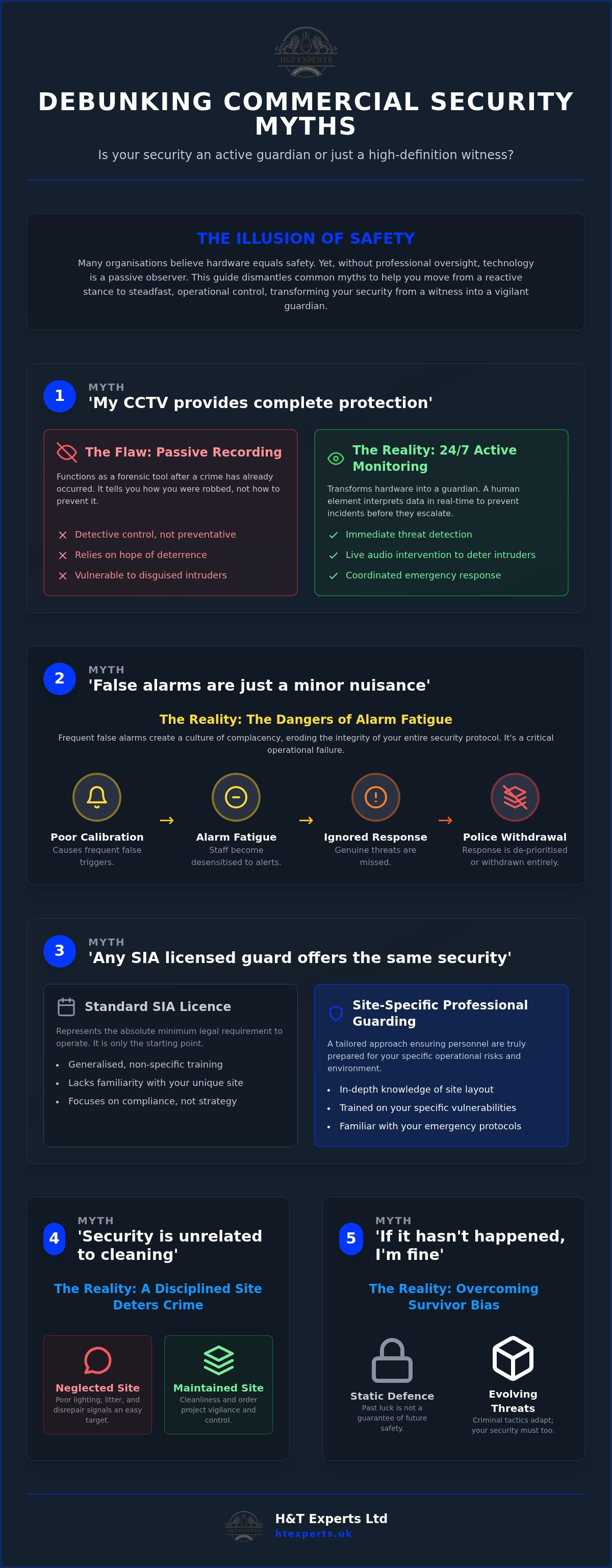
5 Critical Signs Your Commercial Security Is Inadequate: A Myth-Busting Guide
Your expensive CCTV system might be nothing more than a high-definition witness to your business's loss. Many organisations operate under the false assumption that hardware alone equals safety; however, without professional oversight, technology remains a passive observer rather than a deterrent. If you find yourself plagued by rising insurance premiums or the persistent anxiety of out-of-hours incidents, it's time to evaluate the effectiveness of your current measures. Recognising the signs your commercial security is inadequate is the first step towards moving from a reactive stance to a position of steadfast, operational control.
We understand the frustration caused by frequent false alarms and the pressure of maintaining a secure site whilst managing complex operational costs. This article will dismantle common security myths and provide a clear roadmap for professionalising your protection strategy. You'll gain a thorough understanding of hidden vulnerabilities and the rigorous protocols required to move beyond basic equipment. By the end of this guide, you'll have the confidence to implement a safety framework that prioritises human expertise and constant readiness, ensuring your assets are managed by a capable and vigilant guardian.
Key Takeaways
• Understand why passive recording is insufficient and how active 24/7 monitoring transforms your hardware into a proactive deterrent.
• Identify the technical failures behind frequent false alarms to eliminate operational fatigue and restore the integrity of your response protocols.
• Learn to differentiate between standard SIA licensing and site-specific professional guarding to ensure your security personnel are truly prepared for any scenario.
• Discover the strategic link between specialist cleaning and site safety, ensuring your premises project a high level of oversight and discipline.
• Recognise the critical signs your commercial security is inadequate by overcoming survivor bias and adapting to the latest criminal tactics in the UK.
Myth 1: 'My CCTV Cameras Provide Complete Protection'
Many business owners view their CCTV installation as a final solution to their safety concerns. This is a dangerous misconception. If your system merely records footage for you to review the following morning, you've missed the core objective of a robust protection strategy. Passive recording is one of the clearest signs your commercial security is inadequate because it relies on the hope that a criminal will be deterred by the presence of a lens. Modern criminals are increasingly sophisticated; they understand how to obscure their identity or exploit the delay between an incident and its discovery. Relying on hardware alone creates a psychological blind spot where the owner feels protected whilst the site remains fundamentally vulnerable.
The Reality of Passive Surveillance
Passive CCTV functions primarily as a forensic tool. It tells you how you were robbed, but it doesn't stop the crime from occurring. To understand why this fails, we must look at the different types of Security controls available to a business. Most unmonitored systems are detective controls rather than preventative ones. Even with high-definition resolution, recorded footage often fails to result in a successful prosecution due to poor lighting, face coverings, or the sheer speed of the theft. True protection requires integrating these cameras with a rapid emergency security response protocol that triggers the moment a perimeter is breached. Without a human element to interpret the data, your cameras are just expensive witnesses to your loss.
Why Real-Time Monitoring Changes the Game
Moving from simple surveillance to active 24/7 monitoring transforms your security from a witness into a guardian. Professional monitoring centres don't just watch; they intervene. This methodology shifts the focus from "what happened" to "what is being prevented". When a site is actively managed, the response is immediate and disciplined.
Immediate threat detection
Advanced sensors alert professionals to unauthorised movement the second it occurs.
Live audio intervention
Trained operators can speak directly to intruders via on-site speakers, often deterring them before they enter a building.
Coordinated response
Monitoring centres can verify a crime in progress and dispatch emergency services or mobile patrols with high-priority status.
Hardware is merely the eyes of the operation; the professional response is the brain and the muscle. If you aren't managing the human response, your hardware is merely a witness to crime. Professional oversight ensures that your technology serves a purpose beyond post-incident analysis, providing the constant readiness required to protect your assets effectively.
Myth 2: 'False Alarms are Just a Minor Nuisance'
Dismissing a siren as a technical glitch is a dangerous habit for any business owner. Frequent false alarms are one of the most overlooked signs your commercial security is inadequate. They indicate a system that lacks calibration and professional oversight. When sensors are too sensitive or poorly positioned, the resulting noise creates a culture of complacency. This isn't just a nuisance; it's an operational failure that erodes the effectiveness of your entire safety protocol. Ignoring these malfunctions is a clear indicator that the signs your commercial security is inadequate are already manifesting in your daily operations, leaving you vulnerable when a genuine threat arises.
The consequences of a "crying wolf" system extend far beyond employee frustration. In the UK, police response to intruder alarms is strictly governed by National Police Chiefs' Council (NPCC) policies. If your premises generate multiple false call-outs within a twelve-month period, the police may de-prioritise your site or withdraw their response entirely. This leaves your assets unprotected at the very moment you need authority intervention. Securing your premises requires more than just hardware; it demands a disciplined management approach to ensure every alert is treated with the seriousness it deserves.
The Dangers of Alarm Fatigue
Alarm fatigue is a critical operational risk where repeated false triggers desensitise responders, leading to delayed or ignored reactions during a genuine breach. When your staff and neighbours hear your alarm several times a week, they stop looking for intruders and start looking for the "off" switch. This psychological desensitisation is exactly what sophisticated criminals exploit. They may even intentionally trigger your alarm multiple times to observe your response time and wait for the moment your team stops investigating. This complacency during a real incident leads to catastrophic losses that could have been prevented with a more reliable system.
Professional Calibration and Response
Maintaining a high-security environment requires regular system health checks and technical precision. A professional security partner ensures that sensors are calibrated to account for environmental factors like heating systems, wildlife, or moving stock. By utilising professional alarm response services, you introduce a layer of expert verification that filters out false triggers before they escalate. This methodology reduces business interruption and ensures that when an alarm sounds, it is met with a swift, coordinated, and serious response. Moving from a neglected, noisy system to a professionally managed one provides the steadfast reliability necessary for true peace of mind.
Myth 3: 'Any SIA Licensed Guard Offers the Same Security'
Is a valid Security Industry Authority (SIA) licence enough to protect your high-value assets? Many businesses mistakenly believe that any uniformed presence is sufficient. However, relying on a provider that merely fills a rota is one of the subtle signs your commercial security is inadequate. A professional security officer is more than just a visible deterrent; they are a highly trained specialist equipped to manage crises and maintain operational discipline. There is a vast difference between a "warm body" hired to occupy a chair and a professional dedicated to security guarding. Without site-specific training and a proactive mindset, a guard is simply a witness, not a protector.
Poor management oversight is the primary cause of guarding failure. When a security company fails to provide rigorous leadership, the result is often "guard sleep" or missed patrols. These lapses aren't just staff issues; they're systemic failures that indicate the signs your commercial security is inadequate have been ignored. Accountability is the cornerstone of effective protection. If your current provider doesn't offer detailed, transparent reporting of every patrol and incident, you're operating with a dangerous lack of visibility. True security requires a culture of excellence where every individual understands their role in the wider safety strategy.
Evaluating Guarding Standards
Minimum licensing should be viewed as the floor of safety, not the ceiling. If your provider doesn't conduct regular supervisor visits or random site audits, your protection is likely compromised. An unmotivated guard force often results from a lack of investment in their development. You might notice inconsistent situational awareness or a failure to follow site-specific protocols. These are clear indicators that your current provider lacks the rigorous standards required for high-stakes environments. Professionalism is maintained through constant oversight and a commitment to operational excellence that goes far beyond basic legal requirements.
The Value of Operational Experience
Effective asset protection is built on years of refined methodology and hands-on leadership. With over 25 years of operational experience, we understand that incident management requires more than just following a standard manual. It demands a partnership based on transparent communication and direct involvement from senior leadership. Why does director-level involvement matter? It ensures that clear lines of responsibility are established and that site-specific risks are addressed immediately. When leadership is personally invested in your peace of mind, the quality of service remains consistently high. This disciplined approach eliminates complacency and ensures that every patrol is purposeful, documented, and effective.
Myth 4: 'Security is Unrelated to Site Maintenance and Cleaning'
Does the external appearance of your premises reflect a high level of discipline? Many organisations separate maintenance and protection into different silos, failing to recognise that the physical state of a property is a powerful psychological signal. A neglected site is an invitation. When a property shows signs of decay, such as uncollected litter or fading signage, it communicates a lack of active oversight. This environmental weakness is one of the most visible signs your commercial security is inadequate because it suggests that if management doesn't notice the rubbish, they won't notice an intruder. Criminals seek out these "soft" targets where the risk of detection feels low.
The 'Broken Windows' Effect in Business
Visible neglect encourages opportunistic crime through a phenomenon known as the 'Broken Windows' effect. If a single window is left unrepaired, it signals that no one cares, leading to further vandalism and anti-social behaviour. In a commercial context, graffiti and litter act as beacons for criminal activity. Maintaining a pristine environment through specialist cleaning services UK is not merely about aesthetics; it's a strategic deterrent. A well-presented site creates an atmosphere of total control, making it clear to potential offenders that the premises are under constant, vigilant management. This level of order is a foundational element of any professional safety framework and is often the first thing a surveyor looks for when identifying signs your commercial security is inadequate.
Sanitation as a Safety Protocol
Hygiene and safety are deeply interconnected, particularly in industrial or high-traffic environments. Emergency biohazard cleaning is a critical component of site security, ensuring that hazardous incidents are managed with the same rigour as a physical breach. Beyond deterrence, a clean site improves the technical effectiveness of your hardware. Dust-free environments ensure CCTV lenses remain clear and sensors remain unobstructed by debris or overgrowth. This synergy is best achieved through an integrated security and cleaning approach, where every member of the team is trained to spot vulnerabilities whilst performing their primary duties. When order and cleanliness are prioritised, the psychological impact on potential intruders is profound; they see a business that is disciplined, observant, and prepared. To ensure your premises project this standard of excellence, contact our specialist team to professionalise your site oversight.
Myth 5: 'If It Hasn't Happened Yet, My Security is Fine'
Is your current safety the result of a robust strategy or merely a sequence of fortunate events? Many business owners fall victim to survivor bias, the dangerous assumption that a lack of past incidents validates their current setup. This reactive mindset is one of the most critical signs your commercial security is inadequate. Security isn't a static installation; it's an active behaviour that must evolve alongside criminal methodology. Relying on "how we've always done it" ignores the reality that criminals are constantly refining their tactics to bypass traditional hardware and predictable routines.
The transition from reactive luck to professional asset protection requires a fundamental shift in perspective. You must move from wondering what might happen to knowing exactly how you'll respond. A secure site is one where vulnerabilities are identified and closed before they can be exploited. If you haven't reviewed your protocols in the last twelve months, you're likely operating with hidden gaps that have developed as your business or the local environment has changed. Professionalism means being prepared for the incident that hasn't happened yet, ensuring your readiness is constant rather than a response to trauma.
Conducting a Professional Risk Assessment
Effective oversight begins with identifying blind spots in your physical and operational perimeter. An external expert eye is essential for this process, as those who work on-site daily often become accustomed to minor lapses. A professional audit involves testing response times, evaluating employee protocols, and probing the synergy between your hardware and human response. Do your staff know exactly what to do during a breach? Are your patrol routes predictable? These questions expose the signs your commercial security is inadequate before a criminal does. Rigorous testing ensures that your safety framework is as robust in practice as it appears on paper.
Future-Proofing Your Business Assets
Your protection strategy must be scalable. As your business grows, your risk profile changes, requiring a more sophisticated integration of technology and human intelligence. A robust shield is built on the synergy between advanced methodology and trained professionals who can adapt to fluid situations. Future-proofing isn't about buying more equipment; it's about establishing a culture of accountability and operational excellence. By contacting H&T Experts Ltd for a comprehensive security evaluation, you gain access to over 25 years of operational experience. We help you move beyond passive hardware to a position of steadfast, managed safety, ensuring your assets are protected by a vigilant guardian at all times.
Moving from Reactive Hardware to Proactive Protection
Transitioning from a passive security setup to a proactive, managed strategy is the only way to ensure the long-term safety of your UK business. We've explored how unmonitored hardware, frequent false alarms, and neglected site maintenance serve as clear signs your commercial security is inadequate. These vulnerabilities create an environment where criminals feel emboldened by a perceived lack of oversight. True protection requires a synergy between advanced technology and disciplined human expertise to move beyond simple surveillance toward total operational control.
H&T Experts provides the steadfast reliability your organisation demands, backed by over 25 years of operational expertise. Our approach integrates rigorously managed, SIA licensed guarding with comprehensive 24/7 monitoring and emergency response capabilities. We don't just record incidents; we prevent them through constant readiness and professional oversight. Our methodology ensures that your security protocols are as disciplined as your business operations.
Take the first step towards securing your assets with a partner that values integrity and transparency. Request a professional security consultation from H&T Experts today to identify your hidden risks and professionalise your site's safety protocols. You deserve the peace of mind that comes from knowing your business is under the care of a vigilant guardian.
Frequently Asked Questions
What are the most common physical signs of inadequate commercial security?
Visible neglect is often the first indicator. Overgrown shrubbery that obscures CCTV views, flickering external lighting, and accumulated litter are common physical signs your commercial security is inadequate. These elements signal to opportunistic criminals that the premises lack vigilant oversight. Ensuring your perimeter remains clear and well-lit is a fundamental step in maintaining a robust deterrent and projecting an image of total control.
How often should a business review its security protocols?
A business should review its security protocols at least once every twelve months. However, immediate audits are necessary following significant operational changes, such as a change in site layout or a local increase in crime rates. Regular reviews ensure that your protection strategy evolves alongside emerging threats and that your staff remain disciplined in their response duties, preventing complacency from setting in.
Is CCTV alone enough to satisfy business insurance requirements?
CCTV alone is rarely sufficient to satisfy comprehensive business insurance requirements in the UK. Many insurers mandate that electronic systems be paired with active 24/7 monitoring or professional response services to mitigate risk effectively. Without these layers of intervention, a camera system is viewed as a detective tool rather than a preventative measure, which can lead to higher premiums or denied claims during an incident.
What is the difference between a security guard and a professional security officer?
The difference lies in training, methodology, and management oversight. While a standard guard might merely occupy a post, a professional security officer is a trained specialist who operates under a rigorous safety framework. These professionals are equipped to manage complex incidents, maintain detailed patrol logs, and provide the constant readiness required to protect high-value assets with absolute integrity and transparency.
Can poor site maintenance actually increase my risk of being targeted by criminals?
Poor site maintenance directly increases your risk of being targeted. Criminals interpret uncollected waste and graffiti as evidence of a lack of management presence. This perception of neglect suggests that a physical breach might go unnoticed for longer periods. Maintaining a pristine environment communicates a high level of discipline, effectively deterring anti-social behaviour and making it clear that the site is actively managed.
What happens if my security alarm triggers and I don't have a response service?
If your alarm triggers without a professional response service, you rely on the chance that a passer-by or neighbour will contact the authorities. In the UK, police response is often restricted to verified incidents or monitored systems. Without a dedicated response team, you may find yourself forced to attend the site alone out-of-hours, which presents significant personal safety risks and operational delays.
How can I tell if my current security provider is cutting corners?
You can identify corner-cutting by a lack of transparent, detailed reporting. If your provider fails to conduct regular supervisor audits or if you notice inconsistent patrol timings, these are clear signs of poor management. A reliable partner prioritises accountability and provides documented evidence of every action taken on your site, ensuring that safety protocols are strictly followed without exception or compromise.
What are the benefits of combining security and cleaning services under one provider?
Combining these services creates a synergetic approach to site safety. Cleaning staff often act as additional eyes on the ground, identifying maintenance issues or perimeter gaps during their duties. This integrated methodology ensures a well-maintained, secure-looking environment whilst streamlining communication and accountability under a single management structure. It effectively removes the operational silos that often hide vulnerabilities in your protection strategy.


Ready to Experience Unparalleled Security Solutions?
H&T Experts Ltd is here to ensure your peace of mind. Connect with us today and take the first step towards a safer tomorrow.